
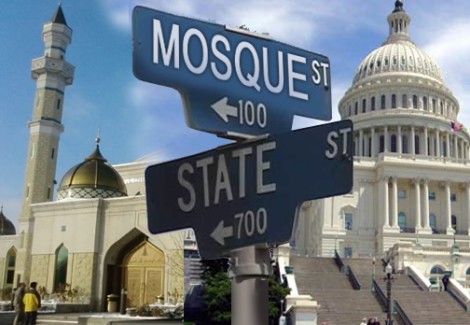
The Muslim Times has been promoting Secularism since its inception five years ago. For our collection of articles to promote secularism in every country of the world, please click here
Source: Huffington Post
President of Tunisia’s Ennahdha Party
This post is an edited/updated version of Sheikh Rached Ghannouchi’s October 1, 2014 Lecture at Columbia University’s Institute for Religion, Culture and Public Life.
Ladies and gentlemen, I would like to begin by expressing my delight at delivering my lecture at this great intellectual institution.
I see the situation in the Middle East not as being in crisis but rather as one that is at a crossroads: Between moving towards democracy, development and progress; and the relapse of the Arab Spring, the spread of chaos and terrorism and the return of despotic and corrupt regimes.
A few years ago, the world watched with awe as people flooded the streets of Tunis, Tripoli, Cairo and Sanaa, demanding freedom, dignity and the ouster of repressive, dictatorial regimes. The so-called “Arab exception to democracy” collapsed before the will of the youth. Arabs and Muslims were no longer considered unworthy of democracy; their political culture no longer considered as one rooted in the philosophy of oriental despotism. It became evident that support for repressive regimes by the free world to avoid the risk of power falling into Islamists, is no longer a necessary choice.
Stereotypes broke down and the Arab Spring became a source of inspiration for the people of the world – before facts on the ground changed once again and forces working to counter the Arab revolutions began succeeding. Syria was pushed into civil war, Libya deteriorated into chaos, Egypt returned to military rule.
Why did the map of the Middle East change so fast – from a promising democratic movement to being hotspots of conflicts and tensions? Is the cause the rise of Islamists and their failure to govern and build stable democratic systems? I will present a view that is based on Tunisia’s experience, the last shining candle of the Arab Spring.
Tunisia succeeded in developing a modernist constitution that stipulates freedom of conscience and guarantees the rights of women and minorities. It is the fruit of peaceful cooperation between moderate secularists and moderate Islamists. Tunisia was able to overcome its political crisis in 2013 thanks largely to our commitment to consensus and national dialogue that culminated in an independent, technocratic government tasked with managing the process of holding free and fair elections.
Tunisia is also engaged in a war against terrorism, which began under the Troika government led by Ennahdha, our party of Muslim democrats that on 27 August 2013 designated Ansar al-Sharia as a terrorist organization, arresting dozens of its leaders, dismantling its cells and foiling many of its operations.
Tunisia’s experience shows that democracy is possible in the Middle East as long as its conditions are present. There is no “Arab exception to democracy.” There is no contradiction between Islam and democracy. And dictatorship is not a necessary destiny.
Tunisia was able to embark on this path thanks to a variety of factors that unfortunately were not present at the required level in other countries.
The first factor is the rejection of domination and monopoly of power: Ennahdha Party which won the majority in the elections of the National Constituent Assembly in 2011, refused to dominate power. We instead called for a national unity government after the 2011 elections and were able to form a coalition government with two secular parties – Ettakattol and CPR.
From the beginning, Ennahdha has been committed to the establishment of a political system where secularists and Islamists coexist. That was not always easy, but Ennahdha’s compromises were the principal catalyst for resolving crises and for accelerating the adoption of the Constitution.
Coexistence with secularists was the result of a reformist intellectual process. Our party was the first Islamic movement to adopt democracy in 1981 and to unequivocally announce that it is a civic party that believes in democracy, citizenship and civic values. It is a conviction that did not dither even after the savage wave of repression of the 1990’s in which we were subjected to by Ben Ali’s regime. Ennahdha remained a peaceful movement struggling against dictatorship through democratic means, rejecting violence and extremism. Refusing domination of power and opting for coexistence between secularists and Islamists were two important factors in the success of the Tunisian model.
The next important factor in Tunisia’s success is the adoption of what we call “consensus” politics. This is based on our belief that during transitional periods, ruling with 50% +1 majority does not lead to a stable political system; what is needed is as wide a consensus as possible between the main political trends whether in the majority or minority.
That is why we wanted a constitution that doesn’t just represent a simple majority but the widest majority possible. This principle of consensus helped save Tunisia from many of the crises that it faced because we focused instead on a national dialogue that brought together all the political trends and views represented by 22 parties, with no exclusions.
Categories: Africa, Islam, Secularism, The Muslim Times, Tunisia
Ckcjvjcjvjfjfjfjjfjfjfjfjfjfjvjvjvjjvjvjvjvjvjfjfjfjfjfjfjvjvjvjvjfjjvjfjvjvjvhvjvhvhhhhhhghhyyyyhhghvhvhvhvhhvhvhvhvhvhvhhhhuhhhhhhhdhfhfhfhdhdhdhdhdhdhdhfhfhfhfhfhfhfhffhfhfhhffhfhhfhhhhhxhchhchchhhwhhhhhhh
I believe that the world of Muslim will be getting worse for years ahead.
If God place Trump as a President of United States, the world of Muslim will be worse.
The fruit of decades of the hate teaching between extremist Sunni and Shia have been coming to the fruition since of 11/9 2001.
Prophet Muhammad (pbuh) said; If you do good deed will come to you and if you do evil deed will come against you. Millions innocent people have been suffering and killed. I am so sad, pity, and heartbreaking.Enough is enough.
This horrific conflict will not end soon until all political and spiritual leaders of Saudi Arabia and Iran obey Human Right, and treat all people fairly and equally regardless his belief, religion, race and ages.
The root of conflict are in Saudi Arabia and Iran, as long as both countries still keep hating and judging each other, do not accept and respect each other, there is no peace in Syria, Iraq, Yemen, Libya, other Islamic countries. this is religious conflict just like conflict between Catholic and protestant 700 year ago.
This religious conflict can be solved with the word of wisdom that Allah provided us in His Books;
Let us hold firmly the word of wisdom of almighty Allah
You may be sure that wisdom is good for your soul.Get wisdom and you have a bright future.Wisdom is offers you long life as well as wealth and honor. Wisdom can make your life pleasant and lead you safely through it.
Allah already warned in His books. Bible and Al Quran;
The Prophet Mohammad (PBUH), said: “None of you has faith until you love for your neighbour what you love for yourself.”
These Golden Rules are found in Christianity, Judaism, and other religions.
“Love your neighbor as yourself. If you keep on biting and devouring each other, watch out or you will be destroyed by each other.
These are the messages we must give the next generation.(our children and grandchildren) at home and schools.
So, as long as Saudi Arabia and Iran leader still keep hating each other, there will be no a permanent peace in Islamic world.
Let us pray to God, may Allah guide both leaders to respect and love each other. Allah is All Knower.
Was Salam