
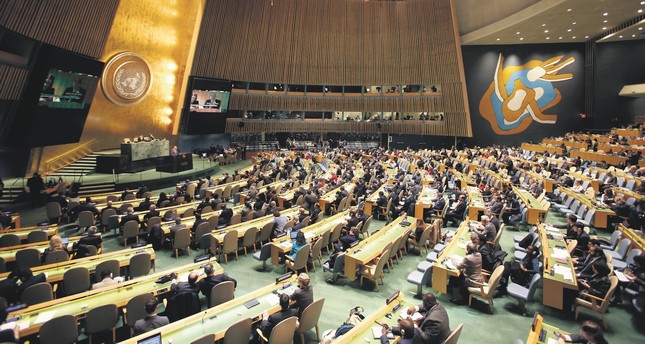
People gather at the General Assembly, prior to a vote, Thursday, Dec. 21, at the United Nations headquarters.
The U.S. has found itself alone following a U.N. vote condemning Trump’s move on Jerusalem, with a large majority of the international community positioning itself opposite the Washington
During an emergency session Thursday in New York, the majority of the 193-member U.N. General Assembly voted on the U.N.’s call for the U.S. to withdraw from its decision to recognize Jerusalem as the capital of Israel, with 128 votes in favor, nine against and 35 abstentions, uniting the international community on the issue while leaving the U.S. and Israel alone despite their intense lobbying that has included undemocratic threats to allies. The draft resolution reaffirmed the 10 previous U.N. Security Council (UNSC) resolutions on Jerusalem dating back to 1967, including requirements that the city’s final status be decided in direct negotiations between Israel and Palestinians.
The resolution also called to affirming that any actions that “have altered the character, status or demographic composition of the Holy City of Jerusalem” have no legal effect and must be rescinded. It also calls on all states “to refrain from the establishment of diplomatic missions” in Jerusalem. “Although this decision is not binding, the U.N. General Assembly may decide to take some steps in accordance with this outcome. Thus, since world society confronts it, all the U.S.’s further actions on the issue would become illegitimate,” said Ahmet Kasım Han, an associate professor at Istanbul’s Kadir Has University’s International Relations Department. The resolution was co-sponsored by Turkey, term president of the Organisation of Islamic Cooperation (OIC), and Yemen, chair of the Arab Group at the U.N. It is very similar to the defeated UNSC resolution.
Han said: “The U.S. would not step back from the issue, despite being condemned, since this is a matter of prestige. ”
The emergency session yesterday is based on U.N. Resolution 377, which enables member states to come up with appropriate suggestions to unite on common measures in case of a lack of unanimity in the UNSC on issues that, for example, pose a threat of war. There have been 10 session in the U.N. regarding that resolution so far, the latest of which was in 2009 on the invasion of Palestine and east Jerusalem.
Muhittin Ataman, an academic from Ankara Social Sciences University, said the vote in the U.N. General Assembly indicated that a significant part of the world has stood out against the U.S., despite threats, making the vote a significant political and diplomatic gain for the international community on Palestine.
Regarding the implications of such an outcome, Ataman said: “The vote will both undermine the role the U.S. is playing as a hegemon in the field of international relations and also the role of President Donald Trump’s administration.” According to Han, however, thanks to this outcome, the U.S. would degrade from the position of rule-making country to the country that takes position on illegitimate decisions.
During his speech at the UNGC session yesterday, Foreign Minister Çavuşoğlu said that being strong does not make one right.
“Dear friends, the Palestinians have the right to their own state according to the 1967 borders with east Jerusalem as its capital,” he said while adding that a vote in favor of Palestine will place us on the right side in history.
“Palestinians have the right to have their own state in accordance with the 1967 borders with east Jerusalem as its capital. This is the main parameter and only hope for a just and lasting peace in the region,” he said.
Çavuşoğlu also called outright the U.S.’s threats to cut development aids “bullying” and completely “unacceptable.”
“It is unethical to think that votes and dignity are for sale, you can be strong but that doesn’t make you right,” Çavuşoğlu said.
Palestinian Foreign Minister Riad al-Maliki also slammed the controversial step in the session. “Does the U.S. not wonder why it stands so isolated in this position which is being rejected by everyone near and far?” he asked. “And why even its closest allies are turning a blind eye to this decision?”
U.S. Ambassador to the U.N. Nikki Haley, on the other hand, repeated U.S. threats, saying that the U.S. “will remember this day in which it was singled out.”
“This vote will make a difference on how Americans look at the U.N., and on how we look at countries who disrespect us in the U.N.,” she said.
The U.S. threatened to cut financial aids
Ahead of the voting session, the U.S. and Israel pursued intense lobbying to convince member states to vote in favor of the U.S. decision, leaving the international community surprised at how undemocratic a state can be in such a situation. Trump on Wednesday threatened to cut off financial aid to countries that vote in favor of the United Nations draft resolution against his decision to recognize Jerusalem as Israel’s capital.
“They take hundreds of millions of dollars and even billions of dollars, and then they vote against us. Well, we’re watching those votes. Let them vote against us. We’ll save a lot. We don’t care,” Trump told reporters at the White House.
Before Trump, U.S. Ambassador to the U.N. Nikki Haley on Tuesday warned countries that she will report back to the president with the names of those who support the draft resolution rejecting the U.S. decision to recognize Jerusalem as Israel’s capital.
In a letter to more than 180 of the 193 U.N. member states’ ambassadors and an even tougher tweet on Tuesday, Haley hinted at possible U.S. retaliation, but Trump’s comments made clear to recipients of U.S. assistance that billions of dollars could be at stake.
Haley’s threat drew sharp criticism from the international community, particularly the Palestinian and Turkish foreign ministers before they flew to New York for the General Assembly vote. They accused the U.S. of intimidation.
READ MORE HERE: https://www.dailysabah.com/diplomacy/2017/12/22/uss-financial-threats-fail-to-intimidate-international-community-on-jerusalem
Categories: America, Americas, United Nations