

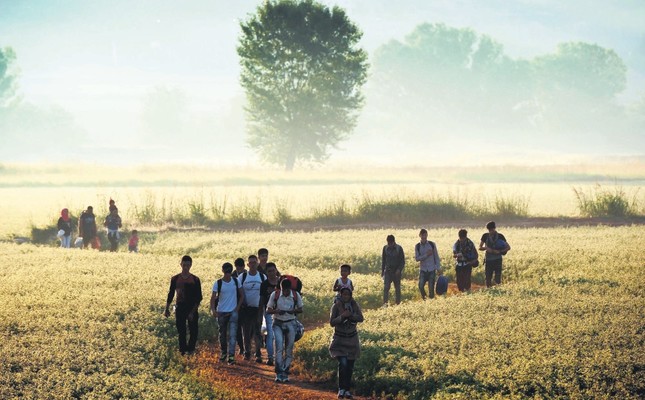
Migrants walking through a field to cross the border from Greece to Macedonia near the Greek village of Idomeni, Aug. 29, 2015. (AFP Photo)
Given the crisis-ridden and weakened state of politics in the world today, we have to examine how countries from east to west are responding and/or failing to respond to the challenges facing them
The recent dynamism of Turkey’s foreign policy has opened up new possibilities in its relationship with a host of countries including Russia, Iraq, Iran, Azerbaijan, Kazakhstan, Uzbekistan, Saudi Arabia, Qatar, United Arab Emirates, Israel, the EU, the Balkan countries and several important African nations. Despite differences over the support the U.S. gives to the People’s Protection Units (YPG), the outlawed PKK’s Syria branch, Turkey has worked with the Obama administration on several regional issues. In essence, Turkey seeks a policy of balance and equilibrium between east and west, Europe and the Middle East, Euro-Asia and Africa and the North and Latin Americas.
The key to this perspective is the fact that Turkey does not see foreign policy as a zero-sum game. The fact that Turkey is a member of NATO does not mean that it cannot have good relations with Russia or China. Turkey’s strong cultural and historical ties with the larger Muslim world do not prevent it from seeking to join the European Union as a full member. None of these equations are mutually exclusive. To the contrary, if used properly, they can be mutually empowering relations whereby centuries-old prejudices, misperceptions and political rivalries between the Islamic world and the West can be overcome. None of these relationships have to be developed and cultivated at the expense of the other.
Seeking a policy of balance and equilibrium is also necessitated by Turkey’s geo-political position, historical ties with several regions and continents, security interests as well as the evolving challenges of globalism. Reductionism does not work in any field of human quest. It is all the more so in foreign policy. While some want to see Turkey reduce all of its options to one single set of choices such as the West or the Middle East, the realities on the ground as well as Turkey’s broader perspective on the world suggest and even force the necessity of having multiple options.
more: http://www.dailysabah.com/columns/ibrahim-kalin/2017/01/21/remembering-ibn-khaldun-and-toynbee-challenge-and-response
Categories: The Muslim Times, Turkey, Turks