
Rahma Roshadi19th April 2026 alhakam.org
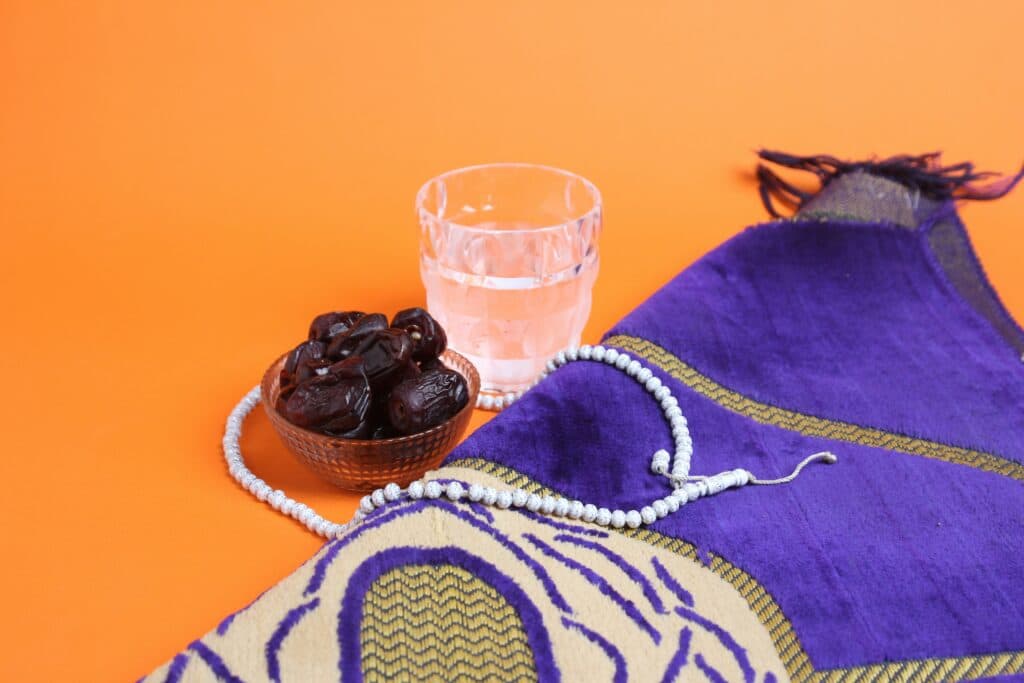
Image: Rauf Alvi/Unsplash
Eid-ul-Fitr is often seen as the ultimate victory after a whole month of battling hunger and thirst. But behind the celebratory echoes of the takbir, there’s a common trend I notice every Shawwal: friends complaining about digestive issues. From diarrhoea and bloating to sudden spikes in cholesterol and blood sugar – you name it.
Medically speaking, it’s pretty straightforward – it’s just the result of a drastic change in eating habits. But if we look deeper through the lens of Islamic teachings, this “post-Eid sickness” is actually a spiritual wake-up call. It reminds us of the importance of balance (tawassut), i.e., moderation, a principle we often toss out the window the moment the holiday celebrations begin.
Spiritual roots behind the physical symptoms
It’s almost like an unwritten ritual: during Eid-ul-Fitr – especially here in Indonesia – dining tables are packed with rich, coconut milk-based dishes. Not to mention the sodas and sweet treats found in practically every home.
After a whole month of training our self-control through Ramadan, there’s this very human urge to go on a “revenge” eating and drinking spree. And that’s where the irony lies. We celebrate our victory over our desires by letting those very same desires take back the wheel.
Islam isn’t just about rituals; it’s a complete guide for living that cares deeply about human well-being. Those complaints of diarrhoea and stomach issues after Eid are actually signals from our bodies. They’re telling us that we’ve ignored the principle of consuming what is tayyib, i.e., good, and the importance of moderation in enjoying the blessings Allah has provided.
“Eat and drink, but be not excessive. Indeed, He does not like those who commit excess.” (Surah al-A‘raf, Ch.7: V.32)
This verse isn’t just a moral rule; it’s actually a very accurate health prescription. When we ignore these limits, our body’s balance gets thrown off, and sickness arrives as a little “reminder”.
Right in the middle of all that food euphoria, Islam offers a beautiful solution: the recommendation of six days of sunnah fasting in the month of Shawwal. The Holy Prophet Muhammad (sa) said: “Whoever fasts Ramadan and follows it with six days of Shawwal, it is as if he fasted for the entire year.” (Sahih Muslim, Kitab as-siyam, Hadith 1969)
Theologically, the reward is massive. But let’s look at it from the perspective of self-control. Why are we encouraged to jump back into fasting right after we’ve just been “freed” from the mandatory one?
First, psychologically, Shawwal fasting acts as a cooling-down period or a transition phase. After a full month of our stomachs resting during the day, hitting it with heavy, rich foods all of a sudden on Eid can give our digestive system a total shock. By fasting those six days, we’re slowly bringing our metabolism back to a more regular pattern, preventing an out-of-control spike in our appetite.
Secondly, the beauty of Islam lies in the lesson that worship doesn’t just stop when Ramadan ends. The Shawwal fast is the first real test after “graduation”. It proves whether the self-control we practised during Ramadan was actually deep-rooted, or if we were just “ticking a box” to get it over with.
The philosophy of balance in Islam
Islamic teachings are strongly against any form of extremism and that includes how we consume food. We have to keep a balance between our soul and our physical body so we can function at our best as servants of God.
The Prophet Muhammad (sa) actually gave us a very “scientific” guide on how to eat. He used the analogy of a vessel: fill 1/3 with food, 1/3 with water, and leave 1/3 for air (breathing room).
“A human being fills no vessel worse than his own stomach. It is enough for the son of Adam to eat a few mouthfuls to keep his back straight. But if he must fill it, then one-third (of his stomach) should be for his food, one-third for his drink, and one-third for his breath.” (Sunan Ibn Majah, Kitab al-At‘imah, Hadith 3349)
Interestingly, this advice from the Prophet Muhammad (sa) was scientifically proven in the 20th century. In a 2005 study at UCLA, researchers found that mice given a calorie-restricted diet – just enough to survive – actually lived longer than mice that were given regular, full-portioned meals.
A second piece of evidence came in 2006, when Christiaan Leeuwenburgh from the University of Florida’s Institute on Ageing discovered that cutting food portions by just 8% can prevent a lot of organ damage caused by ageing. To put that into perspective, the “portion” he’s referring to is the typical “eat-until-you’re-full” amount that people usually consume every day.
Another discovery from molecular biologist Kalluri Suba Rao in 2004 showed that eating less actually allows the body to “concentrate” more on repairing itself. This means things like DNA repair, flushing out toxins and replacing damaged cells with healthy ones can happen much more effectively.
On the flip side, when we overeat, our body gets way too busy with “catabolism” (basically just working overtime to break down all that food) and doesn’t have the time to fix itself. This is one of the main reasons behind many of today’s health issues, like high blood pressure and high cholesterol, which can ultimately shorten our life expectancy.
So if we actually applied this formula during our Eid, the risk of digestive issues would drop significantly. This balance teaches us that we can still enjoy delicious food without actually hurting our own bodies.
In the eyes of Islam, our bodies aren’t entirely ours to do whatever we want with; they are a trust from the Creator. Taking care of our health by not overeating is a form of gratitude and responsibility for that trust. Getting sick because of greed doesn’t just hurt us physically – it also gets in the way of our worship and our social lives.
Ongoing social dimensions and empathy
Fasting for six days in Shawwal acts as a guardian for the embers of empathy that were lit during Ramadan. While others might still be immersed in a feast of delicacies, those who fast are reminded once again of the hunger faced by our less fortunate brothers and sisters.
When the echoes of the takbir slowly fade and dining tables are still overflowing with luxury, choosing to fast again is a powerful spiritual statement. In a world that seems to give us a “green light” to party and overindulge, a Muslim fasting in Shawwal chooses to feel hunger again. It’s a reminder that for some people out there, hunger isn’t a spiritual choice – it’s a harsh, daily reality.
This is a manifestation of the beauty of Islam: it doesn’t let its followers get swept away in selfish euphoria. While Eid-ul-Fitr is indeed celebrated with great joy, Islam tucks in this sunnah fasting recommendation as a “brake”, ensuring that our happiness doesn’t turn into indifference toward others. By holding back amidst the abundance of post-Lebaran food, we are training our social sensitivity so it doesn’t get numbed by excessive fullness.
Furthermore, the Shawwal fast reinforces that self-control is a continuous journey, not just a “30-day project”. If Ramadan was the school where we were forged, then Shawwal is the first real-world test. The phenomenon of so many people falling ill with digestive issues after Eid shows just how fragile our self-control can be if we only view fasting as a mandatory chore.
This is where the wisdom of Sharia lies. Islam doesn’t want us to be pious only during the holy month, only to flip back to being impulsive and uncontrolled consumers the rest of the year. Instead, we’re invited to have a “soft landing” from the discipline of Ramadan back into normal life. It teaches us that a true winner isn’t just someone who survived a month of hunger, but someone who carries that spirit of restraint into their behaviour in the months that follow.
Ultimately, this beauty boils down to a fundamental concept in Islam: the art of feeling “enough”. In a social framework, when someone controls their appetite, they are indirectly protecting an ecosystem of shared benefits. Someone who doesn’t overconsume has more room – both financially and mentally – to share with others.
This is the most authentic form of gratitude: using our health and the blessing of food to improve our character, rather than letting it become a source of sickness for our bodies.
Celebrating with responsibility
Ultimately, Islamic teachings on Shawwal fasting offer a perspective where physical health and spiritual clarity are two sides of the same coin. The phenomenon of digestive issues after Eid is a valuable lesson; it brings us back to the realisation that anything excessive – even when celebrating something good – will eventually lead to bad results.
Through this taught balance, we are invited to be graceful individuals. Of course, anyone is welcome to enjoy a feast as a form of gratitude, but we must keep ourselves in check as a form of faith. That way, the victory of Eid-ul-Fitr won’t just evaporate as the food runs out. Instead, it leaves a lasting mark on a healthy body and a soul that consistently cares for others. True victory is the continuity of goodness itself.
Islam has provided a complete “toolkit” to keep humans healthy, both inside and out, through fasting and the principle of simplicity. It invites us to keep our feet on the ground, even while we are celebrating a victory in the heavens.
source https://www.alhakam.org/finding-physical-spiritual-balance-sunnah-fasting
Categories: Fasting, Health, Health & Religion, Muslims