

Source: BBC
By Kelly Grovier
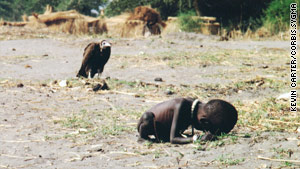
Every so often, a photo stops the world in its tracks. The image of nine-year old Phan Kim Phúc, running naked down a street in Vietnam in June 1972 as her skin burned from a napalm attack was one such photo. South African journalist Kevin Carter’s photograph of a starving Sudanese child being stalked by a hooded vulture in March 1993 was another. On Wednesday evening, the world’s conscience was once again jolted by the sight of a child in appalling distress when an image from the Syrian city of Aleppo went viral on social media. Sitting motionless in an incongruously vibrant orange chair, a young boy – his face caked in dirt and blood – stares glassy-eyed into dead space like a battered and abandoned rag-doll.


Omran Daqneesh sits dazed and bloodied in the back of an ambulance after an air strike on Aleppo (Credit: Aleppo Media Centre via AP)
The alarming photo, captured by Al Jazeera journalist Mahmoud Raslan, was taken after five-year-old Omran Daqneesh was rescued from a building ravaged by Russian airstrikes and has quickly become a symbol for a traumatised people trapped by the Syrian civil war (a conflict that has displaced nearly 12 million people in the past four years and killed at least 250,000 more). Still haunted by images of the lifeless body of three-year old Alan Kurdi, who drowned in the Mediterranean Sea in September 2015 while trying to flee Syria for Europe, many people around the world are horrified by the toll the war is taking on the region’s children.
So unforgettable are the viral images of Kurdi and Daqneesh that they begin to file themselves in our consciousness beside other iconic depictions of violence – a reflex that compounds the dehumanisation of the victims. One is hesitant to suggest that the frightful sight of child after child being fed like fodder into a maw of unrelenting violence in Syria echoes in any way, for example, Francisco Goya’s terrifying painting Saturn Devouring His Son, in which a ghoulish Titan, afraid that one of his children might overthrow him, resolves to eat them one by one.
Though life is not a painting and oughtn’t be confused with one, the greatest works of art intensify our response to life’s tragedies rather than distract us from them. Take Portuguese artist Paula Rego’s contemporary painting War. Created in the wake of the allied invasion of Iraq in 2003 and inspired by a journalistic photograph of children fleeing an explosion (not unlike the circumstances surrounding this week’s photo from Aleppo), Rego’s War dares us to distinguish between what is fantasy and what is real.
Categories: Media, Middle East, Syria, The Muslim Times, War