
Only those who turn to Allah will be saved: Lajna members and nasirat from Germany meet Huzoor
Al Hakam Weekly20th April 2026
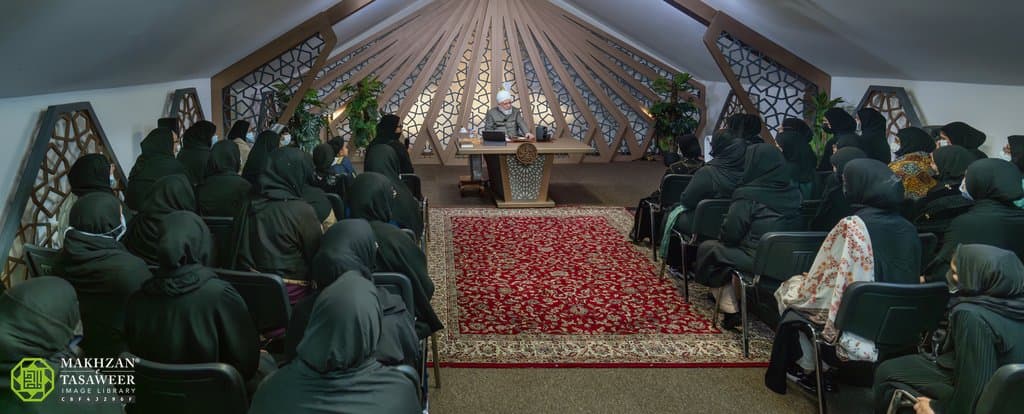
Islamabad, Tilford, UK, 11 April 2026: Lajna members and nasirat from Riedstadt and some other majalis of Lajna Imaillah Germany were blessed with a mulaqat with Hazrat Mirza Masroor Ahmad, Khalifatul Masih V (aa).
Upon arriving, Huzoor (aa) greeted those present and took his seat. Following a brief interaction, the attendees were granted the opportunity to ask questions on a range of religious, moral and contemporary matters.
Strengthen one’s bond with Allah before complaining that prayers have not been accepted
One student asked how a person could remain certain that Allah’s plan was good when it seemed that everything was going wrong and prayers for certain things were not fulfilled.
At the outset, Huzoor (aa) drew attention to the lack of clarity in the way the question had been framed and asked what exactly was meant by things “going wrong”. When the questioner explained that at times one prays for something and does not receive it, Huzoor (aa) referred to the guidance he had given in the previous day’s Friday sermon regarding prayer and the teachings of the Promised Messiah (as).
Huzoor (aa) explained that before asking for worldly matters, a person must first pray for their faith and for a living relationship with Allah the Exalted. If that relationship becomes strong, then prayers are accepted in the right spirit. (Malfuzat [English], Vol. 2, p. 110) He said that many people do not build a relationship with Allah, yet they expect every worldly desire to be fulfilled, whether it relates to examinations, marriage, children, wealth, a house, comfort or other such matters. However, he explained, this was not the purpose for which Allah created mankind. Allah has made it clear that human beings have been created for worship and therefore a person must first examine whether they are fulfilling the due of worship and whether love of Allah has truly taken root in the heart. (Surah adh-Dhariyat, Ch.51: V.57)
Huzoor (aa) further said that no one has any right over Allah. Everything a person receives is His favour. (Dunya Mein Taraqqi Karnay Ke Gur, Anwar-ul-Ulum, Vol. 16, pp. 309-316) If someone offers prayers with attention for a few days, keeps the fasts of Ramadan and offers Tahajjud, this does not create a claim over Allah whereby He must fulfil every wish. Rather, a person should strive to become a grateful servant who continues to fulfil the due of worship. Once this is being done, Allah then opens the way for further prayers to be accepted.
Using the questioner’s own studies as an example, Huzoor (aa) asked what class she was in and learned that she was in Year 12 and preparing for her Abitur. He explained that just as a student must work hard in accordance with the method taught by the teacher in order to gain marks, so too a believer must strive. Allah has also created a law of nature under which each person receives the fruit of their labour, whether they are Muslim, Christian or even an atheist. Thus, if another student works harder, that student may receive better marks. In such a case, a believer cannot complain that Allah’s plan was wrong.
Huzoor (aa) explained that Allah has established both the religious law and the law of nature. The Sharia requires a person to pray, to strengthen faith and to seek Allah sincerely; the law of nature requires effort and hard work. A believer must therefore fulfil the due owed to Allah and also strive properly in worldly matters. Then Allah places blessing in that well-directed and sustained effort.
Blessed relics [tabarrukat] of the Holy Prophet (sa) should be treated with favourable presumption, while avoiding exaggeration and shirk
Another attendee asked to what extent the blessed relics [tabarrukat] of the Holy Prophet (sa) and his noble Companions preserved in Türkiye could be regarded as genuine.
Huzoor (aa) said that he had not personally visited and examined them himself. However, he noted that it is claimed that certain Companions did travel to those regions and that tabarrukat of the Holy Prophet (sa) were brought there. Huzoor (aa) said that, especially during the Ottoman period and perhaps even earlier, such tabarrukat may have been brought to Türkiye. Therefore, if those who have preserved them state that they are genuine and if the accompanying reports concerning their authenticity are recorded, then one may generally accept them as such.
At the same time, Huzoor (aa) cautioned that with such old historical matters, absolute certainty is not always possible and at times exaggerations or replicas may also have entered the picture. He therefore advised maintaining husn-e-zann, a favourable presumption, while also recognising that some things may have been embellished.
By way of example, Huzoor (aa) referred to a site in Sindh, where there is said to be the grave of a Companion. Yet the grave there has been made extremely long in a clearly exaggerated form. Even so, Huzoor (aa) said that it may still be the grave of a Companion and he mentioned that Hazrat Musleh-e-Maud (ra) and other Khulafa had also gone there and prayed. He said that he too used to pray there; if it was indeed the grave of a Companion, then may Allah elevate his rank and not let that place become a means of shirk.
Huzoor (aa) added that, unfortunately, in some such places, people turn them into centres of un-Islamic practices by placing offerings, bowls, flowers and other such things there. This should not happen. Nonetheless, he said that where relics have been preserved, one should generally keep a favourable view and accept that many among them are indeed genuine.
Children born with disabilities are innocent and everlasting life is in the Hereafter
A question was then asked about children who are born disabled. It was said that such children are innocent, yet they endure suffering and become a great trial for their parents. The questioner asked what the wisdom of Allah the Exalted was in this.
Huzoor (aa) explained that such children are indeed innocent and that this world is not the complete and final life. The true and everlasting life is the life to come. He said that in this world, even a long life is only 70 or 80 years. However, Allah the Exalted has already forgiven such children and in Paradise they will be kept healthy and granted an existence of comfort and delight.
Huzoor (aa) added that it is mentioned in Hadith that, in Paradise, such little children will be happy and healthy and they will be under the care of Prophet Abraham (as). (Sahih al-Bukhari, Kitab al-jana’iz, Bab ma qila fi awladi l-mushrikin) Thus, a believer should not look only at the suffering of this world, but should keep before them the reality of the next life.
Huzoor (aa) then turned to the parents and explained that those who show patience, care properly for such children and remain righteous are also rewarded by Allah. If they are worshippers of Allah, then He can grant them Paradise as well. Even where there are shortcomings, Allah may forgive sins, greatly reduce them or lessen punishment on account of such trials.
He further explained that such disabilities should not be understood as though Allah had some hostility towards mankind. Rather, these are often connected with human errors, bodily weaknesses or deficiencies in the physical order. This too becomes a trial through which people may pass and if they endure it with patience and righteousness, Allah grants immense reward in the next life.
The foundation of spirituality is salat offered with concentration and reflection
One Lajna member asked what a Lajna member should especially focus on in the present age in order to keep spirituality strong, observing that people are weak and often make religion easier for themselves by combining prayers or becoming lax in matters such as hijab.
Huzoor (aa) explained that the obligations of a Muslim begin with the worship of Allah and that the five daily prayers are the essential means by which spirituality is strengthened. If a person offers the prayers on time and with due attention, spirituality is increased, for Allah Himself has said that prayer restrains from indecency and wrongdoing. (Surah al-‘Ankabut, Ch.29: V.46)
Huzoor (aa) emphasised that it is not enough merely to recite the words mechanically. While reciting Surah al-Fatihah in salat, many people’s minds wander elsewhere and they do not even know the meanings of what they are saying. Huzoor (aa) referred to his recent Eid-ul-Fitr sermon and said that the meanings of اِیَّاکَ نَعۡبُدُ وَاِیَّاکَ نَسۡتَعِیۡنُ [“Thee alone do we worship and Thee alone do we implore for help.” (Surah al-Fatihah, Ch.1: V.4)] had also just been explained there. If a person reflects upon Surah al-Fatihah while reciting it, spirituality is increased.
Huzoor (aa) explained that all five daily prayers should be offered with supplications, humility and concentration. When one begins with Bismillah, one should become conscious that one is entering upon a spiritual act. During the salat, one’s thoughts should remain with the salat itself. If, during salat, the mind turns towards jewellery, clothes, studies or other worldly matters, then spirituality is lost.
He concluded by saying that the most necessary thing is full attention and concentration in salat. Alongside this, a person must act upon the commandments of Allah and perform good deeds. Huzoor (aa) then stressed once more that the most basic thing was salat itself and that if one began offering prayer properly and with reflection, many other problems would also be resolved.
The true essence of hijab
A little seven-year-old girl then asked what age Ahmadi children should begin to observe hijab.
Huzoor (aa) replied that she was still very small and that there was no immediate need for it yet. He explained that when girls grow older and begin to feel that they are no longer little children, they may begin observing hijab, generally around the age of 13 or 14, though in some cases it may begin a little earlier or later, depending on individual physical development.
Huzoor (aa) then explained that the real thing is haya, modesty, within the heart. A girl should have the inner awareness that she is an Ahmadi Muslim girl and must not do wrong. Thereafter comes Allah’s command that women and girls should keep themselves covered properly, including the head, hair and body and avoid revealing dress.
Ahmadi girls should pursue fields that benefit humanity
A waqifa-e-nau girl asked which field Ahmadi girls should study.
Huzoor (aa) answered that girls should study in whichever field they genuinely have an interest in, provided it is beneficial and serves humanity. He mentioned that if a girl is good at science, medicine, chemistry or biology, she may become a doctor. He also mentioned teaching, nursing and dental surgery, along with other professions through which people can be benefited.
At the same time, Huzoor (aa) said that some girls write that they wish to become pilots, footballers or pursue sports professionally. He described such pursuits as frivolous and said that one should instead choose fields through which one can be of service to mankind. The essential principle, he said, is that a girl should pursue an area of genuine interest that brings benefit to mankind.
Parents should pray for their children and remove feelings of inferiority
A mother then asked how she could make her two daughters confident.
Huzoor (aa) replied that he had already explained matters to both of them and that, insha-Allah, they would become so. He then said that the mother’s duty was to pray for them: to pray that Allah the Exalted keeps goodness alive within them, keeps them attached to faith and creates in them love for Allah.
Huzoor (aa) referred to his recent sermons on divine love, Tawhid and worship and advised that such sermons should be listened to carefully, their points drawn out and prayers made accordingly. He said that if parents began praying properly for their children, then, insha-Allah, the children would become upright and confident.
He also instructed that any complexes or feelings of inferiority should be removed from children. If other girls at school dressed immodestly, uncovered their hair or mocked Ahmadi girls for wearing a scarf or covering their heads, then the children should be told that there was no need to feel hurt or insecure. Rather, they should understand that they are acting for the sake of Allah and that it is to Him that every person must return.
Huzoor (aa) further said that children should be taught from an early age the matters of faith and be accustomed to religion. They should be instilled with the confidence that what they are doing is right and that Ahmadis are not to follow the world. Islam came to guide mankind, the Holy Prophet (sa) came to bring that guidance and in complete obedience to him the Promised Messiah (as) also came. Ahmadis, therefore, can become firm Ahmadi Muslims only by setting an example for the world rather than following the world.
Good company protects faith, while harmful company should be left
A 15-year-old attendee asked how a person should stop a friend from doing something wrong and how to choose good friends.
Huzoor (aa) first asked her age and then replied that if a friend is doing something wrong, one should stop her by telling her clearly that it is wrong and should not be done. However, if that friend continues and the questioner feels that the bad conduct is beginning to influence her, then Allah’s command is that such company should be left and better friends should be made instead.
Huzoor (aa) explained that good friends are those who possess the spirit of sacrifice, listen well and have good morals. Even if they are not Muslims and even if they do not believe in God, if they do not mock others, do not abuse God and possess goodness in their nature, then friendship with them may be maintained and through one’s own righteousness, one may gradually influence them.
To illustrate the effect of the company, Huzoor (aa) related an incident from the time of the Promised Messiah (as). A Sikh student once sent a message to the Promised Messiah (as) saying that although he had been a religious man, he was becoming an atheist and moving away from belief in God. The Promised Messiah (as) told him that the classmate sitting with him in college appeared to be an atheist and that he should leave that place and sit elsewhere. The man later wrote back saying that the Promised Messiah (as) had been right: simply through that company, even without much conversation, he had been influenced towards atheism. After leaving that seat, his religious thoughts returned. (Apnay Andar Yakjehti Payda Karo…, Anwar-ul-Ulum, Vol. 24, p. 422)
Huzoor (aa) said that in the same way, when a person finds themselves in harmful gatherings with bad influences, they should leave them. Only then can they save themselves. He added that young Ahmadis should develop courage and confidence and should not live in fear of what others will say. They should make themselves leaders, for the world is to follow them, not the other way round.
Materialism is the root of depression and family disputes
Another questioner said that depression was increasing among children and that, as a result, quarrels within families were also increasing. She asked how loving and strong family relationships could be maintained and what should be done when someone in the family seems to be facing depression or mental health difficulties.
Huzoor (aa) replied that quarrels often arise because people have become too inclined towards worldly things and materialism. As worldly desires increase, disappointment also increases when those desires are not fulfilled. People compare themselves with others, seeing someone else’s money, house, car or apparent prosperity and then become discontented with their own condition. This gives rise to depression and once such thinking takes hold, quarrels begin between husbands and wives and children are also disturbed by what they witness.
Huzoor (aa) then quoted the Promised Messiah (as) and explained that if a person tries to hold on to Allah, the world comes after them, whereas if a person runs after the world, the world flees from them. (Malfuzat, Vol. 8, p. 134; Jami’ at-Tirmidhi, Kitab sifati l-qiyamati wa r-raqa’iqi wa l-wara‘i ‘an rasulillahsa, Hadith 2465) He said that the first thing, therefore, is to develop a relationship with Allah. Ahmadi Muslims claim to be true Muslims, so if they are truly Ahmadi Muslims, they should not let worldly desires become the source of depression, quarrels and disputes.
Huzoor (aa) also advised such families to remember their own background and roots, especially those who had come from humble circumstances and then settled in large European cities. They should reflect on how many favours Allah has already bestowed upon them. If a person counts Allah’s favours, then there remains no room for depression, quarrels or disputes.
He further referred to the guidance of the Holy Prophet (sa): that in matters of faith and spirituality, one should look at those above oneself so as to acquire virtues, but in worldly matters, one should look at those below oneself and recognise that there are many in the world in far more difficult circumstances. (Sahih Muslim, Kitab az-zuhdi wa r-raqa’iq, Hadith 5250; Jami’ at-Tirmidhi, Kitab sifati l-qiyamati wa r-raqa’iqi wa l-wara‘i ‘an rasulillahsa, Hadith 2512) Huzoor (aa) remarked that there are countless people in Africa, Pakistan, India, other Asian countries and even Europe who do not have food, whereas many people who complain still enjoy meals, drinks and comforts every day. If they look at those less fortunate and become grateful to Allah, then Allah increases His favours. (Surah Ibrahim, Ch. 14: V. 8)
Huzoor (aa) concluded that the first step in overcoming depression is to reduce excessive worldliness and materialism and to remember Allah, engage in His remembrance and offer prayers. In order to strengthen relationships, one should explain to close family members that the world is temporary and that real life is the next one. Even within this world, life is short, so why should it be spent in quarrelling? A pleasant life can be created by remembering Allah, improving morals, meeting others kindly, greeting them with salaam, smiling and avoiding speaking ill of others. In that way, life passes happily without depression.
A global war has, in effect, already begun; the remedy is prayer, tabligh and turning the world towards Allah
The final question asked how Muslims could remain steadfast in the present uncertain times and what spiritual and practical steps should be taken if a global war were to begin, so that faith, family and Jamaat might be safeguarded.
Huzoor (aa) replied that he had repeatedly been telling members to pray. He then said that uncertain conditions certainly existed, but that, in reality, global war had already begun. He pointed to the fact that countries across the world were already attacking one another: America attacking Iran from afar, Israel attacking and carrying out strikes in the region, Russia attacking Ukraine and dangerous tensions building elsewhere too, including over Taiwan. He explained that even the First and Second World Wars did not engulf the entire world in one instant; rather, they began with one or two nations and then widened. The same conditions, he said, were now present.
Huzoor (aa) therefore urged that people must pray that Allah the Exalted grants mankind sense and that matters do not escalate further, especially to the point where nuclear weapons are used, for then a vast amount of humanity would perish.
He said that in such circumstances Ahmadis must strengthen their state of faith and attach their hearts to Allah the Exalted, praying that He keeps them firm upon faith. He added that others should also be told that there is only one solution: to turn towards Allah. This, he said, was why he had long been urging members to engage in tabligh and to call people towards God, for in the end, mankind’s salvation and survival lie only with Him.
Huzoor (aa) further said that if the message reaches people beforehand, then those who survive such turmoil may at least remember that they had been warned and told to turn to Allah by Ahmadi Muslims. Thus, it is the duty of Ahmadis to bring not only their own family members, but also the wider society and their friends, in this direction.
Huzoor (aa) referred to the following Urdu couplet of the Promised Messiah (as):
آگ ہے پر آگ سے وہ سب بچائے جائیں گے
جو کہ رکھتے ہیں خدائے ذوالعجائب سے پیار
(“There is a fire, but all those shall be saved from this fire who possess love for the God of Great Wonders.”)
Huzoor (aa) said that there is fire on every side and only those who love the Wondrous God will be saved from it. If people wish to witness Divine signs and be saved, they must therefore form a relationship with Allah.
Huzoor (aa) concluded by saying that we must not fall into backbiting, tale-bearing, mutual harm or jealousy. Rather, there should be friendship, love, affection, fulfilment of the rights of Allah and a spirit of sacrifice for one another. If this spirit is established, then individuals, families and ultimately the wider world may be saved.
Conclusion
At the conclusion of the mulaqat, Huzoor (aa) took leave and the meeting came to an end.
(Summary prepared by Al Hakam)
source https://www.alhakam.org/lajna-members-and-nasirat-germany-11-april-2026
Categories: Ahmadis, Allah, Muslims, Prayers, world war III