
Permissive airstrikes on non-military targets and the use of an artificial intelligence system have enabled the Israeli army to carry out its deadliest war on Gaza, a +972 and Local Call investigation reveals.
 ByYuval Abraham November 30, 2023
In partnership with

The Israeli army’s expanded authorization for bombing non-military targets, the loosening of constraints regarding expected civilian casualties, and the use of an artificial intelligence system to generate more potential targets than ever before, appear to have contributed to the destructive nature of the initial stages of Israel’s current war on the Gaza Strip, an investigation by +972 Magazine and Local Call reveals. These factors, as described by current and former Israeli intelligence members, have likely played a role in producing what has been one of the deadliest military campaigns against Palestinians since the Nakba of 1948.
The investigation by +972 and Local Call is based on conversations with seven current and former members of Israel’s intelligence community — including military intelligence and air force personnel who were involved in Israeli operations in the besieged Strip — in addition to Palestinian testimonies, data, and documentation from the Gaza Strip, and official statements by the IDF Spokesperson and other Israeli state institutions.
Compared to previous Israeli assaults on Gaza, the current war — which Israel has named “Operation Iron Swords,” and which began in the wake of the Hamas-led assault on southern Israel on October 7 — has seen the army significantly expand its bombing of targets that are not distinctly military in nature. These include private residences as well as public buildings, infrastructure, and high-rise blocks, which sources say the army defines as “power targets” (“matarot otzem”).
Subscribe to The Landline
+972’s weekly newsletter
Sign up
The bombing of power targets, according to intelligence sources who had first-hand experience with its application in Gaza in the past, is mainly intended to harm Palestinian civil society: to “create a shock” that, among other things, will reverberate powerfully and “lead civilians to put pressure on Hamas,” as one source put it.
Several of the sources, who spoke to +972 and Local Call on the condition of anonymity, confirmed that the Israeli army has files on the vast majority of potential targets in Gaza — including homes — which stipulate the number of civilians who are likely to be killed in an attack on a particular target. This number is calculated and known in advance to the army’s intelligence units, who also know shortly before carrying out an attack roughly how many civilians are certain to be killed.
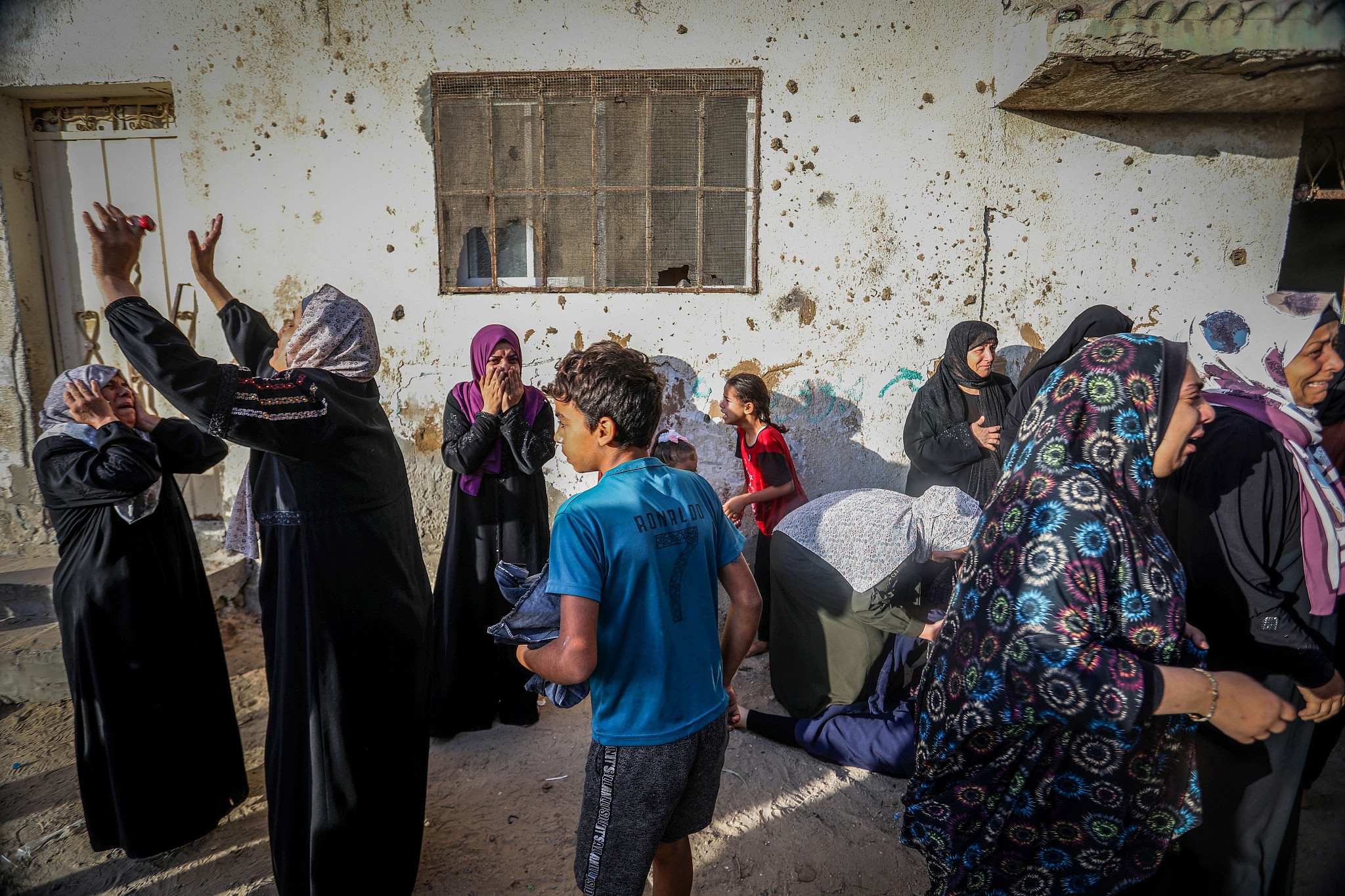
Palestinians react to the devastation caused by an Israeli airstrike in Rafah, southern Gaza Strip, November 11, 2023. (Abed Rahim Khatib/Flash90)
In one case discussed by the sources, the Israeli military command knowingly approved the killing of hundreds of Palestinian civilians in an attempt to assassinate a single top Hamas military commander. “The numbers increased from dozens of civilian deaths [permitted] as collateral damage as part of an attack on a senior official in previous operations, to hundreds of civilian deaths as collateral damage,” said one source.
“Nothing happens by accident,” said another source. “When a 3-year-old girl is killed in a home in Gaza, it’s because someone in the army decided it wasn’t a big deal for her to be killed — that it was a price worth paying in order to hit [another] target. We are not Hamas. These are not random rockets. Everything is intentional. We know exactly how much collateral damage there is in every home.”
According to the investigation, another reason for the large number of targets, and the extensive harm to civilian life in Gaza, is the widespread use of a system called “Habsora” (“The Gospel”), which is largely built on artificial intelligence and can “generate” targets almost automatically at a rate that far exceeds what was previously possible. This AI system, as described by a former intelligence officer, essentially facilitates a “mass assassination factory.”
According to the sources, the increasing use of AI-based systems like Habsora allows the army to carry out strikes on residential homes where a single Hamas member lives on a massive scale, even those who are junior Hamas operatives. Yet testimonies of Palestinians in Gaza suggest that since October 7, the army has also attacked many private residences where there was no known or apparent member of Hamas or any other militant group residing. Such strikes, sources confirmed to +972 and Local Call, can knowingly kill entire families in the process.
In the majority of cases, the sources added, military activity is not conducted from these targeted homes. “I remember thinking that it was like if [Palestinian militants] would bomb all the private residences of our families when [Israeli soldiers] go back to sleep at home on the weekend,” one source, who was critical of this practice, recalled.
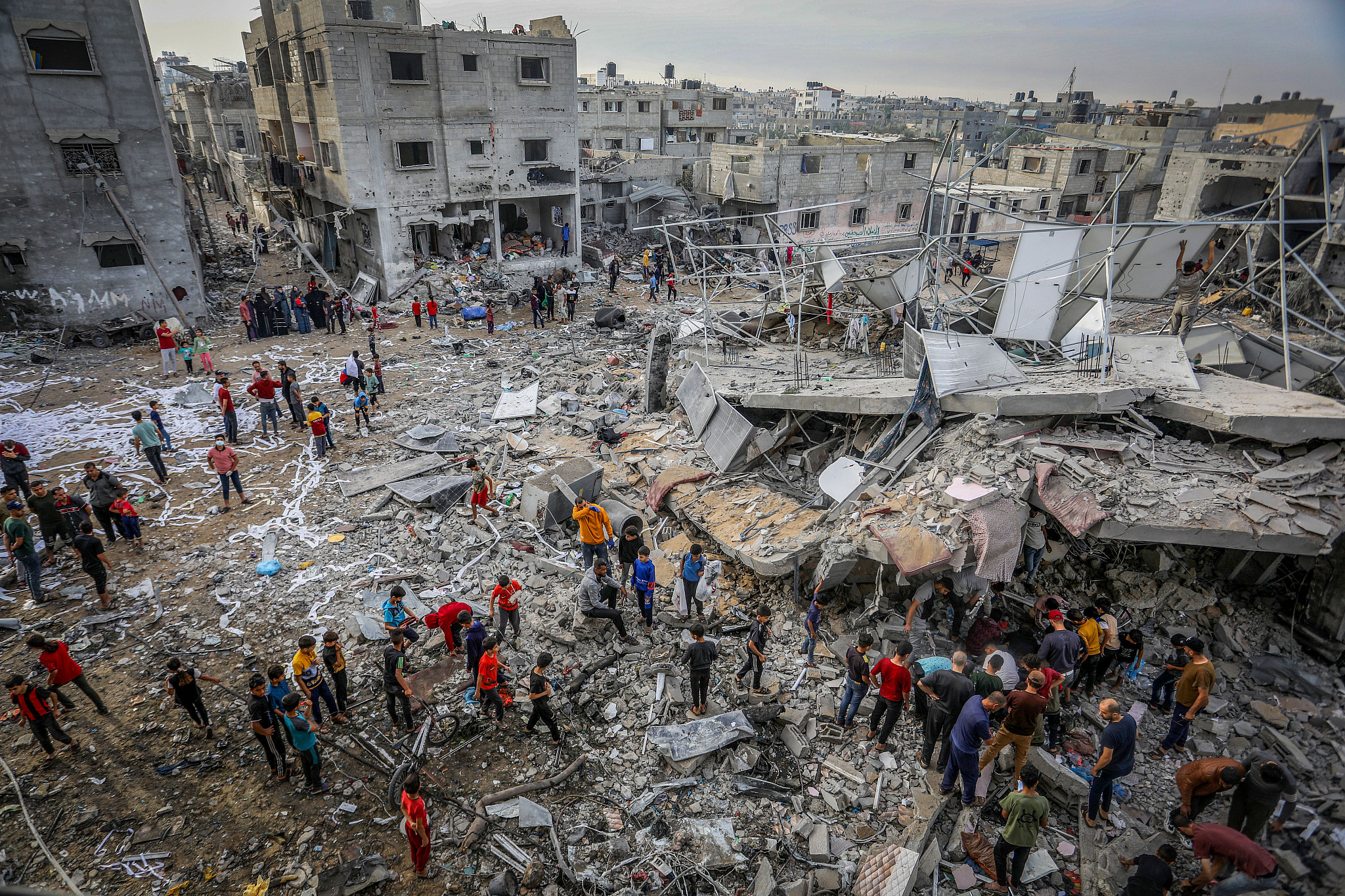
Palestinians at the rubble of a building destroyed by Israeli airstrikes in Rafah, southern Gaza Strip, November 11, 2023. (Abed Rahim Khatib/Flash90)
Another source said that a senior intelligence officer told his officers after October 7 that the goal was to “kill as many Hamas operatives as possible,” for which the criteria around harming Palestinian civilians were significantly relaxed. As such, there are “cases in which we shell based on a wide cellular pinpointing of where the target is, killing civilians. This is often done to save time, instead of doing a little more work to get a more accurate pinpointing,” said the source.
The result of these policies is the staggering loss of human life in Gaza since October 7. Over 300 families have lost 10 or more family members in Israeli bombings in the past two months — a number that is 15 times higher than the figure from what was previously Israel’s deadliest war on Gaza, in 2014. At the time of writing, around 15,000 Palestinians have been reported killed in the war, and counting.
“All of this is happening contrary to the protocol used by the IDF in the past,” a source explained. “There is a feeling that senior officials in the army are aware of their failure on October 7, and are busy with the question of how to provide the Israeli public with an image [of victory] that will salvage their reputation.”
‘An excuse to cause destruction’
Israel launched its assault on Gaza in the aftermath of the October 7 Hamas-led offensive on southern Israel. During that attack, under a hail of rocket fire, Palestinian militants massacred more than 840 civilians and killed 350 soldiers and security personnel, kidnapped around 240 people — civilians and soldiers — to Gaza, and committed widespread sexual violence, including rape, according to a report by the NGO Physicians for Human Rights Israel.
From the first moment after the October 7 attack, decisionmakers in Israel openly declared that the response would be of a completely different magnitude to previous military operations in Gaza, with the stated aim of totally eradicating Hamas. “The emphasis is on damage and not on accuracy,” said IDF Spokesperson Daniel Hagari on Oct. 9. The army swiftly translated those declarations into actions.
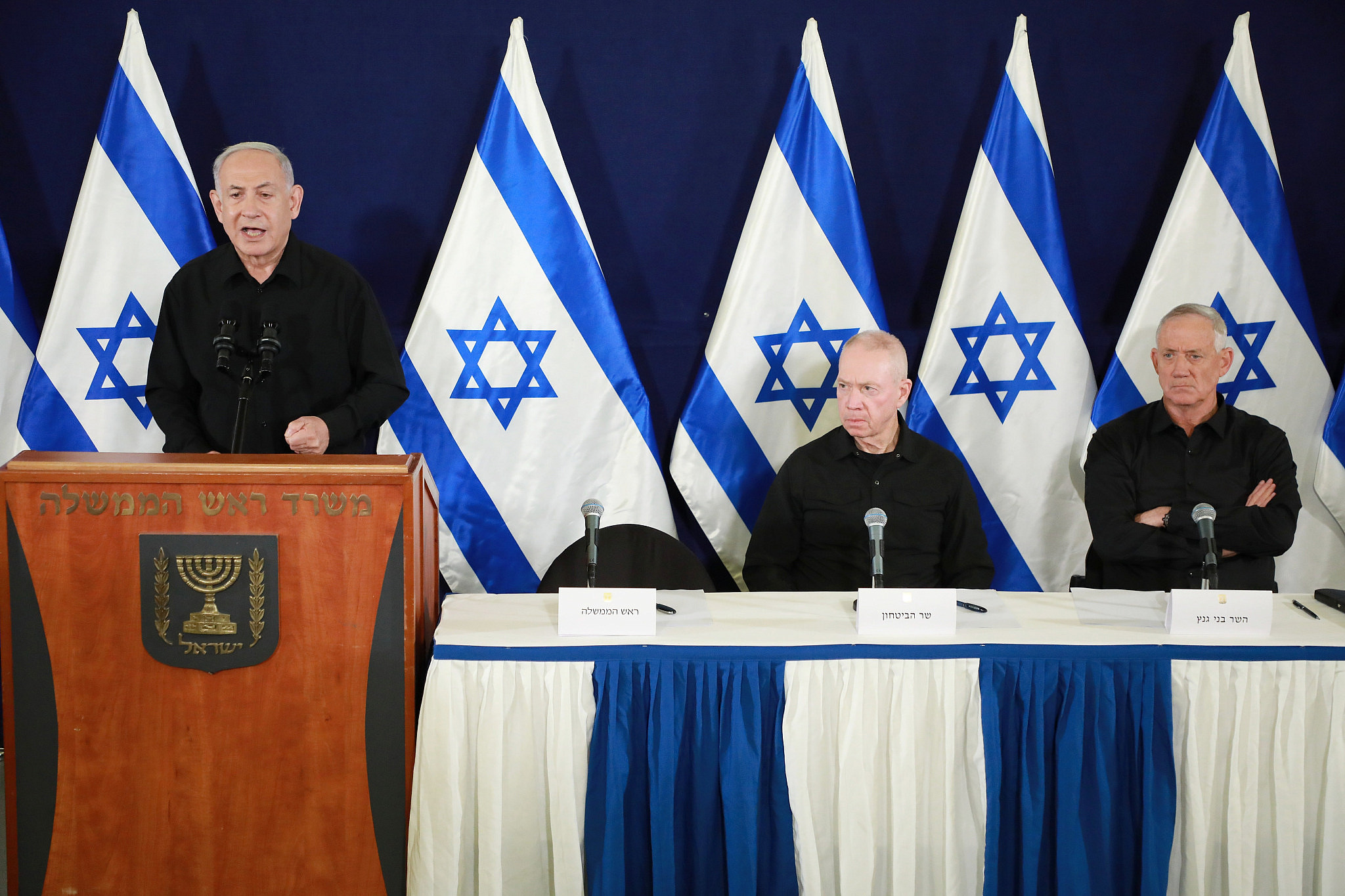
Israeli Prime Minister Benjamin Netanyahu, Defense Minister Yoav Gallant, and Minister without Portfolio Benny Gantz hold a joint press conference at the Defense Ministry, Tel Aviv, November 11, 2023. (Marc Israel Sellem/POOL)
According to the sources who spoke to +972 and Local Call, the targets in Gaza that have been struck by Israeli aircraft can be divided roughly into four categories. The first is “tactical targets,” which include standard military targets such as armed militant cells, weapon warehouses, rocket launchers, anti-tank missile launchers, launch pits, mortar bombs, military headquarters, observation posts, and so on.
The second is “underground targets” — mainly tunnels that Hamas has dug under Gaza’s neighborhoods, including under civilian homes. Aerial strikes on these targets could lead to the collapse of the homes above or near the tunnels.
The third is “power targets,” which includes high-rises and residential towers in the heart of cities, and public buildings such as universities, banks, and government offices. The idea behind hitting such targets, say three intelligence sources who were involved in planning or conducting strikes on power targets in the past, is that a deliberate attack on Palestinian society will exert “civil pressure” on Hamas.
The final category consists of “family homes” or “operatives’ homes.” The stated purpose of these attacks is to destroy private residences in order to assassinate a single resident suspected of being a Hamas or Islamic Jihad operative. However, in the current war, Palestinian testimonies assert that some of the families that were killed did not include any operatives from these organizations.
In the early stages of the current war, the Israeli army appears to have given particular attention to the third and fourth categories of targets. According to statements on Oct. 11 by the IDF Spokesperson, during the first five days of fighting, half of the targets bombed — 1,329 out of a total 2,687 — were deemed power targets.
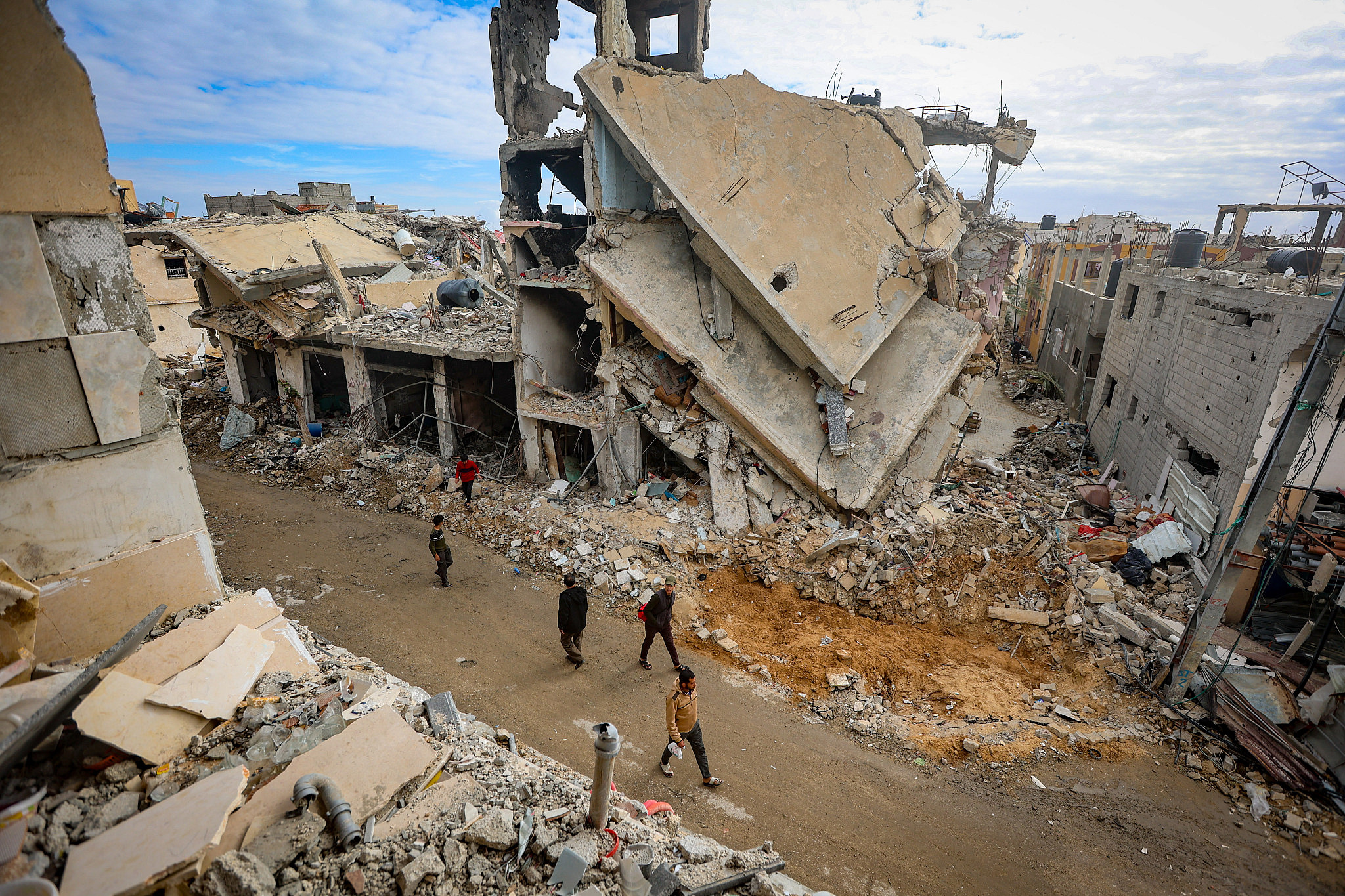
Palestinians walk next to the rubble of buildings destroyed by Israeli airstrikes in Khan Younis, southern Gaza Strip, November 28, 2023. (Atia Mohammed/Flash90)
“We are asked to look for high-rise buildings with half a floor that can be attributed to Hamas,” said one source who took part in previous Israeli offensives in Gaza. “Sometimes it is a militant group’s spokesperson’s office, or a point where operatives meet. I understood that the floor is an excuse that allows the army to cause a lot of destruction in Gaza. That is what they told us.
“If they would tell the whole world that the [Islamic Jihad] offices on the 10th floor are not important as a target, but that its existence is a justification to bring down the entire high-rise with the aim of pressuring civilian families who live in it in order to put pressure on terrorist organizations, this would itself be seen as terrorism. So they do not say it,” the source added.
Various sources who served in IDF intelligence units said that at least until the current war, army protocols allowed for attacking power targets only when the buildings were empty of residents at the time of the strike. However, testimonies and videos from Gaza suggest that since October 7, some of these targets have been attacked without prior notice being given to their occupants, killing entire families as a result.
The wide-scale targeting of residential homes can be derived from public and official data. According to the Government Media Office in Gaza — which has been providing death tolls since the Gaza Health Ministry stopped doing so on Nov. 11 due to the collapse of health services in the Strip — by the time the temporary ceasefire took hold on Nov. 23, Israel had killed 14,800 Palestinians in Gaza; approximately 6,000 of them were children and 4,000 were women, who together constitute more than 67 percent of the total. The figures provided by the Health Ministry and the Government Media Office — both of which fall under the auspices of the Hamas government — do not deviate significantly from Israeli estimates.
The Gaza Health Ministry, furthermore, does not specify how many of the dead belonged to the military wings of Hamas or Islamic Jihad. The Israeli army estimates that it has killed between 1,000 and 3,000 armed Palestinian militants. According to media reports in Israel, some of the dead militants are buried under the rubble or inside Hamas’ underground tunnel system, and therefore were not tallied in official counts.
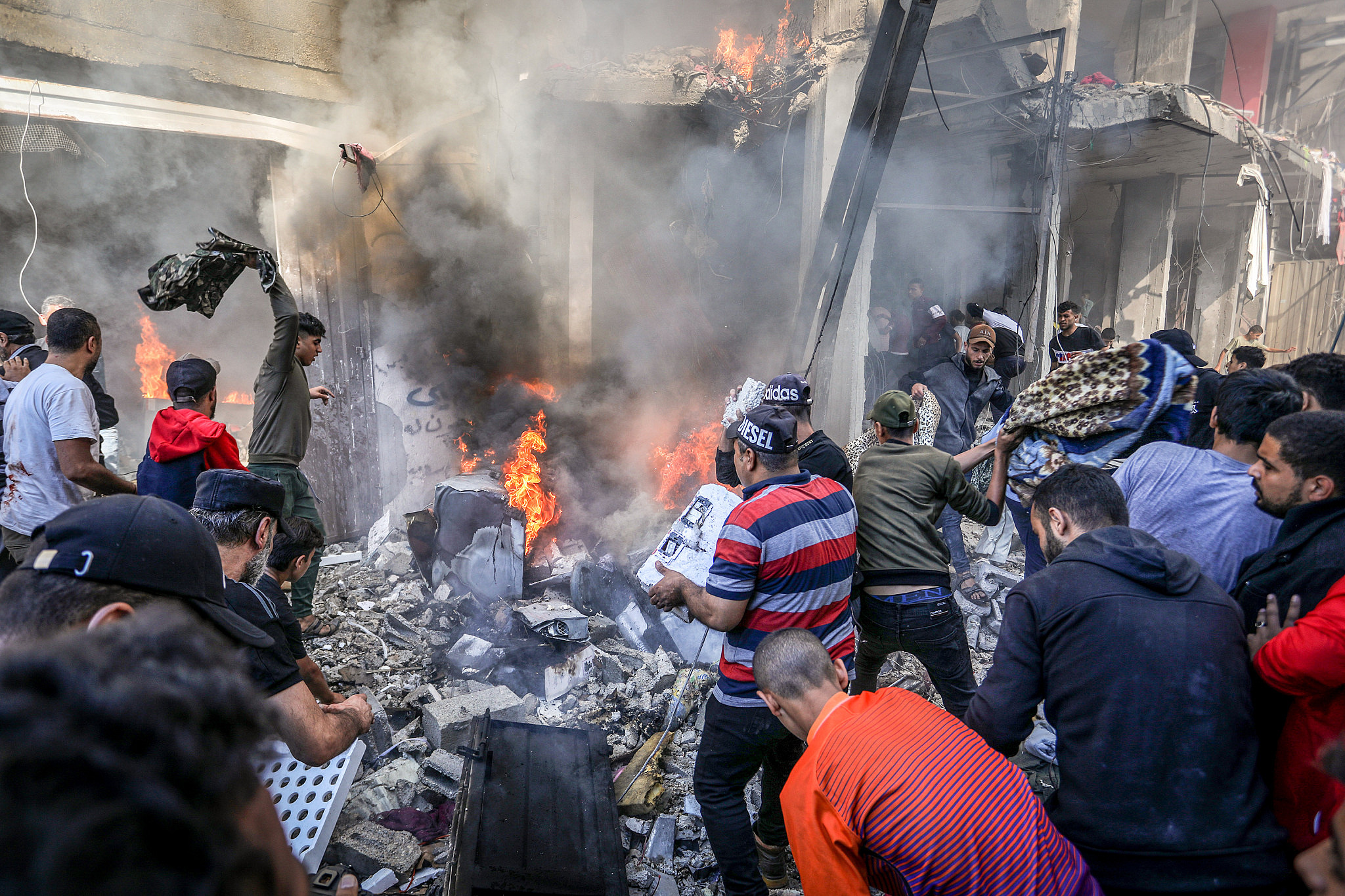
Palestinians try to put out a fire after an Israeli airstrike on a house in the Shaboura refugee camp in the city of Rafah, southern of the Gaza Strip, on November 17, 2023. (Abed Rahim Khatib/Flash90)
UN data for the period up until Nov. 11, by which time Israel had killed 11,078 Palestinians in Gaza, states that at least 312 families have lost 10 or more people in the current Israeli attack; for the sake of comparison, during “Operation Protective Edge” in 2014, 20 families in Gaza lost 10 or more people. At least 189 families have lost between six and nine people according to the UN data, while 549 families have lost between two and five people. No updated breakdowns have yet been given for the casualty figures published since Nov. 11.
The massive attacks on power targets and private residences came at the same time as the Israeli army, on Oct. 13, called on the 1.1 million residents of the northern Gaza Strip — most of them residing in Gaza City — to leave their homes and move to the south of the Strip. By that date, a record number of power targets had already been bombed, and more than 1,000 Palestinians had already been killed, including hundreds of children.
In total, according to the UN, 1.7 million Palestinians, the vast majority of the Strip’s population, have been displaced within Gaza since October 7. The army claimed that the demand to evacuate the Strip’s north was intended to protect civilian lives. Palestinians, however, see this mass displacement as part of a “new Nakba” — an attempt to ethnically cleanse part or all of the territory.
‘They knocked down a high-rise for the sake of it’
According to the Israeli army, during the first five days of fighting it dropped 6,000 bombs on the Strip, with a total weight of about 4,000 tons. Media outlets reported that the army had wiped out entire neighborhoods; according to the Gaza-based Al Mezan Center for Human Rights, these attacks led to “the complete destruction of residential neighborhoods, the destruction of infrastructure, and the mass killing of residents.”
As documented by Al Mezan and numerous images coming out of Gaza, Israel bombed the Islamic University of Gaza, the Palestinian Bar Association, a UN building for an educational program for outstanding students, a building belonging to the Palestine Telecommunications Company, the Ministry of National Economy, the Ministry of Culture, roads, and dozens of high-rise buildings and homes — especially in Gaza’s northern neighborhoods.
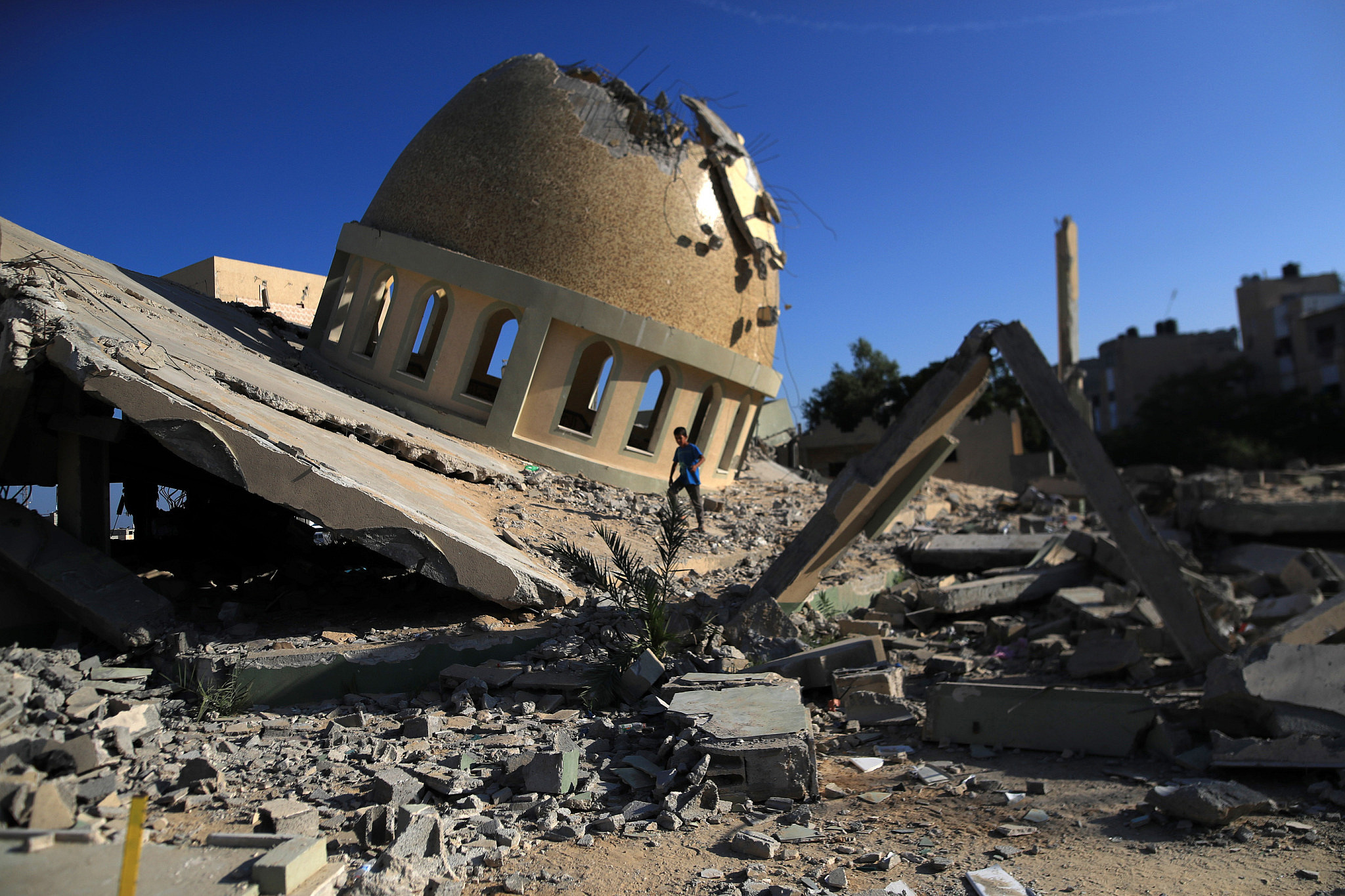
The ruins of Al-Amin Muhammad Mosque which was destroyed in an Israeli airstrike on October 20, Khan Younis refugee camp, southern Gaza Strip, October 31, 2023. (Mohammed Zaanoun/Activestills)
On the fifth day of fighting, the IDF Spokesperson distributed to military reporters in Israel “before and after” satellite images of neighborhoods in the northern Strip, such as Shuja’iyya and Al-Furqan (nicknamed after a mosque in the area) in Gaza City, which showed dozens of destroyed homes and buildings. The Israeli army said that it had struck 182 power targets in Shuja’iyya and 312 power targets in Al-Furqan.
The Chief of Staff of the Israeli Air Force, Omer Tishler, told military reporters that all of these attacks had a legitimate military target, but also that entire neighborhoods were attacked “on a large scale and not in a surgical manner.” Noting that half of the military targets up until Oct. 11 were power targets, the IDF Spokesperson said that “neighborhoods that serve as terror nests for Hamas” were attacked and that damage was caused to “operational headquarters,” “operational assets,” and “assets used by terrorist organizations inside residential buildings.” On Oct. 12, the Israeli army announced it had killed three “senior Hamas members” — two of whom were part of the group’s political wing.
Yet despite the unbridled Israeli bombardment, the damage to Hamas’ military infrastructure in northern Gaza during the first days of the war appears to have been very minimal. Indeed, intelligence sources told +972 and Local Call that military targets that were part of power targets have previously been used many times as a fig leaf for harming the civilian population. “Hamas is everywhere in Gaza; there is no building that does not have something of Hamas in it, so if you want to find a way to turn a high-rise into a target, you will be able to do so,” said one former intelligence official.
“They will never just hit a high-rise that does not have something we can define as a military target,” said another intelligence source, who carried out previous strikes against power targets. “There will always be a floor in the high-rise [associated with Hamas]. But for the most part, when it comes to power targets, it is clear that the target doesn’t have military value that justifies an attack that would bring down the entire empty building in the middle of a city, with the help of six planes and bombs weighing several tons.”
Indeed, according to sources who were involved in the compiling of power targets in previous wars, although the target file usually contains some kind of alleged association with Hamas or other militant groups, striking the target functions primarily as a “means that allows damage to civil society.” The sources understood, some explicitly and some implicitly, that damage to civilians is the real purpose of these attacks.
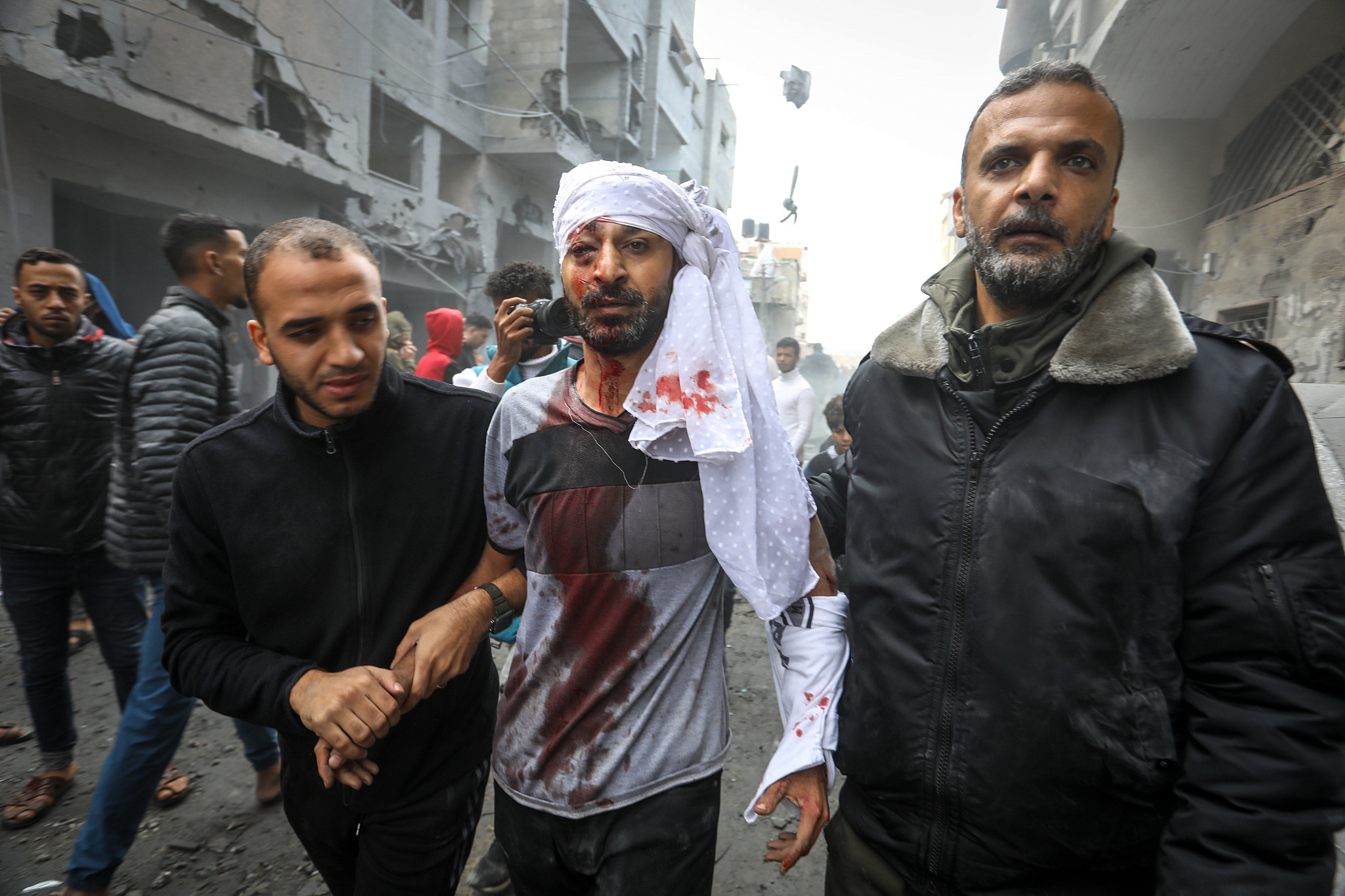
Palestinians survivors are brought out of the rubble of houses destroyed in an Israeli airstrike in the city of Rafah, southern Gaza Strip, November 20, 2023. (Abed Rahim Khatib/Flash90)
In May 2021, for example, Israel was heavily criticized for bombing the Al-Jalaa Tower, which housed prominent international media outlets such as Al Jazeera, AP, and AFP. The army claimed that the building was a Hamas military target; sources have told +972 and Local Call that it was in fact a power target.
“The perception is that it really hurts Hamas when high-rise buildings are taken down, because it creates a public reaction in the Gaza Strip and scares the population,” said one of the sources. “They wanted to give the citizens of Gaza the feeling that Hamas is not in control of the situation. Sometimes they toppled buildings and sometimes postal service and government buildings.”
Although it is unprecedented for the Israeli army to attack more than 1,000 power targets in five days, the idea of causing mass devastation to civilian areas for strategic purposes was formulated in previous military operations in Gaza, honed by the so-called “Dahiya Doctrine” from the Second Lebanon War of 2006.
According to the doctrine — developed by former IDF Chief of Staff Gadi Eizenkot, who is now a Knesset member and part of the current war cabinet — in a war against guerrilla groups such as Hamas or Hezbollah, Israel must use disproportionate and overwhelming force while targeting civilian and government infrastructure in order to establish deterrence and force the civilian population to pressure the groups to end their attacks. The concept of “power targets” seems to have emanated from this same logic.
The first time the Israeli army publicly defined power targets in Gaza was at the end of Operation Protective Edge in 2014. The army bombed four buildings during the last four days of the war — three residential multi-story buildings in Gaza City, and a high-rise in Rafah. The security establishment explained at the time that the attacks were intended to convey to the Palestinians of Gaza that “nothing is immune anymore,” and to put pressure on Hamas to agree to a ceasefire. “The evidence we collected shows that the massive destruction [of the buildings] was carried out deliberately, and without any military justification,” stated an Amnesty report in late 2014.
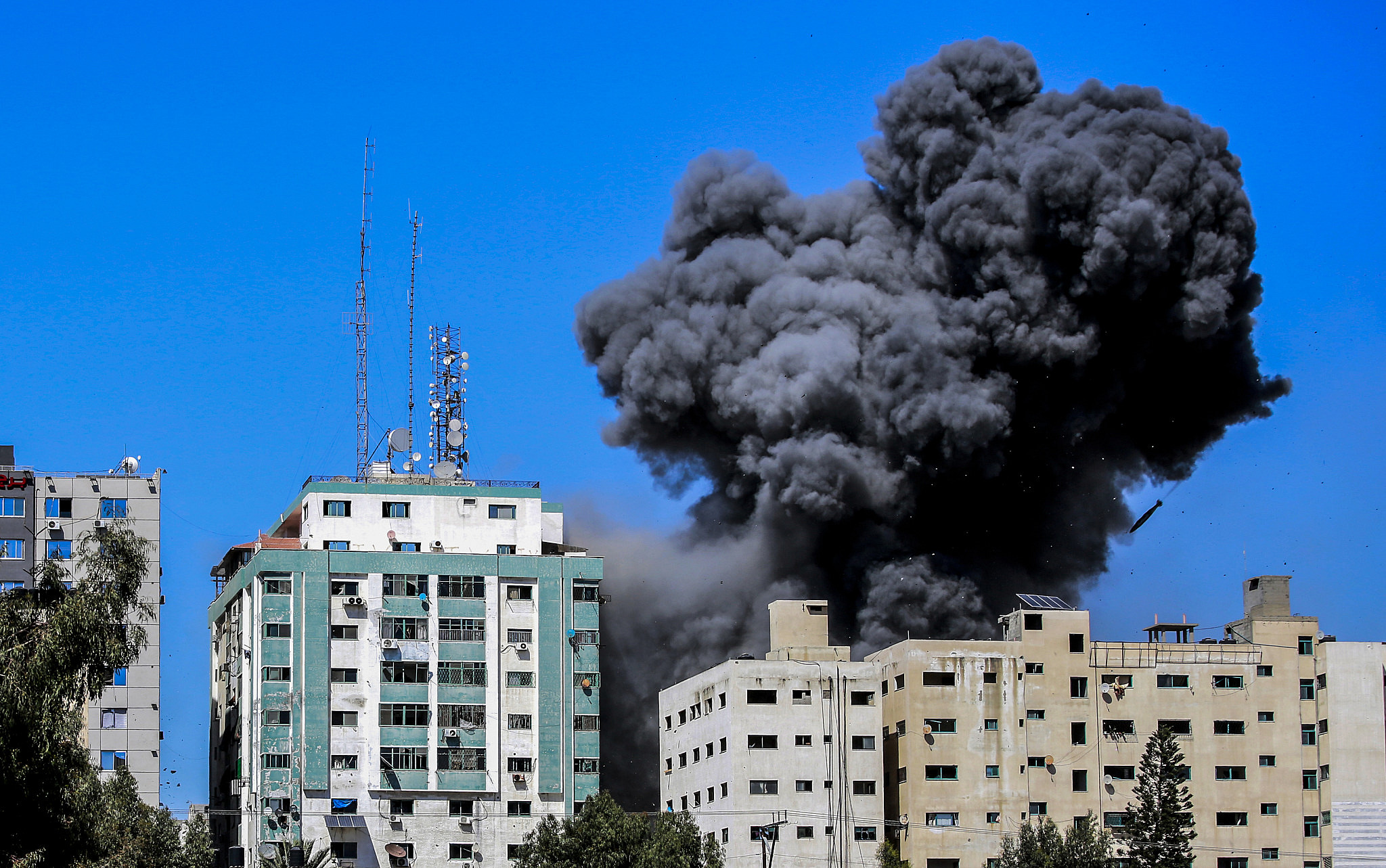
Smoke rises after an Israeli airstrike hits Al-Jalaa tower, which houses apartments and several media outlets including the Associated Press and Al Jazeera, Gaza City, May 15, 2021. (Atia Mohammed/Flash90)
In another violent escalation that began in November 2018, the army once again attacked power targets. That time, Israel bombed high-rises, shopping centers, and the building of the Hamas-affiliated Al-Aqsa TV station. “Attacking power targets produces a very significant effect on the other side,” one Air Force officer stated at the time. “We did it without killing anyone and we made sure that the building and its surroundings were evacuated.”
Previous operations have also shown how striking these targets is meant not only to harm Palestinian morale, but also to raise the morale inside Israel. Haaretz revealed that during Operation Guardian of the Walls in 2021, the IDF Spokesperson’s Unit conducted a psy-op against Israeli citizens in order to boost awareness of the IDF’s operations in Gaza and the damage they caused to Palestinians. Soldiers, who used fake social media accounts to conceal the campaign’s origin, uploaded images and clips of the army’s strikes in Gaza to Twitter, Facebook, Instagram, and TikTok in order to demonstrate the army’s prowess to the Israeli public.
During the 2021 assault, Israel struck nine targets that were defined as power targets — all of them high-rise buildings. “The goal was to collapse the high-rises in order to put pressure on Hamas, and also so that the [Israeli] public would see a victory image,” one security source told +972 and Local Call.
However, the source continued, “it didn’t work. As someone who has followed Hamas, I heard firsthand how much they did not care about the civilians and the buildings that were taken down. Sometimes the army found something in a high-rise building that was related to Hamas, but it was also possible to hit that specific target with more accurate weaponry. The bottom line is that they knocked down a high-rise for the sake of knocking down a high-rise.”
‘Everyone was looking for their children in these piles’
Not only has the current war seen Israel attack an unprecedented number of power targets, it has also seen the army abandon prior policies that aimed at avoiding harm to civilians. Whereas previously the army’s official procedure was that it was possible to attack power targets only after all civilians had been evacuated from them, testimonies from Palestinian residents in Gaza indicate that, since October 7, Israel has attacked high-rises with their residents still inside, or without having taken significant steps to evacuate them, leading to many civilian deaths.
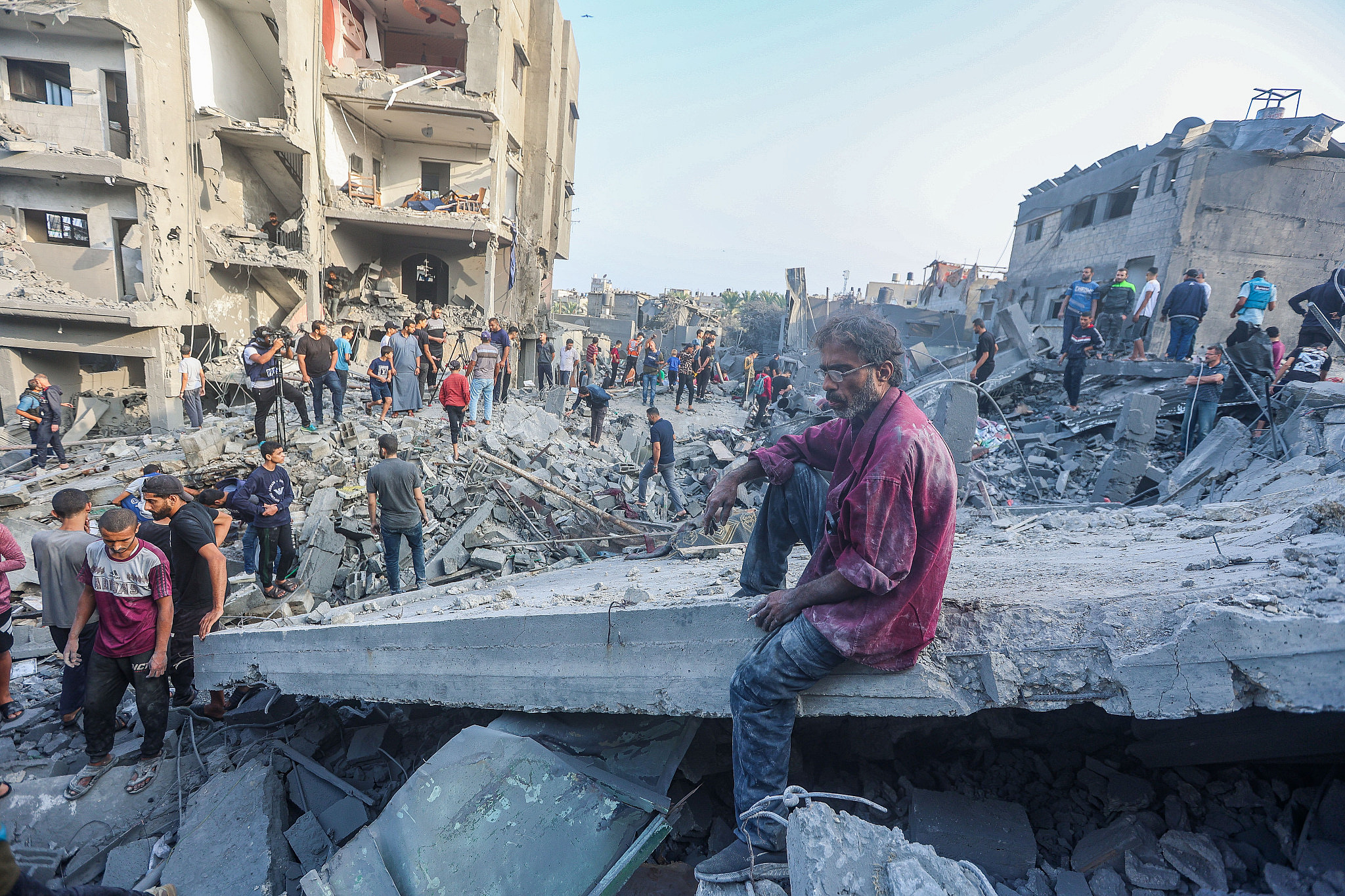
Palestinians at the rubble of a destroyed building after an Israeli airstrike in the central Gaza Strip, November 5, 2023. (Atia Mohammed/Flash90)
Such attacks very often result in the killing of entire families, as experienced in previous offensives; according to an investigation by AP conducted after the 2014 war, about 89 percent of those killed in the aerial bombings of family homes were unarmed residents, and most of them were children and women.
Tishler, the air force chief of staff, confirmed a shift in policy, telling reporters that the army’s “roof knocking” policy — whereby it would fire a small initial strike on the roof of a building to warn residents that it is about to be struck — is no longer in use “where there is an enemy.” Roof knocking, Tishler said, is “a term that is relevant to rounds [of fighting] and not to war.”
The sources who have previously worked on power targets said that the brazen strategy of the current war could be a dangerous development, explaining that attacking power targets was originally intended to “shock” Gaza but not necessarily to kill large numbers of civilians. “The targets were designed with the assumption that high-rises would be evacuated of people, so when we were working on [compiling the targets], there was no concern whatsoever regarding how many civilians would be harmed; the assumption was that the number would always be zero,” said one source with deep knowledge of the tactic.
“This would mean there would be a total evacuation [of the targeted buildings], which takes two to three hours, during which the residents are called [by phone to evacuate], warning missiles are fired, and we also crosscheck with drone footage that people are indeed leaving the high-rise,” the source added.
However, evidence from Gaza suggests that some high-rises — which we assume to have been power targets — were toppled without prior warning. +972 and Local Call located at least two cases during the current war in which entire residential high-rises were bombed and collapsed without warning, and one case in which, according to the evidence, a high-rise building collapsed on civilians who were inside.
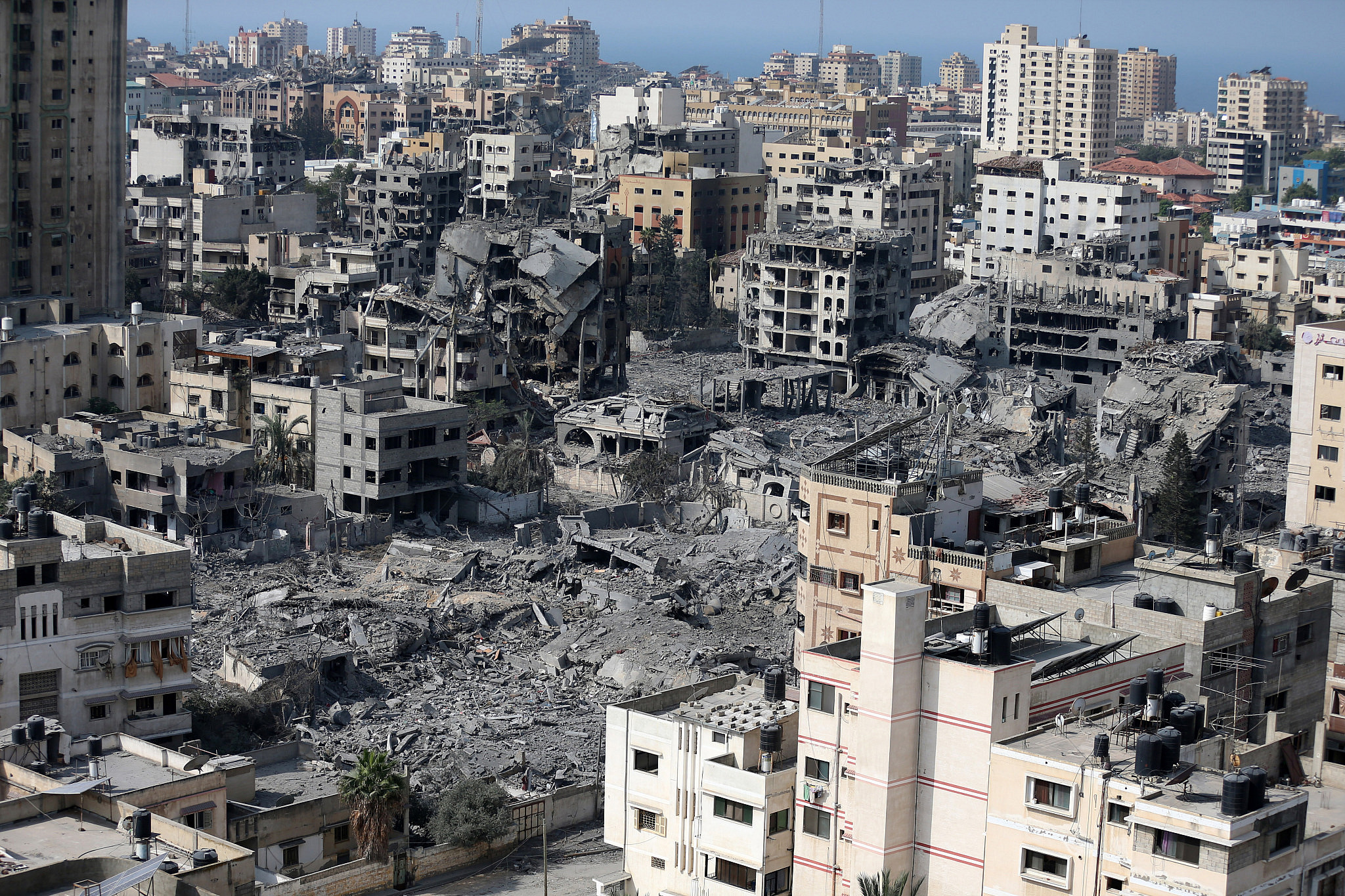
Devastation is seen in the area of Al-Rimal at the heart of Gaza City after Israeli bombing, October 23, 2023. (Mohammed Zaanoun/Activestills)
On Oct. 10, Israel bombed the Babel Building in Gaza, according to the testimony of Bilal Abu Hatzira, who rescued bodies from the ruins that night. Ten people were killed in the attack on the building, including three journalists.
On Oct. 25, the 12-story Al-Taj residential building in Gaza City was bombed to the ground, killing the families living inside it without warning. About 120 people were buried under the ruins of their apartments, according to the testimonies of residents. Yousef Amar Sharaf, a resident of Al-Taj, wrote on X that 37 of his family members who lived in the building were killed in the attack: “My dear father and mother, my beloved wife, my sons, and most of my brothers and their families.” Residents stated that a lot of bombs were dropped, damaging and destroying apartments in nearby buildings too.
Six days later, on Oct. 31, the eight-story Al-Mohandseen residential building was bombed without warning. Between 30 and 45 bodies were reportedly recovered from the ruins on the first day. One baby was found alive, without his parents. Journalists estimated that over 150 people were killed in the attack, as many remained buried under the rubble.
The building used to stand in Nuseirat Refugee Camp, south of Wadi Gaza — in the supposed “safe zone” to which Israel directed the Palestinians who fled their homes in northern and central Gaza — and therefore served as temporary shelter for the displaced, according to testimonies.
According to an investigation by Amnesty International, on Oct. 9, Israel shelled at least three multi-story buildings, as well as an open flea market on a crowded street in the Jabaliya Refugee Camp, killing at least 69 people. “The bodies were burned … I didn’t want to look, I was scared of looking at Imad’s face,” said the father of a child who was killed. “The bodies were scattered on the floor. Everyone was looking for their children in these piles. I recognized my son only by his trousers. I wanted to bury him immediately, so I carried my son and got him out.”
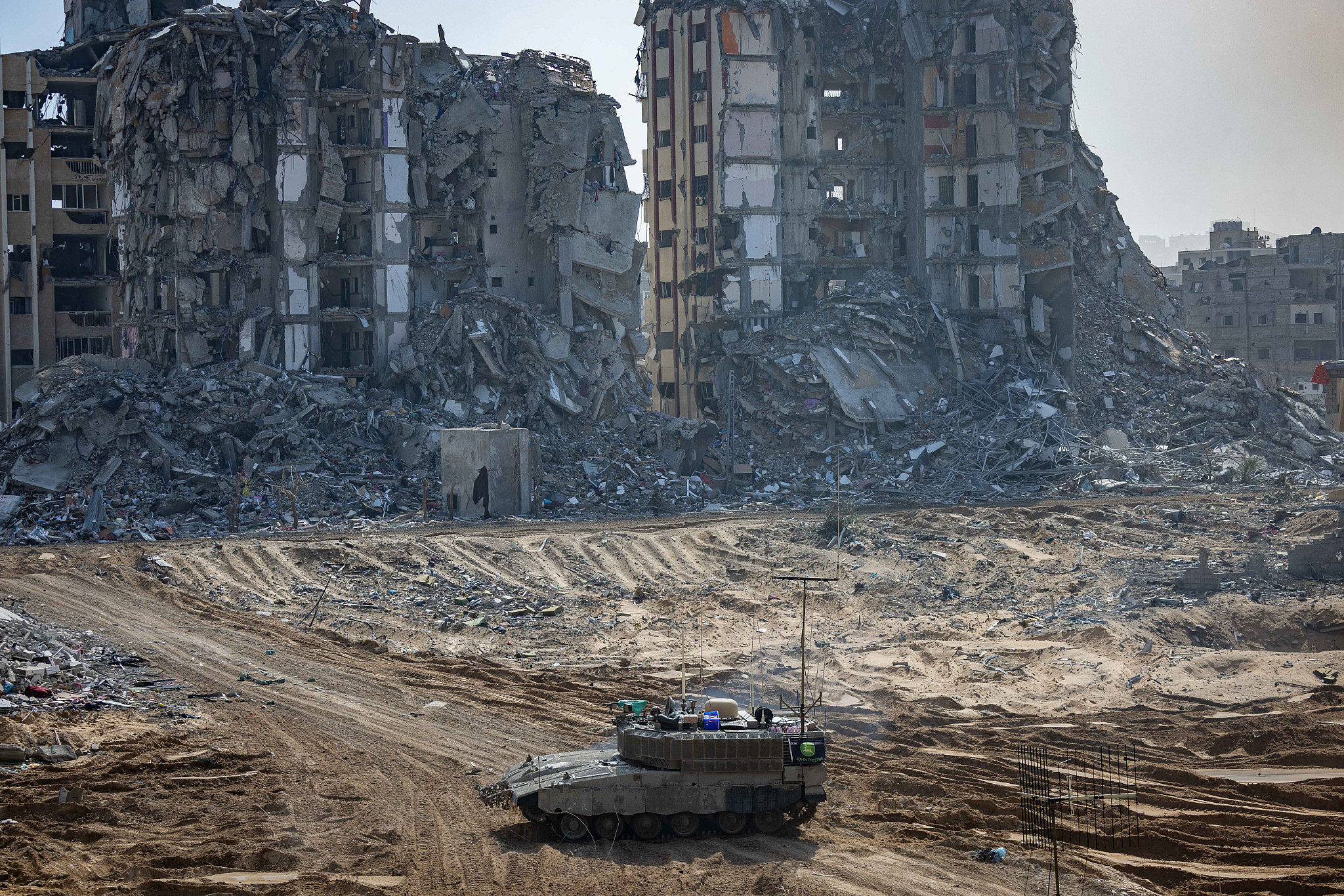
An Israeli tank is seen inside Al-Shati refugee camp, northern Gaza Strip, November 16, 2023. (Yonatan Sindel/Flash90)
According to Amnesty’s investigation, the army said that the attack on the market area was aimed at a mosque “where there were Hamas operatives.” However, according to the same investigation, satellite images do not show a mosque in the vicinity.
The IDF Spokesperson did not address +972’s and Local Call’s queries about specific attacks, but stated more generally that “the IDF provided warnings before attacks in various ways, and when the circumstances allowed it, also delivered individual warnings through phone calls to people who were at or near the targets (there were more from 25,000 live conversations during the war, alongside millions of recorded conversations, text messages and leaflets dropped from the air for the purpose of warning the population). In general, the IDF works to reduce harm to civilians as part of the attacks as much as possible, despite the challenge of fighting a terrorist organization that uses the citizens of Gaza as human shields.”
‘The machine produced 100 targets in one day’
According to the IDF Spokesperson, by Nov. 10, during the first 35 days of fighting, Israel attacked a total of 15,000 targets in Gaza. Based on multiple sources, this is a very high figure compared to the four previous major operations in the Strip. During Guardian of the Walls in 2021, Israel attacked 1,500 targets in 11 days. In Protective Edge in 2014, which lasted 51 days, Israel struck between 5,266 and 6,231 targets. During Pillar of Defense in 2012, about 1,500 targets were attacked over eight days. In Cast Lead” in 2008, Israel struck 3,400 targets in 22 days.
Intelligence sources who served in the previous operations also told +972 and Local Call that, for 10 days in 2021 and three weeks in 2014, an attack rate of 100 to 200 targets per day led to a situation in which the Israeli Air Force had no targets of military value left. Why, then, after nearly two months, has the Israeli army not yet run out of targets in the current war?
The answer may lie in a statement from the IDF Spokesperson on Nov. 2, according to which it is using the AI system Habsora (“The Gospel”), which the spokesperson says “enables the use of automatic tools to produce targets at a fast pace, and works by improving accurate and high-quality intelligence material according to [operational] needs.”
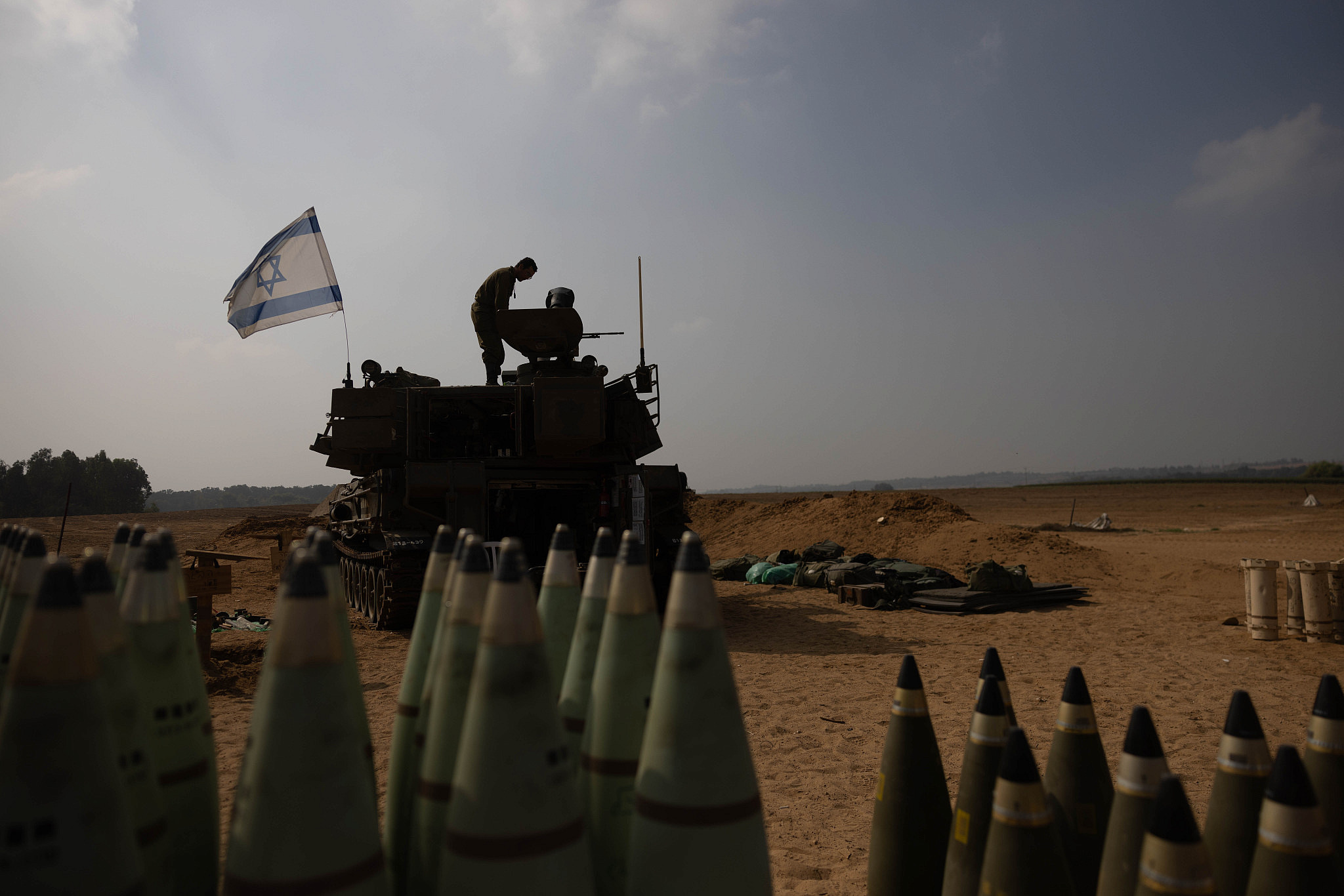
Israeli artillery stationed near the Gaza fence, southern Israel, November 2, 2023. (Chaim Goldberg/Flash90)
In the statement, a senior intelligence official is quoted as saying that thanks to Habsora, targets are created for precision strikes “while causing great damage to the enemy and minimal damage to non-combatants. Hamas operatives are not immune — no matter where they hide.”
According to intelligence sources, Habsora generates, among other things, automatic recommendations for attacking private residences where people suspected of being Hamas or Islamic Jihad operatives live. Israel then carries out large-scale assassination operations through the heavy shelling of these residential homes.
Habsora, explained one of the sources, processes enormous amounts of data that “tens of thousands of intelligence officers could not process,” and recommends bombing sites in real time. Because most senior Hamas officials head into underground tunnels with the start of any military operation, the sources say, the use of a system like Habsora makes it possible to locate and attack the homes of relatively junior operatives.
One former intelligence officer explained that the Habsora system enables the army to run a “mass assassination factory,” in which the “emphasis is on quantity and not on quality.” A human eye “will go over the targets before each attack, but it need not spend a lot of time on them.” Since Israel estimates that there are approximately 30,000 Hamas members in Gaza, and they are all marked for death, the number of potential targets is enormous.
In 2019, the Israeli army created a new center aimed at using AI to accelerate target generation. “The Targets Administrative Division is a unit that includes hundreds of officers and soldiers, and is based on AI capabilities,” said former IDF Chief of Staff Aviv Kochavi in an in-depth interview with Ynet earlier this year.
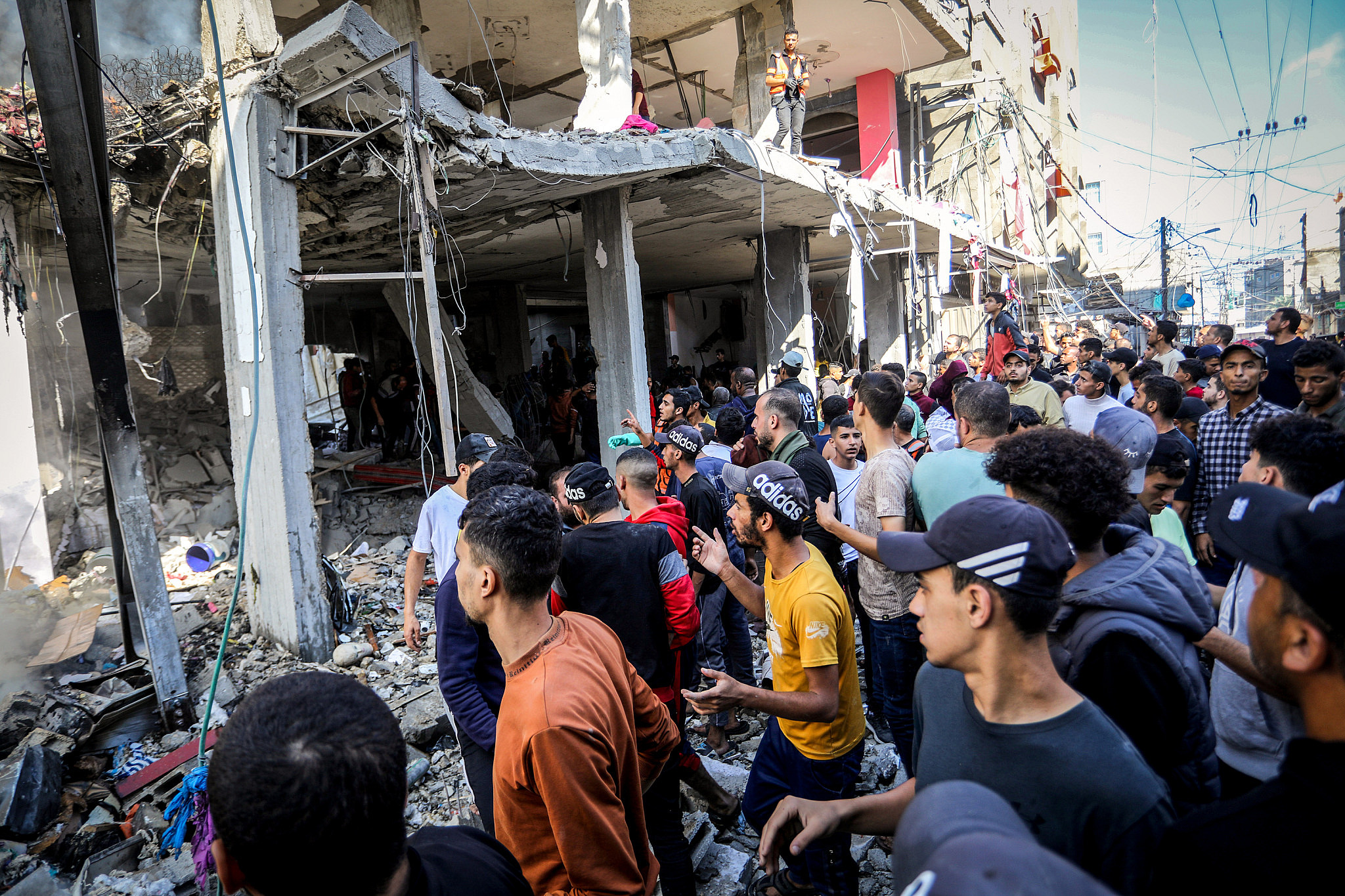
Palestinians search for the wounded after an Israeli airstrike on a house in the Shaboura refugee camp in the city of Rafah, southern Gaza Strip, November 17, 2023. (Abed Rahim Khatib/Flash90)
“This is a machine that, with the help of AI, processes a lot of data better and faster than any human, and translates it into targets for attack,” Kochavi went on. “The result was that in Operation Guardian of the Walls [in 2021], from the moment this machine was activated, it generated 100 new targets every day. You see, in the past there were times in Gaza when we would create 50 targets per year. And here the machine produced 100 targets in one day.”
“We prepare the targets automatically and work according to a checklist,” one of the sources who worked in the new Targets Administrative Division told +972 and Local Call. “It really is like a factory. We work quickly and there is no time to delve deep into the target. The view is that we are judged according to how many targets we manage to generate.”
A senior military official in charge of the target bank told the Jerusalem Post earlier this year that, thanks to the army’s AI systems, for the first time the military can generate new targets at a faster rate than it attacks. Another source said the drive to automatically generate large numbers of targets is a realization of the Dahiya Doctrine.
Automated systems like Habsora have thus greatly facilitated the work of Israeli intelligence officers in making decisions during military operations, including calculating potential casualties. Five different sources confirmed that the number of civilians who may be killed in attacks on private residences is known in advance to Israeli intelligence, and appears clearly in the target file under the category of “collateral damage.”
According to these sources, there are degrees of collateral damage, according to which the army determines whether it is possible to attack a target inside a private residence. “When the general directive becomes ‘Collateral Damage 5,’ that means we are authorized to strike all targets that will kill five or less civilians — we can act on all target files that are five or less,” said one of the sources.
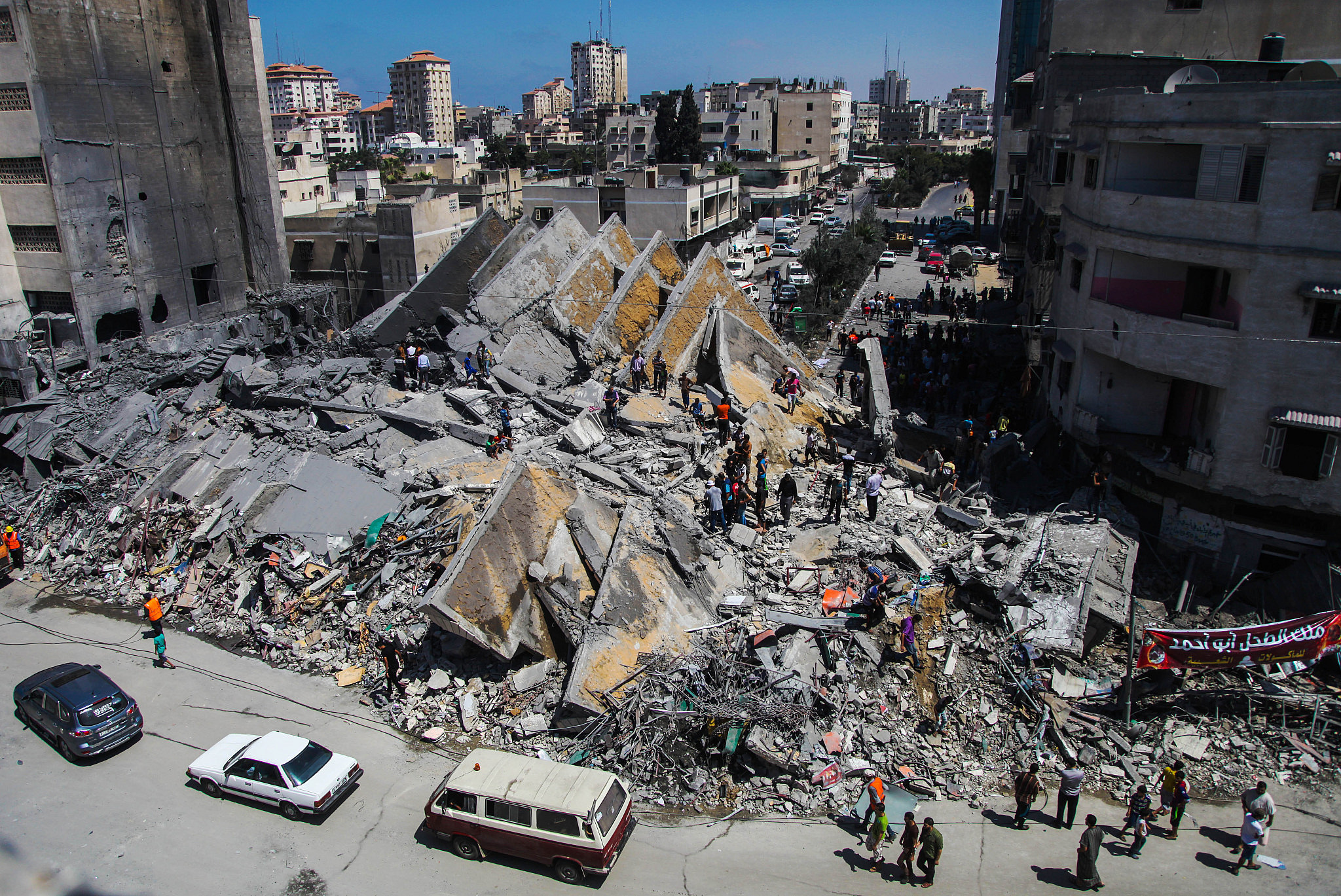
Palestinians gather around the remains of a tower building housing offices which witnesses said was destroyed by an Israeli air strike in Gaza City, August 26, 2014. (Emad Nassar/Flash90)
“In the past, we did not regularly mark the homes of junior Hamas members for bombing,” said a security official who participated in attacking targets during previous operations. “In my time, if the house I was working on was marked Collateral Damage 5, it would not always be approved [for attack].” Such approval, he said, would only be received if a senior Hamas commander was known to be living in the home.
“To my understanding, today they can mark all the houses of [any Hamas military operative regardless of rank],” the source continued. “That is a lot of houses. Hamas members who don’t really matter for anything live in homes across Gaza. So they mark the home and bomb the house and kill everyone there.”
A concerted policy to bomb family homes
On Oct. 22, the Israeli Air Force bombed the home of the Palestinian journalist Ahmed Alnaouq in the city of Deir al-Balah. Ahmed is a close friend and colleague of mine; four years ago, we founded a Hebrew Facebook page called “Across the Wall,” with the aim of bringing Palestinian voices from Gaza to the Israeli public.
The strike on Oct. 22 collapsed blocks of concrete onto Ahmed’s entire family, killing his father, brothers, sisters, and all of their children, including babies. Only his 12-year-old niece, Malak, survived and remained in a critical condition, her body covered in burns. A few days later, Malak died.
Twenty-one members of Ahmed’s family were killed in total, buried under their home. None of them were militants. The youngest was 2 years old; the oldest, his father, was 75. Ahmed, who is currently living in the UK, is now alone out of his entire family.
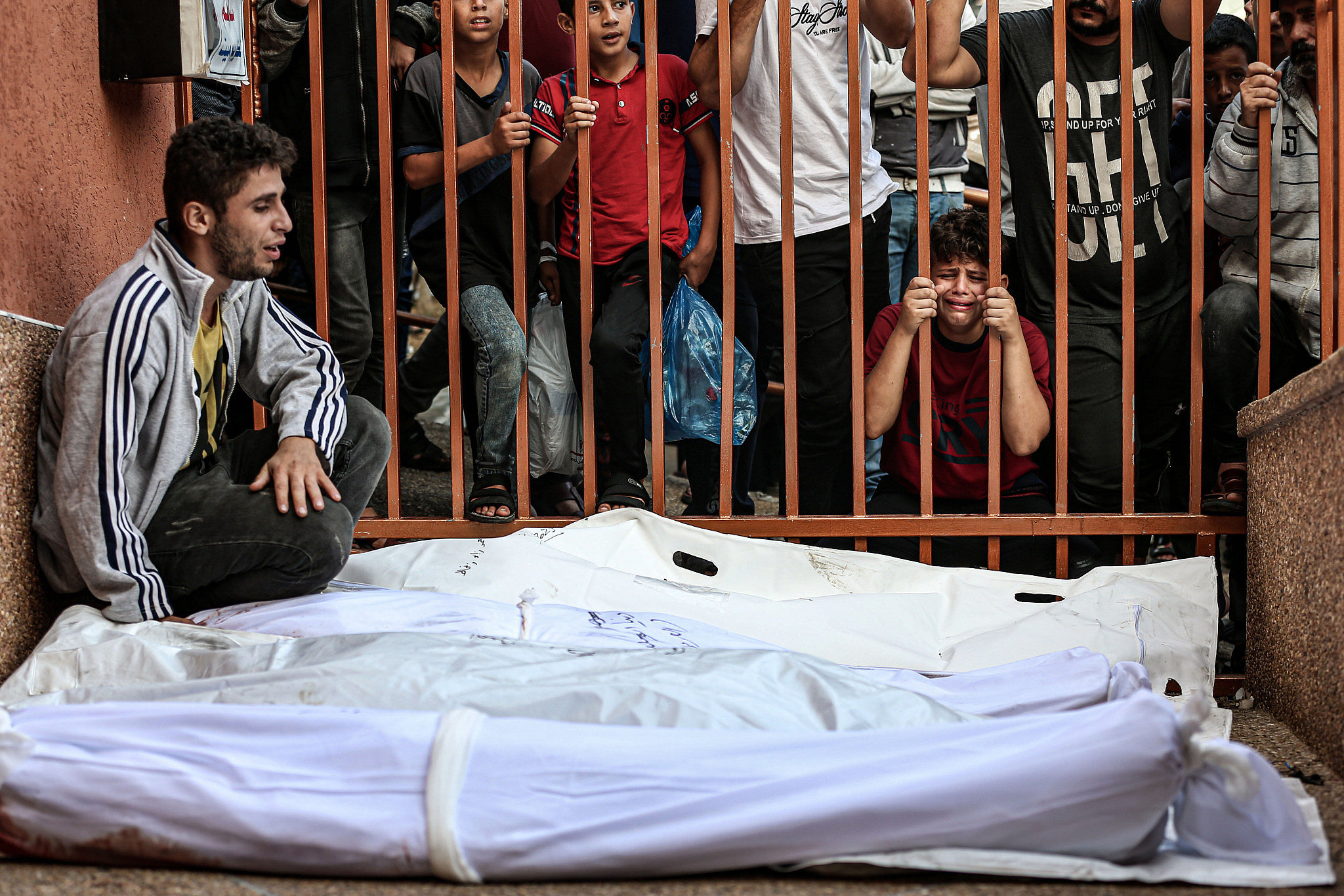
Al-Nasser Hospital in Khan Younis overflows with the bodies of Palestinians killed and wounded overnight in Israeli airstrikes, Gaza Strip, October 25, 2023. (Mohammed Zaanoun/Activestills)
Ahmed’s family WhatsApp group is titled “Better Together.” The last message that appears there was sent by him, a little after midnight on the night he lost his family. “Someone let me know that everything is fine,” he wrote. No one answered. He fell asleep, but woke up in a panic at 4 a.m. Drenched in sweat, he checked his phone again. Silence. Then he received a message from a friend with the terrible news.
Ahmed’s case is common in Gaza these days. In interviews to the press, heads of Gaza hospitals have been echoing the same description: families enter hospitals as a succession of corpses, a child followed by his father followed by his grandfather. The bodies are all covered in dirt and blood.
According to former Israeli intelligence officers, in many cases in which a private residence is bombed, the goal is the “assassination of Hamas or Jihad operatives,” and such targets are attacked when the operative enters the home. Intelligence researchers know if the operative’s family members or neighbors may also die in an attack, and they know how to calculate how many of them may die. Each of the sources said that these are private homes, where in the majority of cases, no military activity is carried out.
+972 and Local Call do not have data regarding the number of military operatives who were indeed killed or wounded by aerial strikes on private residences in the current war, but there is ample evidence that, in many cases, none were military or political operatives belonging to Hamas or Islamic Jihad.
On Oct. 10, the Israeli Air Force bombed an apartment building in Gaza’s Sheikh Radwan neighborhood, killing 40 people, most of them women and children. In one of the shocking videos taken following the attack, people are seen screaming, holding what appears to be a doll pulled from the ruins of the house, and passing it from hand to hand. When the camera zooms in, one can see that it is not a doll, but the body of a baby.
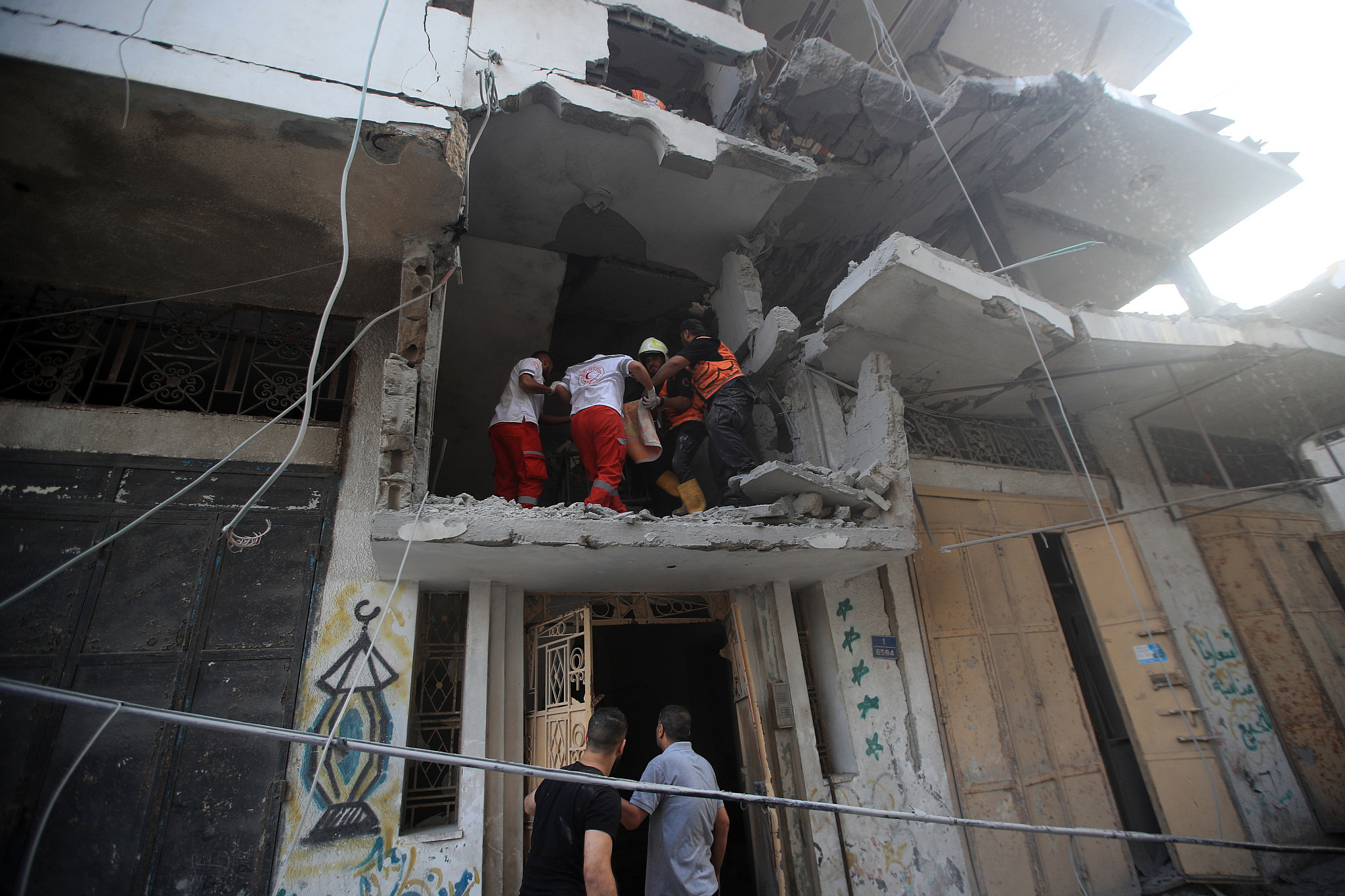
Palestinian rescue services remove the bodies of members of the Shaaban family, all six of whom were killed in an Israeli airstrike on the Sheikh Radwan neighborhood, western Gaza, October 9, 2023. (Mohammed Zaanoun)
One of the residents said that 19 members of his family were killed in the strike. Another survivor wrote on Facebook that he only found his son’s shoulder in the rubble. Amnesty investigated the attack and discovered that a Hamas member lived on one of the upper floors of the building, but was not present at the time of the attack.
The bombing of family homes where Hamas or Islamic Jihad operatives supposedly live likely became a more concerted IDF policy during Operation Protective Edge in 2014. Back then, 606 Palestinians — about a quarter of the civilian deaths during the 51 days of fighting — were members of families whose homes were bombed. A UN report defined it in 2015 as both a potential war crime and “a new pattern” of action that “led to the death of entire families.”
In 2014, 93 babies were killed as a result of Israeli bombings of family homes, of which 13 were under 1 year old. A month ago, 286 babies aged 1 or under were already identified as having been killed in Gaza, according to a detailed ID list with the ages of victims published by the Gaza Health Ministry on Oct. 26. The number has since likely doubled or tripled.
However, in many cases, and especially during the current attacks on Gaza, the Israeli army has carried out attacks that struck private residences even when there is no known or clear military target. For example, according to the Committee to Protect Journalists, by Nov. 29, Israel had killed 50 Palestinian journalists in Gaza, some of them in their homes with their families.
Roshdi Sarraj, 31, a journalist from Gaza who was born in Britain, founded a media outlet in Gaza called “Ain Media.” On Oct. 22, an Israeli bomb struck his parents’ home where he was sleeping, killing him. The journalist Salam Mema similarly died under the ruins of her home after it was bombed; of her three young children, Hadi, 7, died, while Sham, 3, has not yet been found under the rubble. Two other journalists, Duaa Sharaf and Salma Makhaimer, were killed together with their children in their homes.
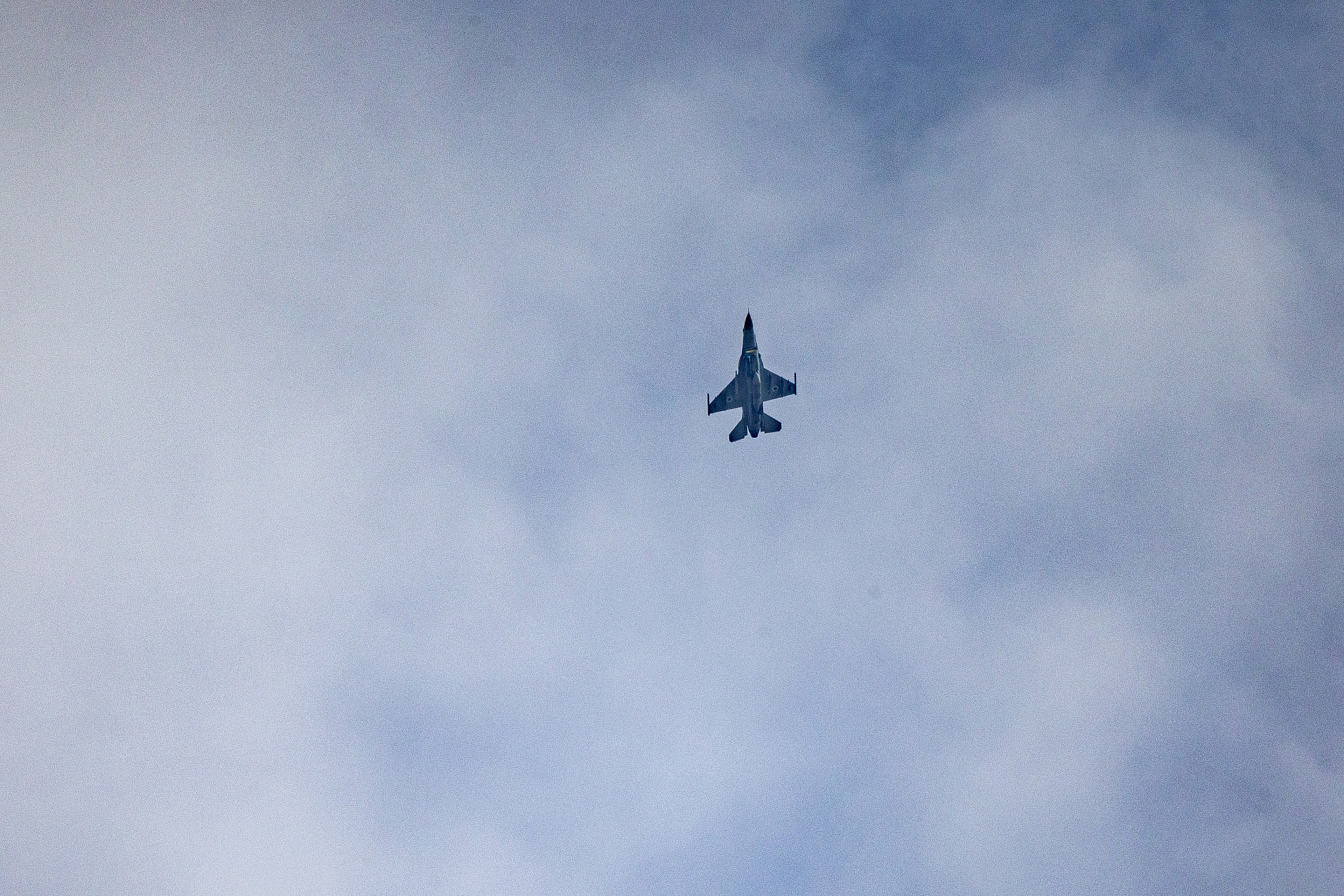
An Israeli warplane is seen flying above the Gaza Strip, November 13, 2023. (Yonatan Sindel/Flash90)
Israeli analysts have admitted that the military effectiveness of these kinds of disproportionate aerial attacks is limited. Two weeks after the start of the bombings in Gaza (and before the ground invasion) — after the bodies of 1,903 children, approximately 1,000 women, and 187 elderly men were counted in the Gaza Strip — Israeli commentator Avi Issacharoff tweeted: “As hard as it is to hear, on the 14th day of fighting, it does not appear that the military arm of Hamas has been significantly harmed. The most significant damage to the military leadership is the assassination of [Hamas commander] Ayman Nofal.”
‘Fighting human animals’
Hamas militants regularly operate out of an intricate network of tunnels built under large stretches of the Gaza Strip. These tunnels, as confirmed by the former Israeli intelligence officers we spoke to, also pass under homes and roads. Therefore, Israeli attempts to destroy them with aerial strikes are in many cases likely to lead to the killing of civilians. This may be another reason for the high number of Palestinian families wiped out in the current offensive.
The intelligence officers interviewed for this article said that the way Hamas designed the tunnel network in Gaza knowingly exploits the civilian population and infrastructure above ground. These claims were also the basis of the media campaign that Israel conducted vis-a-vis the attacks and raids on Al-Shifa Hospital and the tunnels that were discovered under it.
Israel has also attacked a large number of military targets: armed Hamas operatives, rocket launcher sites, snipers, anti-tank squads, military headquarters, bases, observation posts, and more. From the beginning of the ground invasion, aerial bombardment and heavy artillery fire have been used to provide backup to Israeli troops on the ground. Experts in international law say these targets are legitimate, as long as the strikes comply with the principle of proportionality.
In response to an enquiry from +972 and Local Call for this article, the IDF Spokesperson stated: “The IDF is committed to international law and acts according to it, and in doing so attacks military targets and does not attack civilians. The terrorist organization Hamas places its operatives and military assets in the heart of the civilian population. Hamas systematically uses the civilian population as a human shield, and conducts combat from civilian buildings, including sensitive sites such as hospitals, mosques, schools, and UN facilities.”
Intelligence sources who spoke to +972 and Local Call similarly claimed that in many cases Hamas “deliberately endangers the civilian population in Gaza and tries to forcefully prevent civilians from evacuating.” Two sources said that Hamas leaders “understand that Israeli harm to civilians gives them legitimacy in fighting.”
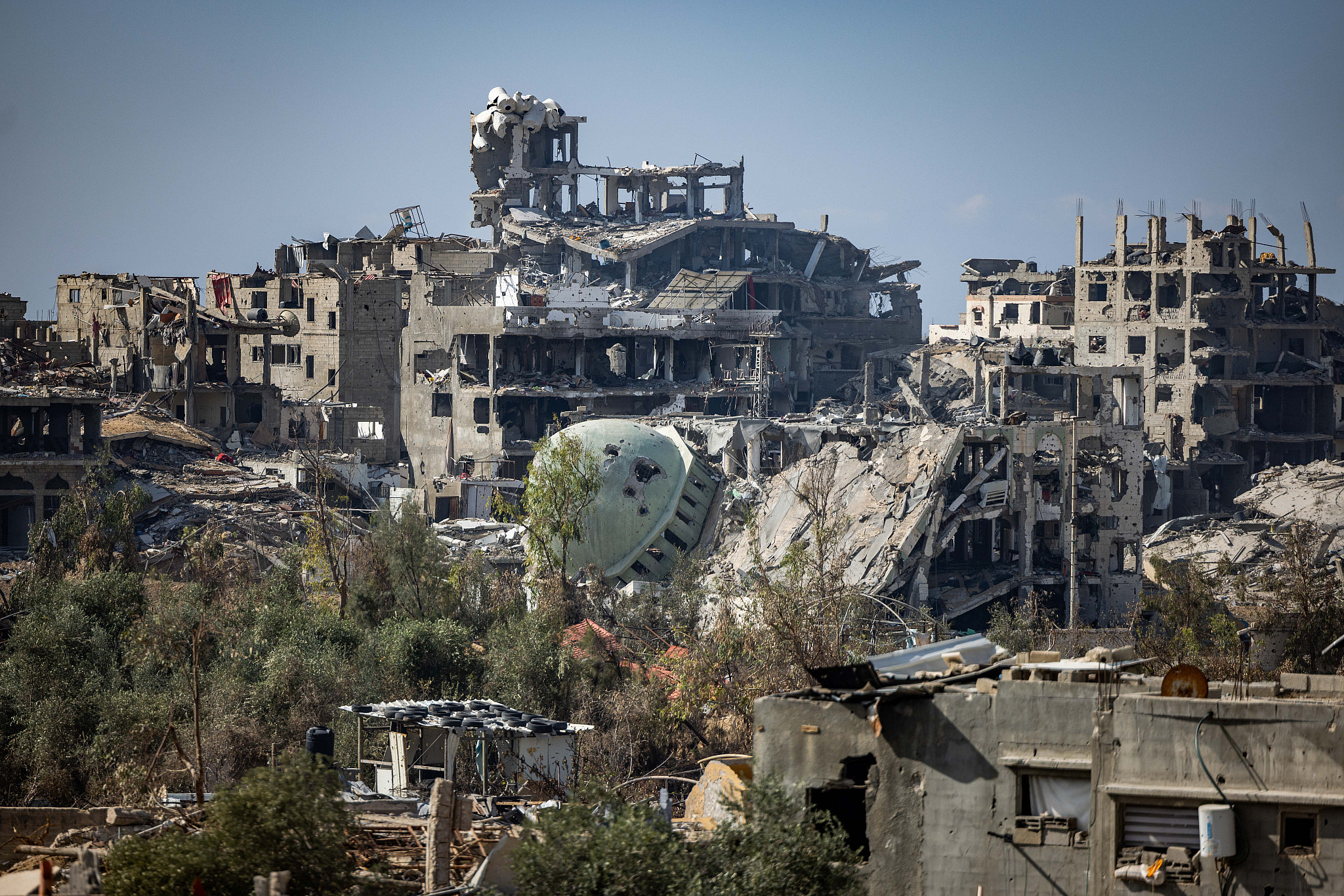
Destruction caused by Israeli bombings is seen inside Al-Shati refugee camp, northern Gaza Strip, November 16, 2023. (Yonatan Sindel/Flash90)
At the same time, while it’s hard to imagine now, the idea of dropping a one-ton bomb aimed at killing a Hamas operative yet ending up killing an entire family as “collateral damage” was not always so readily accepted by large swathes of Israeli society. In 2002, for example, the Israeli Air Force bombed the home of Salah Mustafa Muhammad Shehade, then the head of the Al-Qassam Brigades, Hamas’ military wing. The bomb killed him, his wife Eman, his 14-year-old daughter Laila, and 14 other civilians, including 11 children. The killing caused a public uproar in both Israel and the world, and Israel was accused of committing war crimes.
That criticism led to a decision by the Israeli army in 2003 to drop a smaller, quarter-ton bomb on a meeting of top Hamas officials — including the elusive leader of Al-Qassam Brigades, Mohammed Deif — taking place in a residential building in Gaza, despite the fear that it would not be powerful enough to kill them. In his book “To Know Hamas,” veteran Israeli journalist Shlomi Eldar wrote that the decision to use a relatively small bomb was due to the Shehade precedent, and the fear that a one-ton bomb would kill the civilians in the building as well. The attack failed, and the senior military wing officers fled the scene.
In December 2008, in the first major war that Israel waged against Hamas after it seized power in Gaza, Yoav Gallant, who at the time headed the IDF Southern Command, said that for the first time Israel was “hitting the family homes” of senior Hamas officials with the aim of destroying them, but not harming their families. Gallant emphasized that the homes were attacked after the families were warned by a “knock on the roof,” as well as by phone call, after it was clear that Hamas military activity was taking place inside the house.
After 2014’s Protective Edge, during which Israel began to systematically strike family homes from the air, human rights groups like B’Tselem collected testimonies from Palestinians who survived these attacks. The survivors said the homes collapsed in on themselves, glass shards cut the bodies of those inside, the debris “smells of blood,” and people were buried alive.
This deadly policy continues today — thanks in part to the use of destructive weaponry and sophisticated technology like Habsora, but also to a political and security establishment that has loosened the reins on Israel’s military machinery. Fifteen years after insisting that the army was taking pains to minimize civilian harm, Gallant, now Defense Minister, has clearly changed his tune. “We are fighting human animals and we act accordingly,” he said after October 7.
- October 2023 war
- Gaza
- Israeli airstrikes
- intelligence
- Israeli Air Force
- Israeli army
- IDF spokesperson
- Local Call
- civilian casualties

Yuval Abraham is a journalist and activist based in Jerusalem.
Our team has been devastated by the horrific events of this latest war – the atrocities committed by Hamas in Israel and the massive retaliatory Israeli attacks on Gaza. Our hearts are with all the people and communities facing violence.
We are in an extraordinarily dangerous era in Israel-Palestine. The bloodshed unleashed by these events has reached extreme levels of brutality and threatens to engulf the entire region. Hamas’ murderous assault in southern Israel has devastated and shocked the country to its core. Israel’s retaliatory bombing of Gaza is wreaking destruction on the already besieged strip and killing a ballooning number of civilians. Emboldened settlers in the West Bank, backed by the army, are seizing the opportunity to escalate their attacks on Palestinians.
This escalation has a very clear context, one that +972 has spent the past 13 years covering: Israeli society’s growing racism and militarism, the entrenched occupation, and an increasingly normalized siege on Gaza.
We are well positioned to cover this perilous moment – but we need your help to do it. This terrible period will challenge the humanity of all of those working for a better future in this land. Palestinians and Israelis are already organizing and strategizing to put up the fight of their lives.
Can we count on your support? +972 Magazine is the leading media voice of this movement, a desperately needed platform where Palestinian and Israeli journalists and activists can report on and analyze what is happening, guided by humanism, equality, and justice. Join us.
More About October 2023 war

‘It’s like living in a mortuary, waiting for someone to bury you’
By Mahmoud Mushtaha January 11, 2024

Will the ICJ find Israel guilty of genocide?
By Meron Rapoport January 11, 2024

How Israel’s emergency plans widened the south’s class divides
By Roy Cohen January 10, 2024
UK protests expose wide gulf between gov’t and public on Palestine
Hundreds of thousands in Britain have been mobilizing for a Gaza ceasefire, pushing back against efforts to smear them and restrict their civil liberties.
By Maria Rashed November 29, 2023
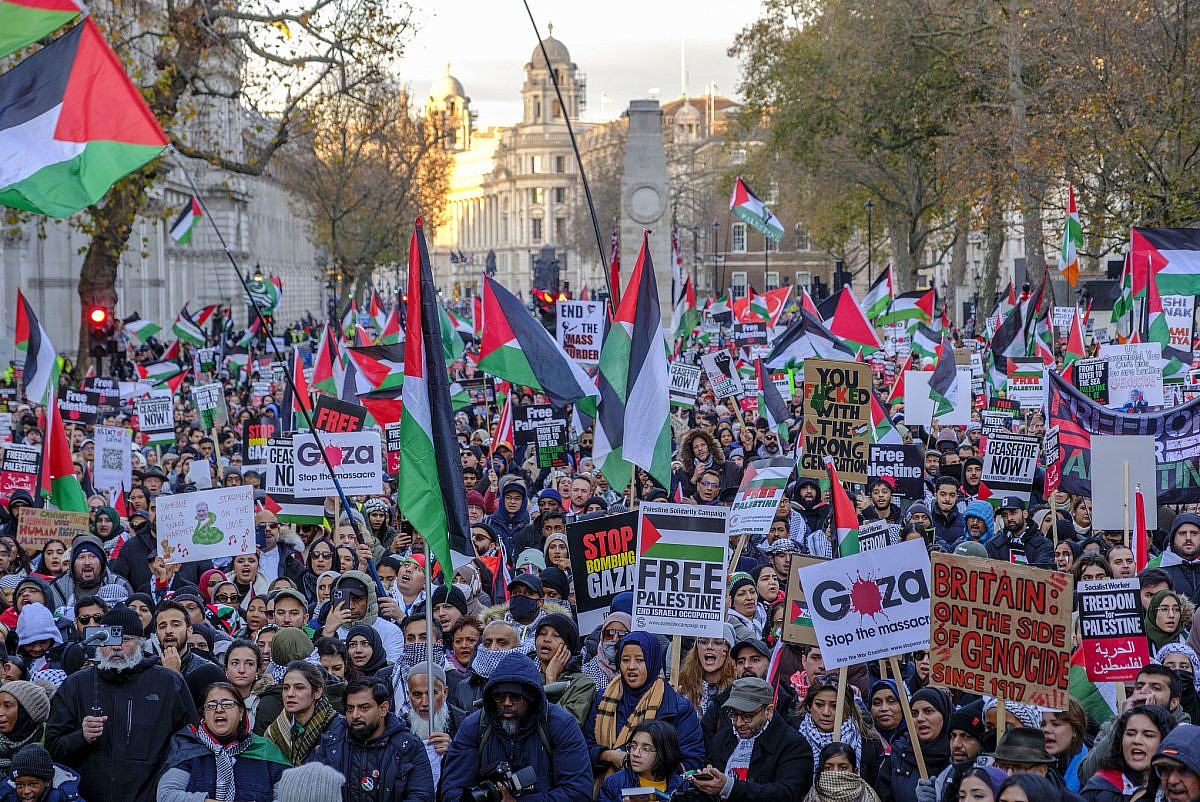
Hundreds of thousands march in support of Palestinians during a rally in London, November 25, 2023. (Jess Hurd)
To walk around London these days is to be immersed in a collective public awakening about the Palestinian struggle. Commuters and cafe-goers can suddenly be seen reading books by prominent Palestinian historians. Palestinian flags hang from apartment windows. Keffiyehs are now a common accessory.
For nearly two months, amid Israel’s ongoing bombardment of the Gaza Strip following Hamas’ October 7 assault on southern Israel, the British public has been mobilizing in unprecedented numbers in defense of Palestinian lives. Hundreds of thousands are taking to the streets every week to urge the UK government to call for a full ceasefire — which it is still refusing to do, even amid the current, temporary cessation of hostilities. Nonetheless, the reverberations are felt strongly in Westminster.
The biggest rally thus far took place in London on Nov. 11; police claimed an attendance of around 300,000, while organizers put the figure closer to 800,000. Either way, it was one of the largest demonstrations in UK history, and by far the biggest turnout for an issue that does not directly impact the lives of most of the protesters.
Subscribe to The Landline
+972’s weekly newsletter
Sign up
The record attendance was partly galvanized by Home Secretary Suella Braverman’s attempts in the preceding days to pressure police to cancel the demonstration, branding the protesters as “hate marchers” and accusing them of inciting antisemitism (Braverman was subsequently booted from the cabinet by Prime Minister Rishi Sunak). Yet anyone who has been to one of the demonstrations in the UK’s capital will attest that they are overwhelmingly peaceful, with many families in attendance as well as people from various ethnicities and backgrounds, including queer and Jewish communities.
Organizing such massive demonstrations is no mean feat. The main force behind the protests is the Palestine Solidarity Campaign (PSC), in collaboration with other organizations including Stop the War Coalition, the Muslim Association of Britain, and Friends of Al Aqsa. These groups have also been using social media to pressure members of Parliament (MPs) to call for a ceasefire and to amplify their protests to a global audience.
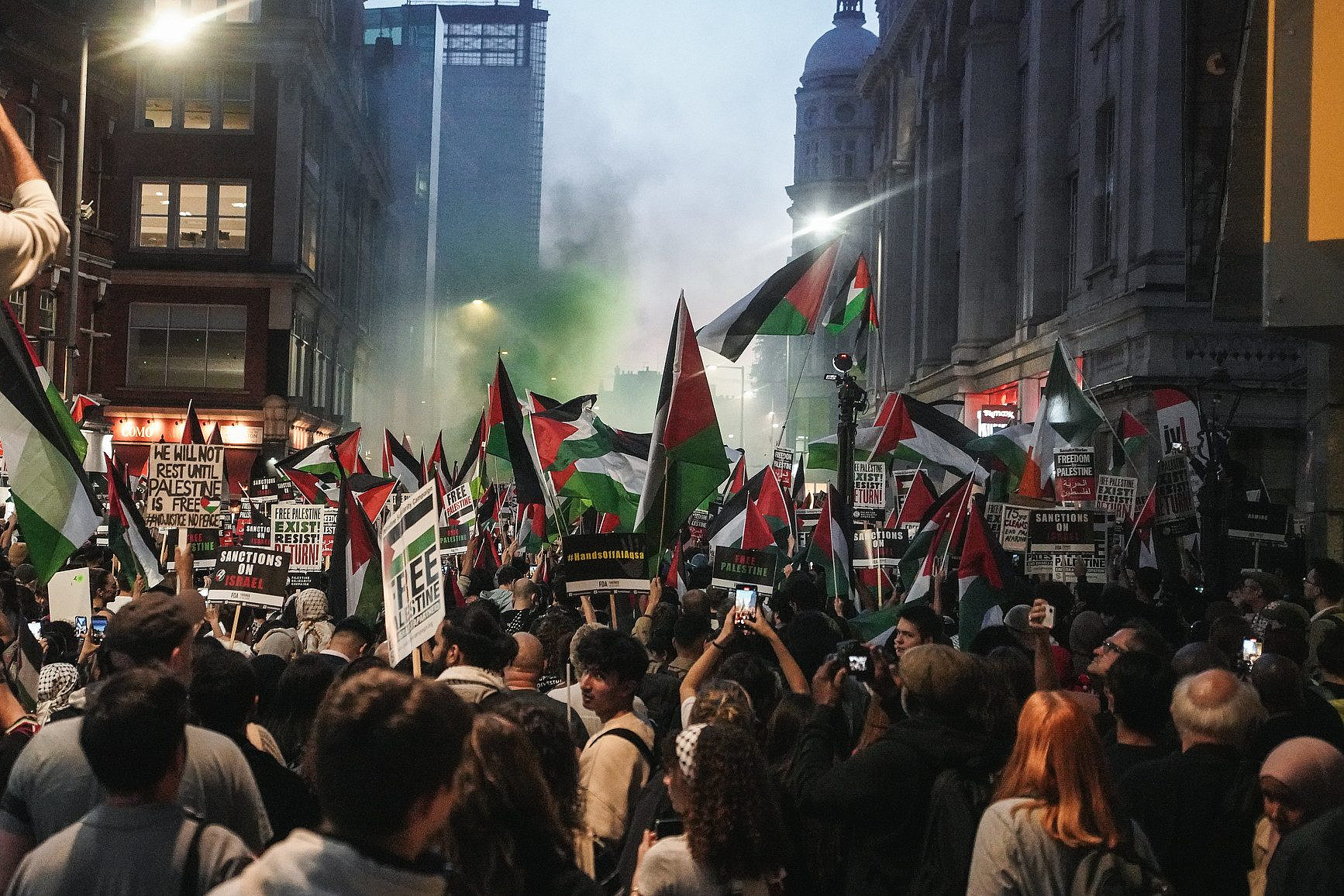
Thousands march through the streets in London in opposition to Israel’s bombardment of Gaza, October 13, 2023. (Alisdare Hickson/CC BY-SA 2.0 DEED)
“We’ve received a lot of support,” Ben Jamal, the 60-year-old British Palestinian activist who heads PSC, told +972. “People witness the brutality and dehumanization of Palestinians, and it compels them to demand a ceasefire. Recent weeks have demonstrated that the public is ready to march and express support for Palestine.”
Until now, however, both the Conservative government and the Labour Party opposition are resisting the public pressure, insisting — in line with U.S. President Joe Biden — on the need for “humanitarian pauses” rather than a full ceasefire, and affirming Israel’s right to self-defense. On Nov. 15, MPs voted overwhelmingly to oppose an immediate ceasefire, despite something of a rebellion within the Labour Party. But protest organizers are vowing to continue mobilizing public pressure so long as Israel’s bombardment of Gaza continues, even as the government attempts to restrict Brits’ right to protest.
Cracking down
Ever since the Hamas attacks of October 7, which killed around 1,200 Israelis and saw over 240 kidnapped to Gaza, the UK government has been unwavering in its support for Israel’s assault on the besieged Strip — an assault that, at the time of this writing, has killed more than 14,500 Palestinians, two-thirds of them women and children.
Within a week of the start of the war, the UK deployed surveillance aircraft and naval forces to the Eastern Mediterranean, ostensibly to deter a broader regional conflagration. On Oct. 19, Prime Minister Sunak visited Israel and told his counterpart Benjamin Netanyahu: “We want you to win.” In Parliament a week later — by which time Israel had killed close to 7,000 Palestinians in Gaza — Sunak stated: “From the start, we have said that the first and most important principle is that Israel has the right to defend itself.”
At the same time, the government has sought to restrict demonstrations expressing solidarity with Palestinians. After then-Foreign Secretary James Cleverly urged those planning to protest to stay at home rather than “cause distress,” Braverman (whom Cleverly has since replaced as home secretary) recommended that police clamp down on the waving of Palestinian flags — which they have so far refrained from doing. The UK’s immigration minister, Robert Jenrick, also instructed the Home Office to explore the possibility of revoking the visas of foreign students and workers who “praise Hamas.”
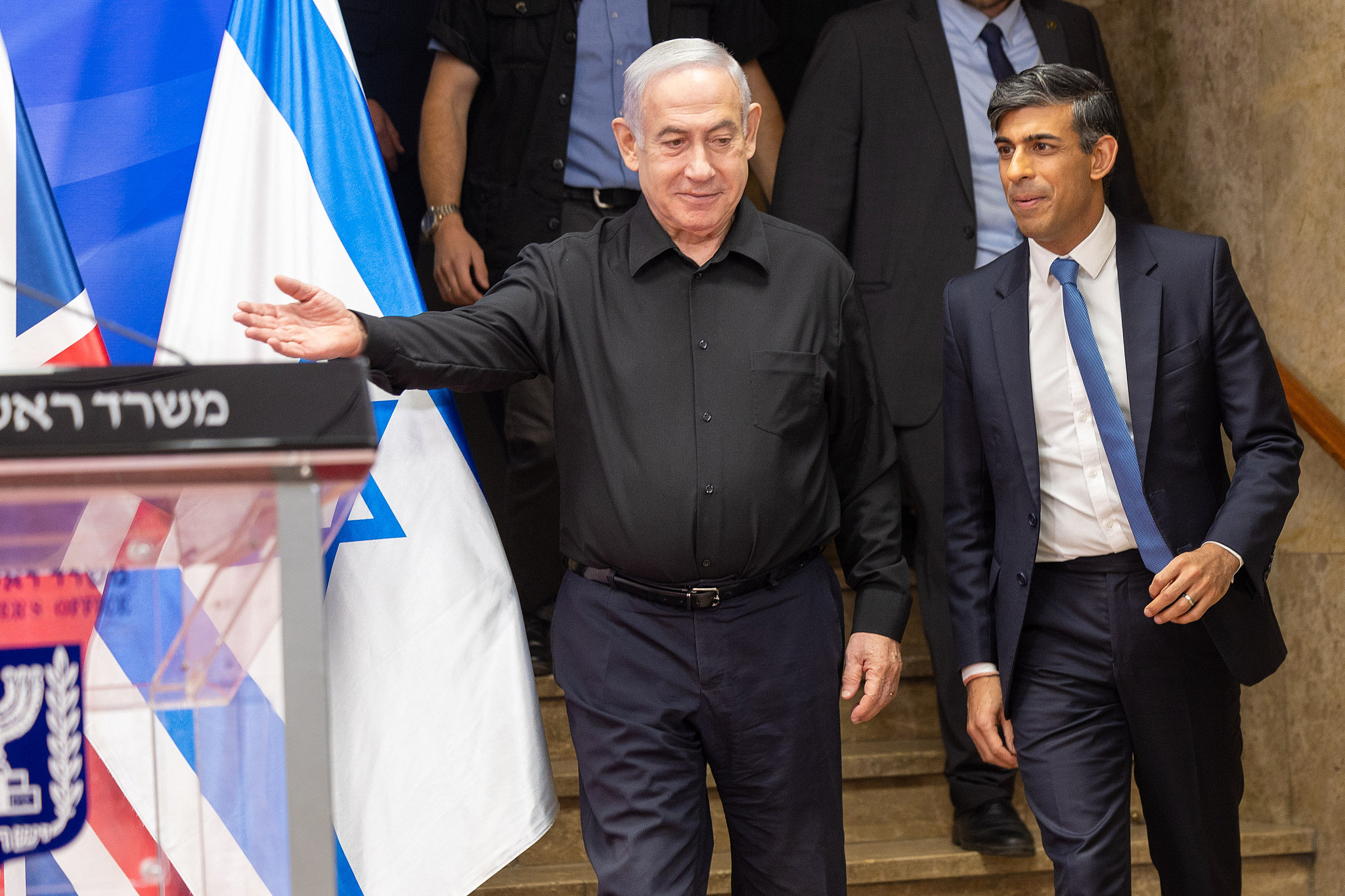
British Prime Minister Rishi Sunak meets Israeli Prime Minister Benjamin Netanyahu in Jerusalem, October 19, 2023. (Simon Walker/No. 10 Downing Street/CC BY 2.0 DEED)
In addition, government officials are seeking to broaden the definition of extremism to include “undermining” British policy and values — a legal move civil rights groups see as a direct threat to freedom of speech — while police are increasing surveillance of schoolchildren.
In order to ensure that the voice of solidarity remains strong despite the threat of governmental repression, PSC has been working closely with legal experts, including those at the European Legal Support Center (ELSC). Alice Garcia, the organization’s advocacy and communication officer, explained that the British government is increasingly “putting a lot of effort into restricting and criminalizing” the right to protest on baseless or trivial grounds.
“People have been arrested for seemingly harmless acts,” she said, noting that a former senior Amnesty International official was arrested for holding a satirical placard. The former home secretary, Garcia continued, “inflamed tensions by spreading a false and distorted picture of the protests” — a strategy “aimed at silencing discussions and advocacy for the Palestinian cause.” Nonetheless, she added, “civic society continues to resist.”
The UK-based human rights organization Liberty has also been defending protesters’ rights. Katy Watts, a lawyer with the organization, explained that the government’s threats — which may violate the UK’s obligations under the European Convention on Human Rights — have generated widespread discord and confusion. As a result, Liberty has been receiving a large number of requests for legal information from individuals who are hesitant to join demonstrations.
“We are emphasizing [to protesters] that displaying a Palestinian flag is not a criminal offense,” Watts said. “These protests have been peaceful, with minimal arrests, and the organizers have been working with the police to address concerns and allow peaceful demonstrations to proceed.”
Pushing back
Many of the British politicians and media commentators who oppose the demonstrations have claimed that the rallies are hotbeds of antisemitism. The month of October indeed saw a record number of anti-Jewish hate crimes in the UK (though, it should be noted, these figures include incidents such as the ripping down of posters raising awareness about Israeli hostages taken by Hamas, which many see as an anti-Israel thought not inherently antisemitic act). Yet there has been a significant Jewish presence at each of the mass pro-Palestine demonstrations in recent weeks, and Jewish activists are stressing that there is nothing antisemitic about calling for a ceasefire.
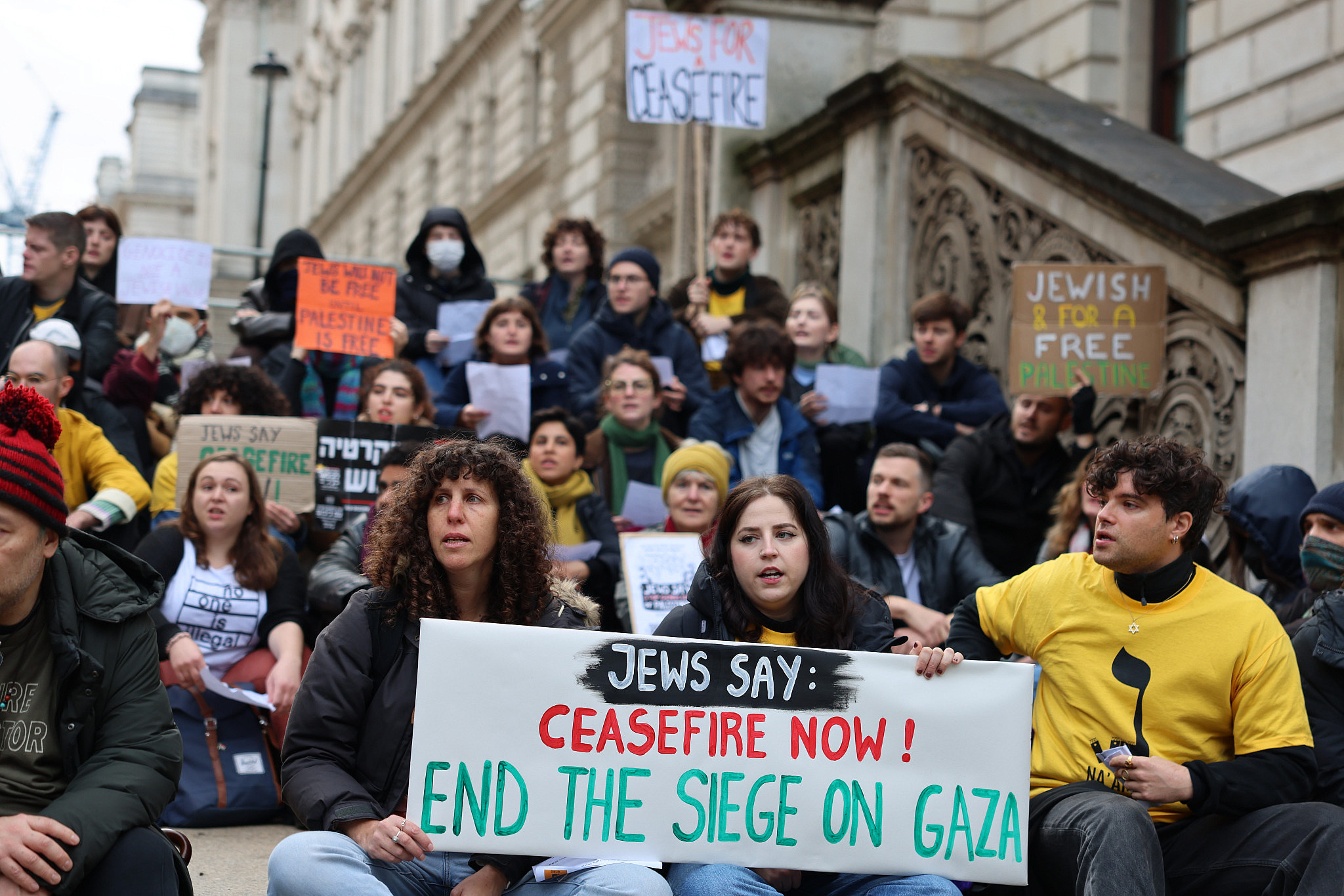
Activists join a sit-in organized by Na’amod: British Jews Against Occupation outside the UK Foreign, Commonwealth and Development Office in London to demand a ceasefire in Gaza, October 31, 2023. (Jacob Lazarus)
“As a Jewish person, it has been challenging,” said Em Hilton, a 32-year-old organizer, campaigner, and co-founder of Na’amod: British Jews Against Occupation. “There’s a need to distinguish criticism of Israel from antisemitism,” she continued, emphasizing that the rise in the latter phenomenon “is horrific, and holding Jews worldwide responsible for Israel’s actions is never acceptable.”
With that said, “the issue of Palestine has arguably always had a lot of support from the [British] public,” Hilton went on, highlighting the “stark contrast” between the growing empathy for Palestinians across the UK and the government’s staunch pro-Israel position. The government, she added, must listen to the public outcry — which has intensified with the growing Palestinian death toll in Gaza — and prioritize an end to the war alongside the release of the Israeli hostages and a negotiated political solution.
Support for Palestine has also been strong among the UK’s queer community. “There is a significant gap between public sentiment, which largely supports a ceasefire and condemns oppression, and the positions taken by the government,” said Jess (who requested to be referred to only by their first name), a member of The Dyke Project, a London-based queer collective that is urging the UK to acknowledge its complicity in the Israeli occupation.
In late October, The Dyke Project replaced advertisements on public transportation with testimonies from queer Palestinians in Gaza — an initiative, Jess explained, that “aimed to dismantle pinkwashing, the process by which the Israeli government presents itself as LGBTQ+ friendly in order to deflect criticism of its treatment of Palestinians. We don’t want to allow this narrative to be enacted in our name.”

Protesters at a march in support of Palestinians in London, November 25, 2023. (Jess Hurd)
A central goal of the group’s actions is to deepen people’s understanding that different struggles against oppression are interconnected. “We encourage queer individuals to recognize the Palestinian cause as their own, to stand for justice, and to not be swayed by misleading portrayals. We stand against all forms of oppression,” said Jess.
Hazem Jamjoum, a Palestinian translator and archivist living in London, believes that people in the UK are feeling betrayed by the impunity that their government and other major powers are granting to Israel to commit atrocities in Gaza. “After two months of undeniable war crimes, requesting a ceasefire is being treated as controversial and almost antisemitic,” he said.
Elaborating on the conflation of pro-Palestine protests and antisemitism, Jamjoum emphasized that “Jewish communities worldwide are [also] shocked by Israel’s actions in the name of Judaism,” and stressed the need to educate people about the history of Zionism.
Most read on +972

Inside Israel’s torture camp for Gaza detainees

‘A mass assassination factory’: Inside Israel’s calculated bombing of Gaza

The ‘mistaken’ killing of three Israeli hostages was a tragedy long foretold
The branding of those working to hold the State of Israel to account as antisemites, he added, allows actual antisemites to operate freely. “The spaces where we’re seeing genuine action to fight antisemitism, and fascism more broadly, is in the anti-Zionist movement. This has been the case for decades.”
And for Jamjoum, the crackdown on protesters’ rights is one of the factors that has, ironically, brought so many people out to the streets in the UK. “People can no longer take democracy for granted,” he explained, with the same dynamic now arising in the United States, Canada, Australia, and much of Europe. In this regard, while Palestine is an excuse for right-wing governments to crack down on civil liberties, it is simultaneously a vehicle with which people worldwide are pushing back.
Maria Rashed is a Palestinian journalist and period activist from Nazareth, currently pursuing her Master’s in Entrepreneurship at Goldsmith University in London.
Our team has been devastated by the horrific events of this latest war – the atrocities committed by Hamas in Israel and the massive retaliatory Israeli attacks on Gaza. Our hearts are with all the people and communities facing violence.
We are in an extraordinarily dangerous era in Israel-Palestine. The bloodshed unleashed by these events has reached extreme levels of brutality and threatens to engulf the entire region. Hamas’ murderous assault in southern Israel has devastated and shocked the country to its core. Israel’s retaliatory bombing of Gaza is wreaking destruction on the already besieged strip and killing a ballooning number of civilians. Emboldened settlers in the West Bank, backed by the army, are seizing the opportunity to escalate their attacks on Palestinians.
This escalation has a very clear context, one that +972 has spent the past 13 years covering: Israeli society’s growing racism and militarism, the entrenched occupation, and an increasingly normalized siege on Gaza.
We are well positioned to cover this perilous moment – but we need your help to do it. This terrible period will challenge the humanity of all of those working for a better future in this land. Palestinians and Israelis are already organizing and strategizing to put up the fight of their lives.
Can we count on your support? +972 Magazine is the leading media voice of this movement, a desperately needed platform where Palestinian and Israeli journalists and activists can report on and analyze what is happening, guided by humanism, equality, and justice. Join us.
More About October 2023 war
‘It’s like living in a mortuary, waiting for someone to bury you’
By Mahmoud Mushtaha January 11, 2024
Will the ICJ find Israel guilty of genocide?
By Meron Rapoport January 11, 2024
How Israel’s emergency plans widened the south’s class divides
By Roy Cohen January 10, 2024
Israeli arrogance thwarted a Palestinian political path. October 7 revealed the cost
A Fatah-Hamas agreement in 2021 offered a different political horizon. But success blinded Israel — just as it did before the 1973 war.
By Menachem Klein November 28, 2023
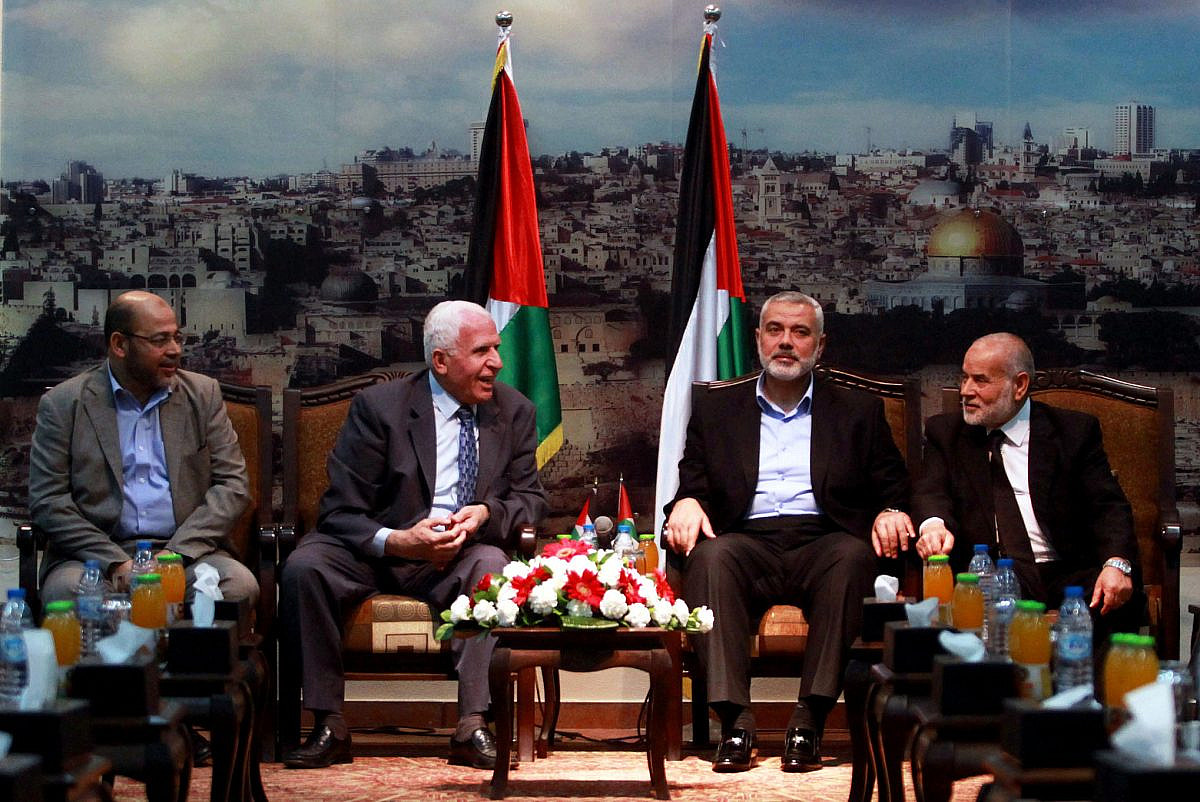
(Left to Right) Hamas leader Moussa Abu Marzouk, Fatah official Azzam Al-Ahmed, Hamas leader Ismail Haniyeh, Fatah official Ahmed Bahar attend a meeting in Gaza City, April 22, 2014. (Abed Rahim Khatib/Flash90)
In partnership with
In February and March 2021, Fatah and Hamas, the two rival Palestinian political parties, reached an agreement to hold elections for the presidency of the Palestinian Authority, its Legislative Council, and Hamas’ entry into the Palestine Liberation Organization (PLO). The elections were planned to take place in accordance with the Oslo Accords, after which negotiations would continue with Israel toward the establishment of a Palestinian state.
The agreement included a commitment to uphold international law, establish a state within the 1967 borders with East Jerusalem as its capital, recognize the PLO as the legitimate and exclusive umbrella framework, conduct a peaceful popular struggle, and transfer the separate government in the Gaza Strip to the Palestinian Authority.
President Mahmoud Abbas sent the agreement to the new Biden administration and European governments in the hope that they would support holding national elections with Hamas’ participation, and would then pressure Israel to allow voting across the occupied territories, including in East Jerusalem. In Abbas’ eyes at the time, Hamas’ signing of the deal was a winning card; apparently, it included a concession by Hamas not to put forward a presidential candidate on its behalf, thus leaving it to Abbas to run again virtually unchallenged.
Subscribe to The Landline
+972’s weekly newsletter
Sign up
The Fatah-Hamas agreement did not come out of the blue. Four years earlier, Hamas published its “General Principles and Policies,” a revised organizational document that significantly deviated from the fundamentalist principles of the group’s original charter from 1987, and that effectively accepted the Oslo Accords as an existing political fact. Even earlier, in 2014, in the presence and mediations of the Emir of Qatar in Doha, the Fatah leadership headed by Abbas met with the Hamas leadership headed by Khaled Mash’al. The full minutes of the talks were published in an official Emirati document. In essence, the message of the Hamas leadership was clear: “If you in Fatah are convinced that you can get a state from Israel along the 1967 lines through negotiations, go for it. We will not interfere.”
As expected, Israel objected to including East Jerusalem in the elections, seeing it as undermining its claims to sovereignty over the occupied and annexed part of the city. Still, Hamas offered to hold the elections anyway, and accepted the restriction imposed by Israel. But Israel and the United States exerted heavy pressure on Abbas to cancel them all the same.
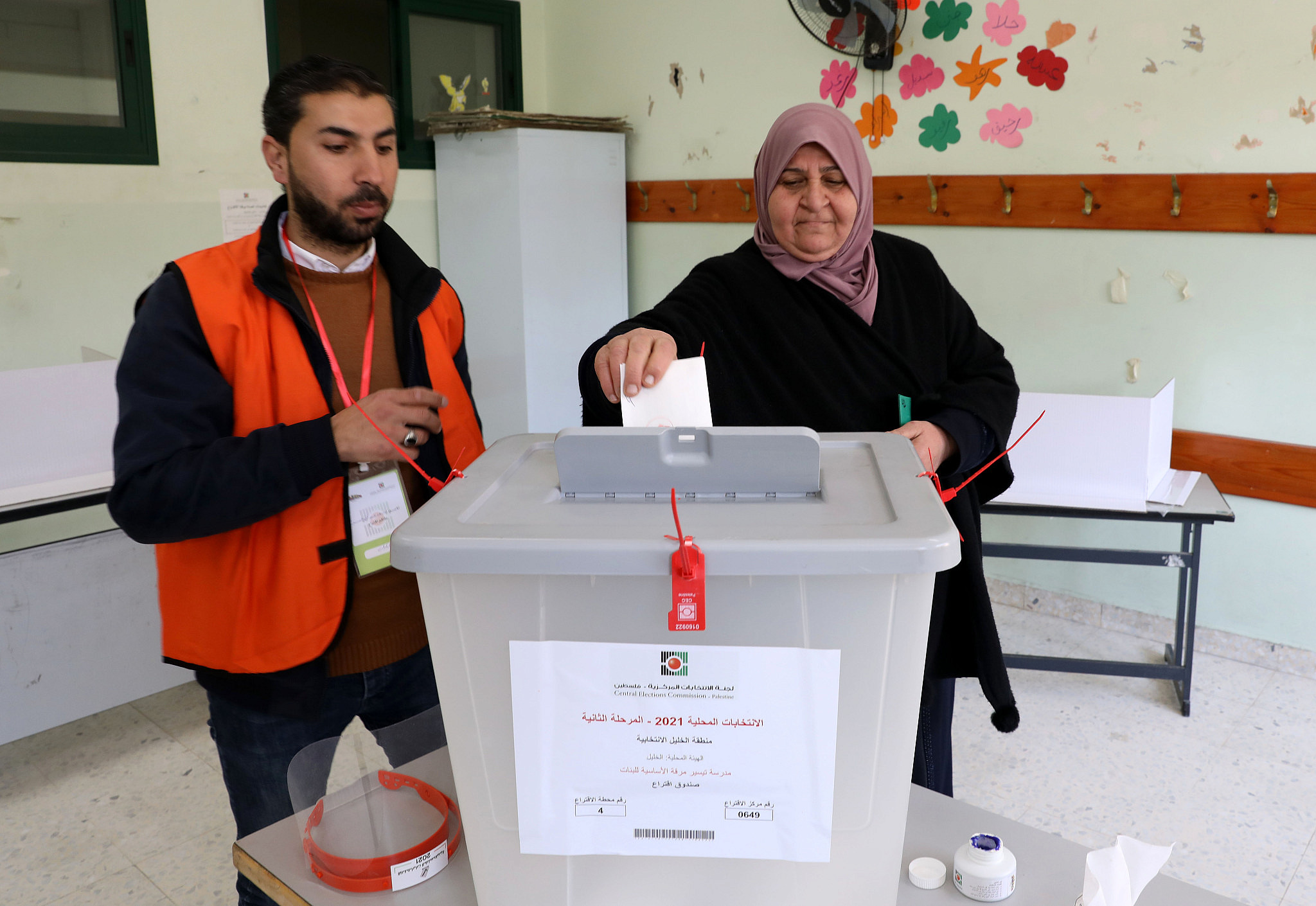
Palestinians vote during the Palestinian local elections, in the West Bank city of Hebron, March 26, 2022. (Wisam Hashlamoun/Flash90)
There were certainly political reasons for Abbas to call off the elections and for Hamas to push for them. Public opinion polls showed that the vast majority of Palestinians wanted Abbas to end his tenure, and that Hamas could stand to win another electoral victory. However, those polls also indicated that Marwan Barghouti, the prominent political prisoner who intended to run from his Israeli jail cell, would win over any other presidential candidate. Had elections not been canceled, and a popular leader emerged democratically, we would likely be in a very different political reality.
In the end, Abbas capitulated under severe pressure. The “Unity Intifada” began a few days later, and with it, Hamas’ Operation “Sword of Jerusalem” and Israel’s “Operation Guardian of the Walls.” According to reports in the New York Times and Washington Post, it was around that same time that Al-Aqsa Brigades, Hamas’ military wing, began conceiving and planning what would become “Al-Aqsa Flood” — the murderous assault of October 7.
‘Never been better’
As many have raised, there are quite a few parallels between last month’s assault and the surprise attack on Israel that happened five decades earlier, in the Yom Kippur War. Operationally, in both 1973 and 2023, Israel’s intelligence chiefs did not pay enough attention to their enemies’ military movements on the ground. Strategically, a neighboring Arab state had sent Israel an alert that was not taken seriously: in 1973, it was Jordan’s King Hussein, and in 2023, Egyptian intelligence. Yet in both cases, the Israeli establishment arrogantly relied on a misconception that its military victories had successfully deterred its enemies.
After each assault, however, everything changed. Despite losing militarily, the achievements of Egypt and Syria in the 1973 war “restored Arab honor,” according to the Egyptian narrative, reclaiming some of what had been lost in Israel’s victory in the 1967 war. Similarly, last month’s Hamas offensive hit Israel at a scale and intensity that no other Palestinian organization has ever done. And Israel will not be able to erase this fact.
As in 1973, the fundamental failure of October 7 was political. In 1971, two years before the war, Egyptian President Anwar Sadat proposed a partial arrangement with Israel, in which the latter would withdraw some 30 kilometers from the Suez Canal to the Mitla Strait and the strategic ridge of Um Hashiba. The Suez would be opened for international navigation, and Egyptian cities on the western side of the Canal that were destroyed by Israeli shelling during the “war of attrition” after 1967 would be rehabilitated. A small number of Egyptian troops would also move to the area from which Israel would withdraw to symbolize the return of Egyptian sovereignty. This arrangement, in turn, would serve as a link toward a more comprehensive agreement based on UN Security Council Resolution 242.
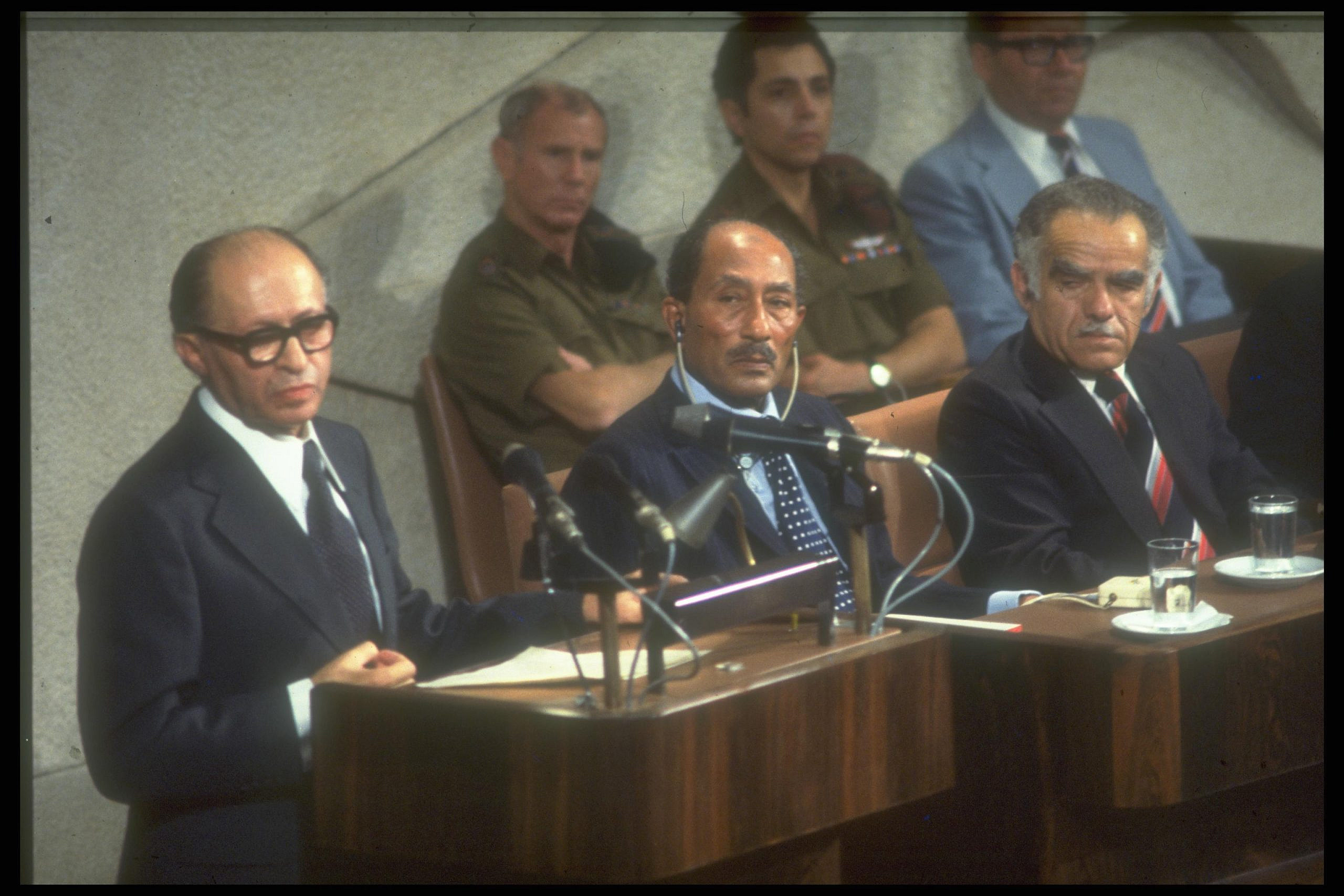
Israeli Prime Minister Menachem Begin alongside Egyptian President Anwar Sadat in the Isralei Knesset, November 20, 1977. (Ya’acov Sa’ar/GPO)
With this proposal — which roughly corresponded to Israeli Defense Minister Moshe Dayan’s ideas at the time — Sadat tried to break the diplomatic deadlock in the region. But Prime Minister Golda Meir did not trust Sadat and his stated goal of peace, even though U.S. Secretary of State William Rogers was convinced of his sincerity. In Meir’s view, there was no difference between Sadat and his predecessor, the pan-Arab nationalist Gamal Abdel Nasser, and both in her eyes simply wanted to destroy Israel. Meir remained stubborn, Dayan relented, and Rogers returned to Washington empty-handed.
After the terrible war, in which over 2,600 Israelis were killed and 300 soldiers were captured, Israel signed an armistice agreement with Egypt in 1974, the terms of which bore remarkable resemblance to Sadat’s 1971 proposal.
When Meir first rejected Sadat’s overtures in 1971, she, like much of the Israeli establishment after the Six-Day War, believed that the country’s position “has never been better.” Indeed, this was actually the slogan of the ruling Alignment party (an incarnation of the founding Labor party) ahead of elections which were supposed to take place in late 1973.
The same arrogance was evident in 2021, when Israel opposed Palestinian elections and pressured Abbas to drop his dealings with Hamas. Netanyahu, like Meir, believed that the government’s policies were successful, and that allowing elections and reorganizing of the Palestinian political leadership would destroy everything Israel had built. Success blinded Israel, and as in 1973, it thought it had never been better.
Returning to the 2021 outline
Since 2006, Israel’s policy toward the Palestinians has consisted of three key components, all supported by the United States and European countries. First, Israel will have total control over the Gaza Strip from the outside, ensuring the physical, legal, and political separation of Gaza from the West Bank, and the maintenance of the rivalry between Fatah and Hamas. In this context, Israel tried to tame Hamas by allowing foreign funding to help it hold the reins of power, along with periodic military strikes to curb its power and force it to abide by the Israeli order.
Second, Israel preferred to manage the conflict with the Palestinians as a whole rather than resolving it. In fact, along with the expansion of West Bank settlements, Israel created a single regime with its supremacy between the Jordan River and the Mediterranean Sea, and turned the PA into a subcontractor that controls the Palestinians on its behalf.
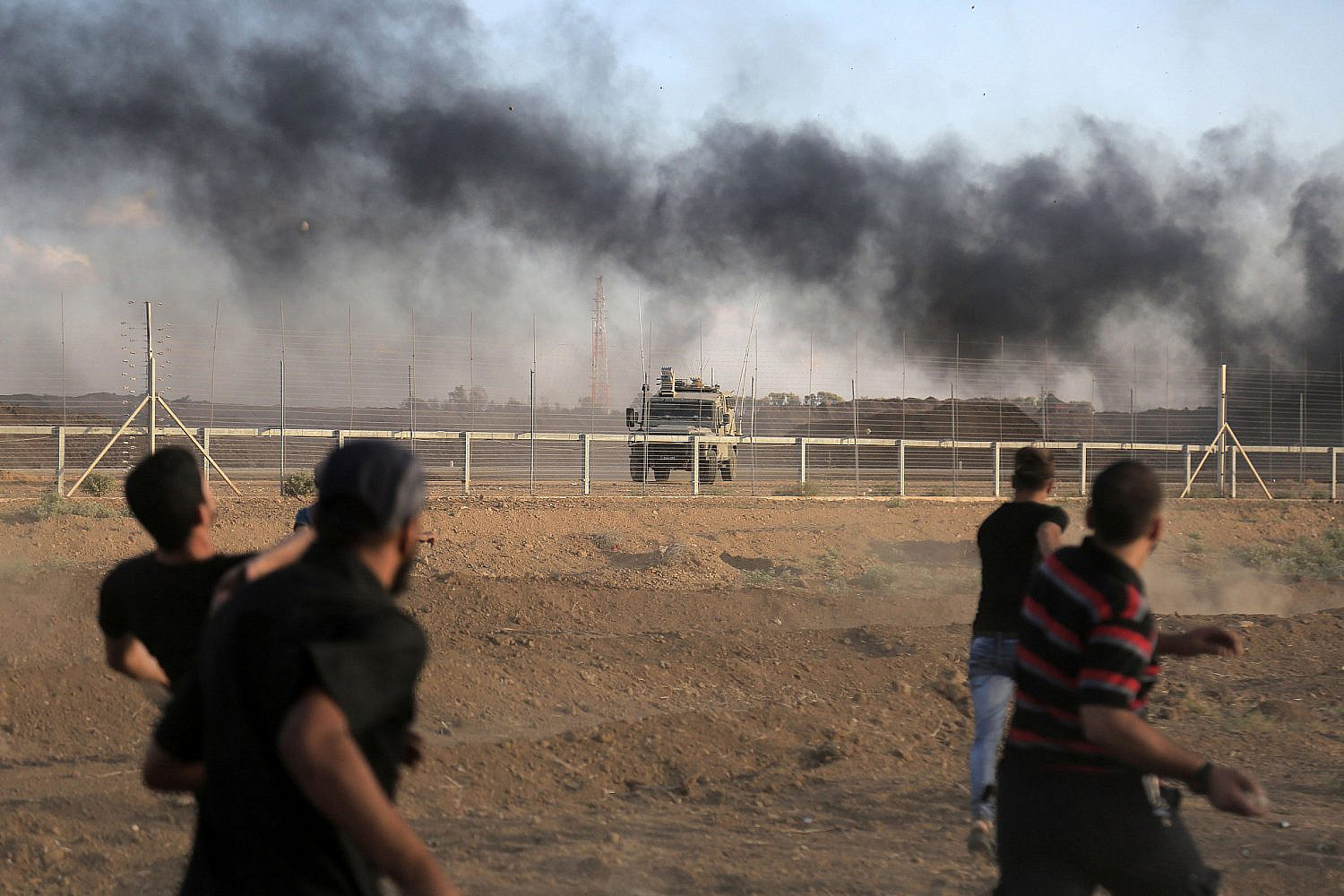
Palestinian protesters throw stones toward an Israeli military jeep, during the 24th “Great March of Return” Friday demonstration near the fence separating Israel from the Gaza Strip, September 7, 2018. (Mohammed Zaanoun/Activestills)
Third, Israel has worked to significantly reduce the wider Israeli-Arab conflict through normalization agreements with Arab states and to leave the Palestinians isolated and weak. The signing of the Abraham Accords was in effect a declaration of the abandonment of the Palestinians to Israel’s mercy.
Just when Israel’s policy was about to reach the peak of its success, through a normalization agreement with Saudi Arabia and the completion of a sophisticated wall around the Gaza Strip, everything collapsed on October 7, at terrible human cost to Israelis and Palestinians. And it could have been different.
It was not only Netanyahu who shaped Israeli policy. Since 2006, Israel’s political and security establishments — all their politicians, generals, and intelligence chiefs — have been full partners in formulating and implementing the now-collapsed approach. Many of them still do not grasp the extent to which Hamas’s bloody offensive requires a drastic change of direction. Rather, they seek to return to the previous principles and find a subcontractor to manage the Gaza Strip on Israel’s behalf, whether it be some local entity, Abbas’ PA or an international body. But no such entity can function without legitimacy granted to it by Palestinian elections; otherwise, it would simply be perceived as an illegitimate collaborator with the cruel occupier.
In other words, we must return to the political outline that was rejected in 2021 in order to create a new reality. Elections are not only about producing results, but about providing a process for parties to renew themselves and their politics. Beyond a ceasefire, we need Palestinian elections as a game changer that can lead to an independent Palestine over all of 1967-occupied territories, instead of replicating the failed order that Israel imposes in the West Bank onto the Gaza Strip.
Most read on +972
Inside Israel’s torture camp for Gaza detainees
‘A mass assassination factory’: Inside Israel’s calculated bombing of Gaza
The ‘mistaken’ killing of three Israeli hostages was a tragedy long foretold
This is the framework that must be set against the Israeli far right, which sees an opportunity in this moment. The far right does not want to return to the preceding arrangements, but rather establish a new, cruel order as consequential as the Nakba of 1948, starting with the Gaza Strip: exile as many Palestinians from Gaza as possible; build settlement cities including the re-building of those evacuated in 2005; then, implement the same plan in the West Bank with the same ferocity.
History has precedents for deterring this terrible path. In 1973-4, it was Henry Kissinger, the U.S. Secretary of State, who pushed Israel to refrain from decimating an Egyptian military unit, thwarting an Israeli attempt to renew the fighting with Egypt once the ceasefire was implemented; it was he, too, who oversaw the signing of two interim agreements between Israel and Egypt. These paved the way for Sadat’s trip to Jerusalem in 1977, and a peace settlement brokered by President Jimmy Carter in 1978-9.
Is there now an American entity of similar weight and willpower to do the same between Israel and the Palestinians?
A version of this article was first published in Hebrew on Local Call. Read it here.
- October 2023 war
- Hamas
- Fatah
- Palestinian Authority
- Palestinian elections
- Egypt
- yom kippur war
- United States
Menachem Klein is professor of Political Science at Bar Ilan University. He was an advisor to the Israeli delegation in negotiations with the PLO in 2000 and was one of the leaders of the Geneva Initiative. His new book, Arafat and Abbas: Portraits of Leadership in a State Postponed, was just published by Hurst London and Oxford University Press New York.
Our team has been devastated by the horrific events of this latest war – the atrocities committed by Hamas in Israel and the massive retaliatory Israeli attacks on Gaza. Our hearts are with all the people and communities facing violence.
We are in an extraordinarily dangerous era in Israel-Palestine. The bloodshed unleashed by these events has reached extreme levels of brutality and threatens to engulf the entire region. Hamas’ murderous assault in southern Israel has devastated and shocked the country to its core. Israel’s retaliatory bombing of Gaza is wreaking destruction on the already besieged strip and killing a ballooning number of civilians. Emboldened settlers in the West Bank, backed by the army, are seizing the opportunity to escalate their attacks on Palestinians.
This escalation has a very clear context, one that +972 has spent the past 13 years covering: Israeli society’s growing racism and militarism, the entrenched occupation, and an increasingly normalized siege on Gaza.
We are well positioned to cover this perilous moment – but we need your help to do it. This terrible period will challenge the humanity of all of those working for a better future in this land. Palestinians and Israelis are already organizing and strategizing to put up the fight of their lives.
Can we count on your support? +972 Magazine is the leading media voice of this movement, a desperately needed platform where Palestinian and Israeli journalists and activists can report on and analyze what is happening, guided by humanism, equality, and justice. Join us.
More About October 2023 war
‘It’s like living in a mortuary, waiting for someone to bury you’
By Mahmoud Mushtaha January 11, 2024
Will the ICJ find Israel guilty of genocide?
By Meron Rapoport January 11, 2024
How Israel’s emergency plans widened the south’s class divides
By Roy Cohen January 10, 2024
Ceasefire reveals the toll of devastation in Khan Younis
Palestinians are using the lull in fighting to stock up on supplies and check on their homes and families throughout Gaza. For many, it’s terrible news.
By Ruwaida Kamal Amer November 28, 2023
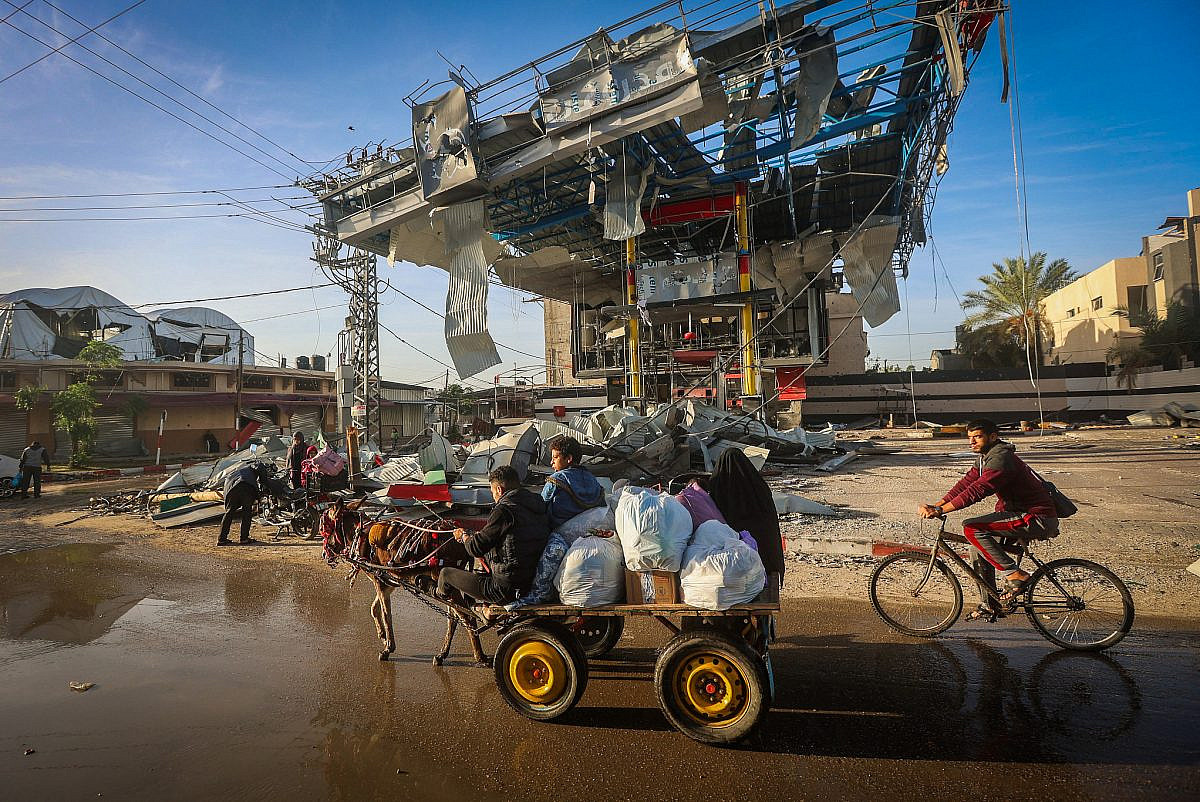
Palestinians returning to their homes during a ceasefire, east of Khan Younis, in the southern Gaza Strip, November 24, 2023. (Atia Mohammed/Flash90)
After 47 days of continuous bombing and destruction, the news that Israel and Hamas had reached a temporary ceasefire agreement was met with cautious relief here in Khan Younis, in the southern Gaza Strip. Since 7 a.m. on Friday, Nov. 24, life has slowly begun to return to something resembling how it looked before the war, with families leaving their homes and shelters for the first time in weeks to check on their relatives or to try and find cooking gas and food. But the relief also brings sorrow and anxiety, as people face up to the scale of the devastation caused by Israel’s bombardment — including the loss of loved ones and homes.
Khan Younis has become heavily overcrowded in recent weeks amid an influx of displaced people from the north, which Israeli troops have invaded, and the areas in the east close to the fence that encages Gaza, which have faced intensive airstrikes and shelling since the beginning of the war. As a result, the city’s population has tripled to approximately 700,000, with residents new and old seeking shelter in hospitals, schools managed by the government and the UN Relief and Works Agency (UNRWA), and the homes of friends and relatives.
Conditions in the city in recent weeks have been incredibly difficult. The roads in the city center are badly damaged, and getting around by car is almost impossible. The markets long ago ran out of food, and we have also faced severe water shortages. Although the temporary ceasefire has allowed for the entry of more humanitarian aid, this is nowhere near sufficient to address the needs of the population after nearly two months of Israel’s bombardment and intensified siege.
Subscribe to The Landline
+972’s weekly newsletter
Sign up
The night of Thursday, Nov. 23 — only hours before the truce was due to take hold — was one of the most violent nights since the war started. Many of us expected this, since Israel often intensifies its attacks on Gaza right up until the last moment before a ceasefire begins.
That night, we could hear violent clashes between the army and the Palestinian armed resistance, and the sounds of exploding tank shells and airstrikes closeby. In the Al-Fukhari area in the east of the city, not far from the fence, where thousands of displaced people have been sheltering in UNRWA schools and the European Hospital, terror broke out among residents and displaced people alike. As Israeli warplanes dropped what felt to us like phosphorus bombs, people were forced to seek cover on the bottom floors of buildings.
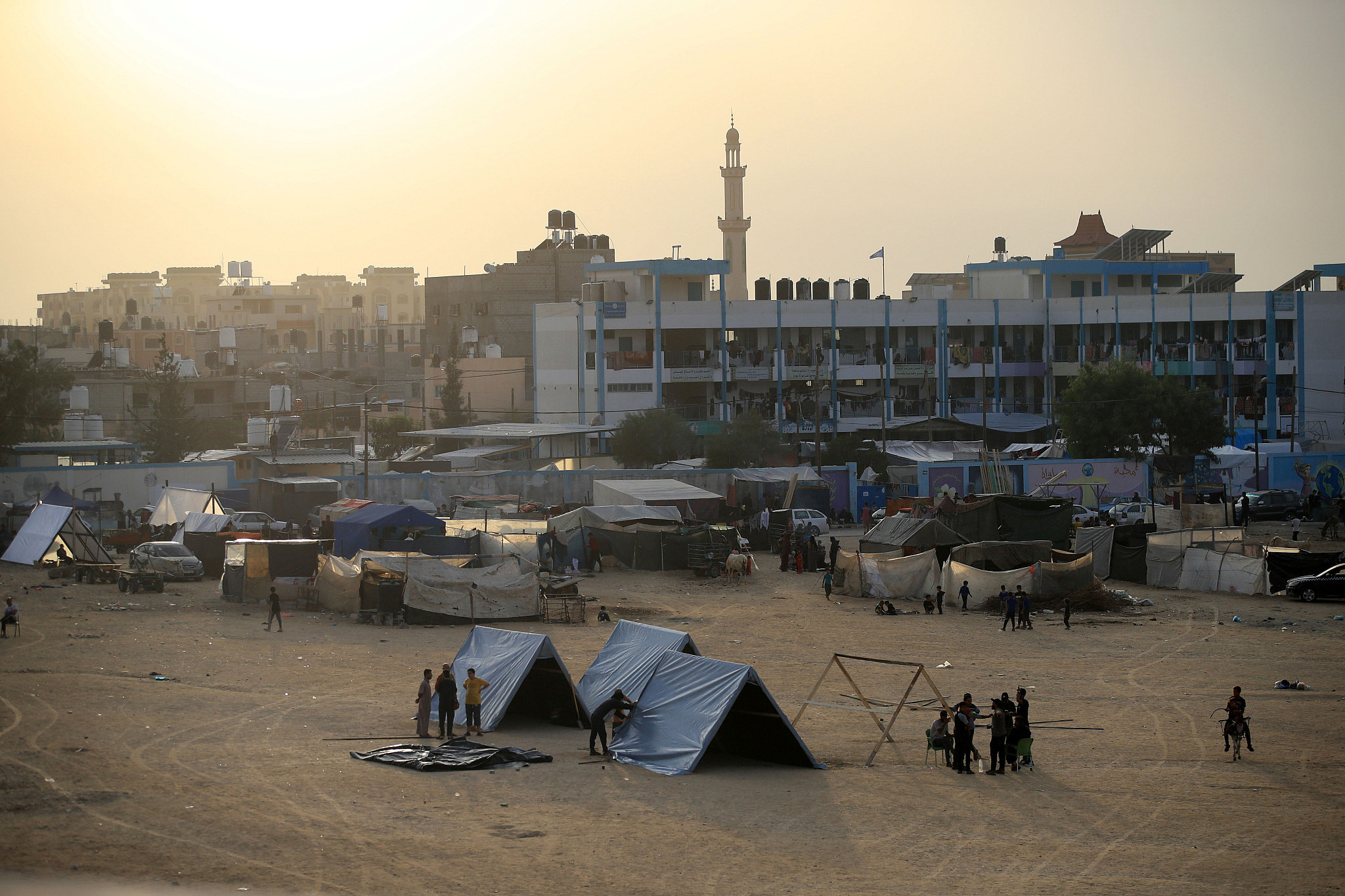
Palestinians displaced from Shuja’iyah and northern Gaza shelter in tents around government schools in the centre of Khan Younis, south Gaza Strip, November 12, 2023. (Mohammed Zaanoun/Activestills)
Since Friday morning, though, when the temporary ceasefire came into effect, relative calm has been restored to Khan Younis. Those displaced from areas to the east of the city have even been returning to their homes and agricultural lands to see the devastation caused by Israel’s bombardment.
The more than 1 million Palestinians displaced from the north have not had this same opportunity, however, with Israel explicitly forbidding them from returning to their homes. Hundreds still tried to do so on Friday as the skies fell silent, in the hope of locating missing loved ones; Israeli soldiers opened fire on the crowds, killing two and wounding dozens more.
‘Finally, we can breathe a little’
Rawiya Jabr, a 40-year-old mother of six, has been seeking shelter in a school in Khan Younis after being displaced from an area close to the fence. According to her, the night before the ceasefire began was “a difficult night because of the constant shells and the screams of the children who were crying in fear. We tried to reassure them, but the sounds were terrifying and we were afraid that these shells would reach us and hit our children.”
The following morning, after learning that a temporary ceasefire had taken hold, Jabr returned to her home. “I wanted to inspect it,” she explained. “What happened to it? Was it destroyed? Is it still intact?” Unfortunately, Jabr’s worst fears were confirmed: her home is no longer standing.
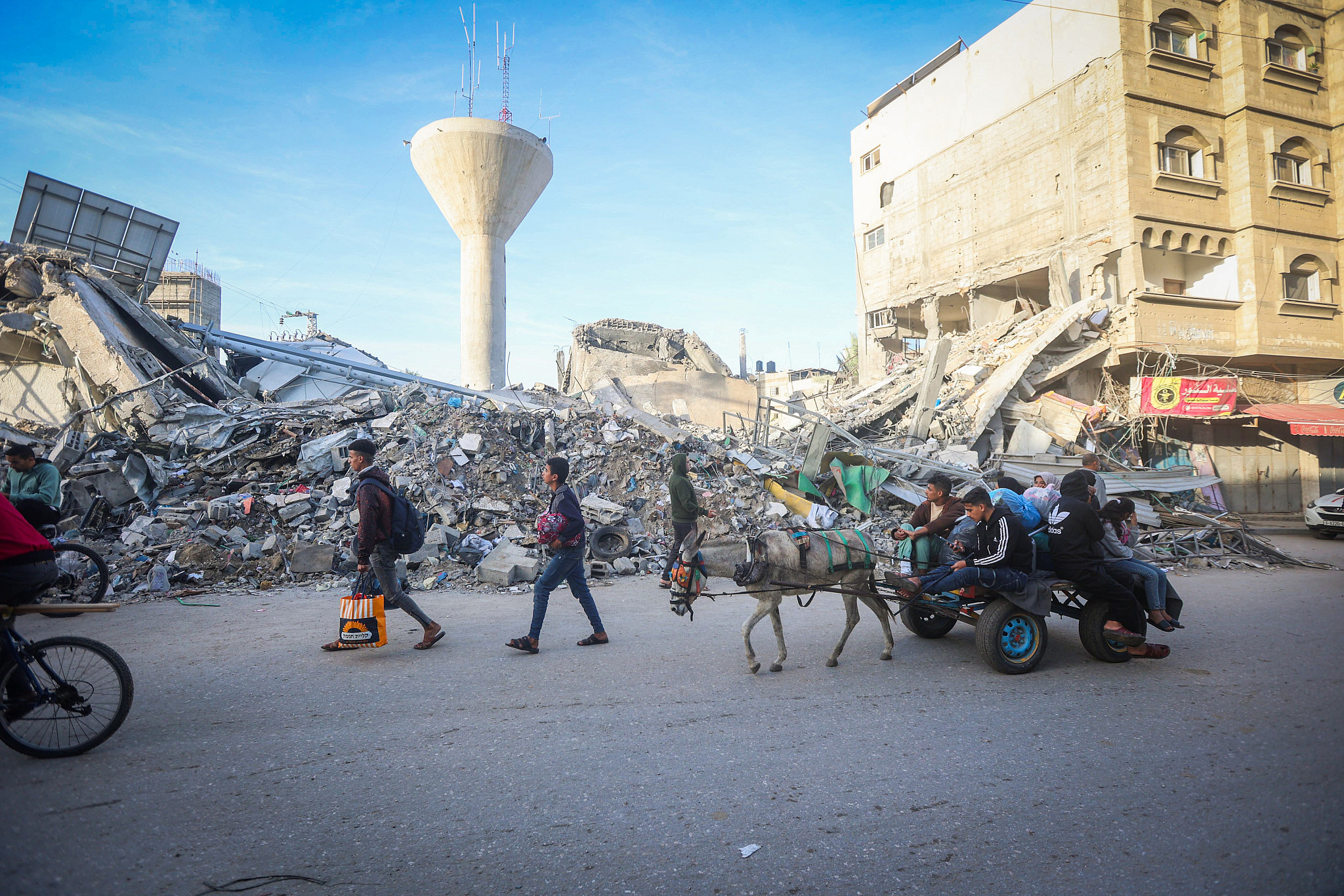
Palestinians returning to their homes during a ceasefire, east of Khan Younis, in the southern Gaza Strip, November 24, 2023. (Atia Mohammed/Flash90)
Despite this tragedy, Jabr is relieved that there is a temporary ceasefire. “People here are happy with the truce because they want to rest from the continuous bombing,” she explained. “We need to sleep. I did not sleep one night continuously. I feel very tired. Each of my children has a problem because of the fear of war: some have epileptic seizures and others have involuntary urination. They all need treatment in order to overcome what they lived through during this difficult war.”
Rola Al-Saad, a 25-year-old resident of Khan Younis, described the relief in the city granted by the ceasefire. “Finally, we can breathe a little after the intensity of the continuous bombing for 47 days,” she said on Friday. “Since 7 in the morning, I have been trying to communicate with family and friends. There are many friends who were martyred along with their families, and some of them lost their homes.”
Saeed Qadeeh, a 55-year-old farmer from the town of Khuza’a to the east of Khan Younis, has been sheltering with his family of 14 in one of the city’s UNRWA schools. With the lull in fighting on Friday, he went to inspect his home, and found that it had been totally destroyed.
“There is no intact house in the area or on our street,” Qadeeh explained. “Everything has been destroyed by the occupation. Agricultural lands have been destroyed, and many trees were burned. I cried a lot when I saw this great destruction, this war against civilians in the Gaza Strip. All the neighbors are crying over their destroyed homes. It feels like an earthquake hit the place and left nothing intact.”
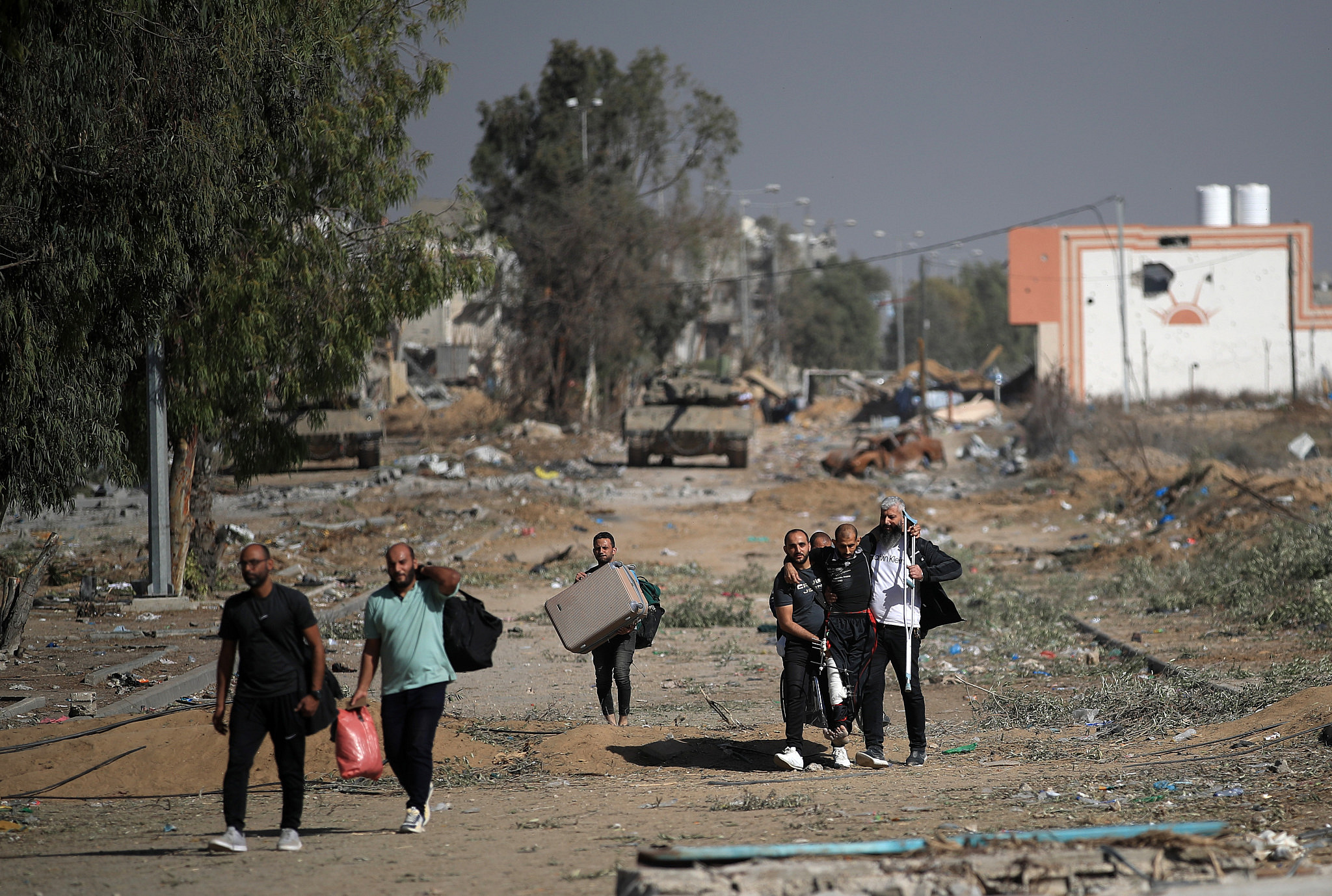
Palestinians on their way to northern Gaza turn back in Salah a-Din Street south of Gaza City after facing Israeli tanks and shootings as the truce starts. Journalists documenting the scene also came under fire, November 24, 2023. (Mohammed Zaanoun/Activestills)
Despite finding his home in ruin, Qadeeh does not intend to leave it again. “I will remain in my destroyed house during the days of the ceasefire, and I will try to stay even if they bomb again,” he said. Life in the schools for displaced people is very difficult. There is no water or food. I fear the spread of diseases. There is no treatment in hospitals. We live in many harsh conditions in this war.”
‘I want to return to my home and my city’
Walid Nofal, 44, arrived in Khan Younis over a month ago after being displaced from Gaza City in the north. For him, the pause in hostilities provides little comfort. “I do not benefit from the ceasefire at all,” he said. “I want to return to my home and my city. I want to check on my family there, with whom I lost contact 10 days ago. I know nothing about them.
“Perhaps the only thing I benefit from is stopping hearing constant explosions and losing many friends,” Nofal continued. “This is a painful war and we want it to end soon. We do not want another war ever. I want my three children to live in peace and security without loss.”
Another resident of Gaza City, 51-year-old Rana Barbari, was also displaced to Khan Younis around two weeks ago with her family. She explained that they had tried to stay in Gaza City as long as possible, knowing that it would be difficult to make it to the south. However, as the Israeli ground invasion intensified, she and her children and grandchildren — 20 people in total — fled southward. When they arrived in Khan Younis, the city was so overcrowded that they were forced to split up across different locations.
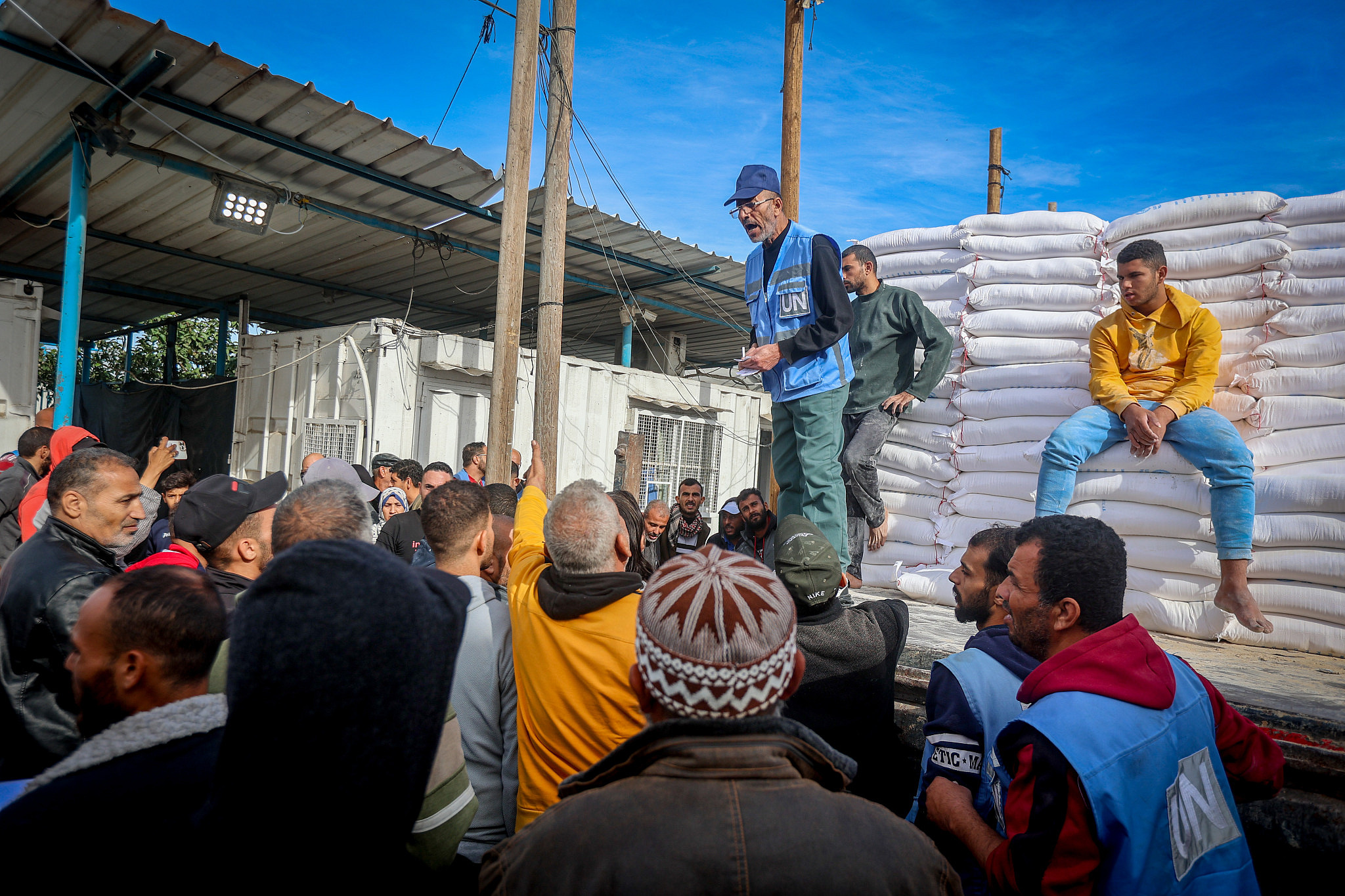
Palestinians receive bags with flour at the United Nations Relief and Works Agency (UNWRA) in Khan Younis, southern Gaza Strip, November 22, 2023. (Atia Mohammed/ Flash90)
Barbari’s 77-year-old father, a survivor of the Nakba of 1948, did not make the journey south with them. He had been with Barbari’s brothers, and she originally thought he had been wounded and was being treated at Al-Shifa Hospital in Gaza City. As the Israeli attacks against Al-Shifa intensified, the family waited for her father to be transferred to a hospital in the south.
“We searched for him a lot because he was an old man,” she explained. But after much searching on Friday, after the ceasefire took effect, they discovered the terrible news that their father had been killed in Gaza City.
Most read on +972
Inside Israel’s torture camp for Gaza detainees
‘A mass assassination factory’: Inside Israel’s calculated bombing of Gaza
The ‘mistaken’ killing of three Israeli hostages was a tragedy long foretold
“I feel great sadness and pain because it has now been two weeks since I have seen my father, and I have not said goodbye to him and buried him,” Barbari said. “This truce does not help us return to our homes and say goodbye to our loved ones.”
It will take a long time to fully comprehend the scale of the devastation that has befallen our land. With thousands still trapped under the rubble, we know that this disaster will continue to unfold in the weeks to come. All we can hope for to prevent even more destruction is the extension of this ceasefire, and an end to this painful war.
Ruwaida Kamal Amer is a freelance journalist from Khan Younis.
source https://www.972mag.com/ceasefire-khan-younis-gaza-devastation/
Categories: Arab World, Asia, Gaza, Gaza, Israel, Middle East, Palestine, War, War crimes