
Jalees Ahmad 29th April 2026
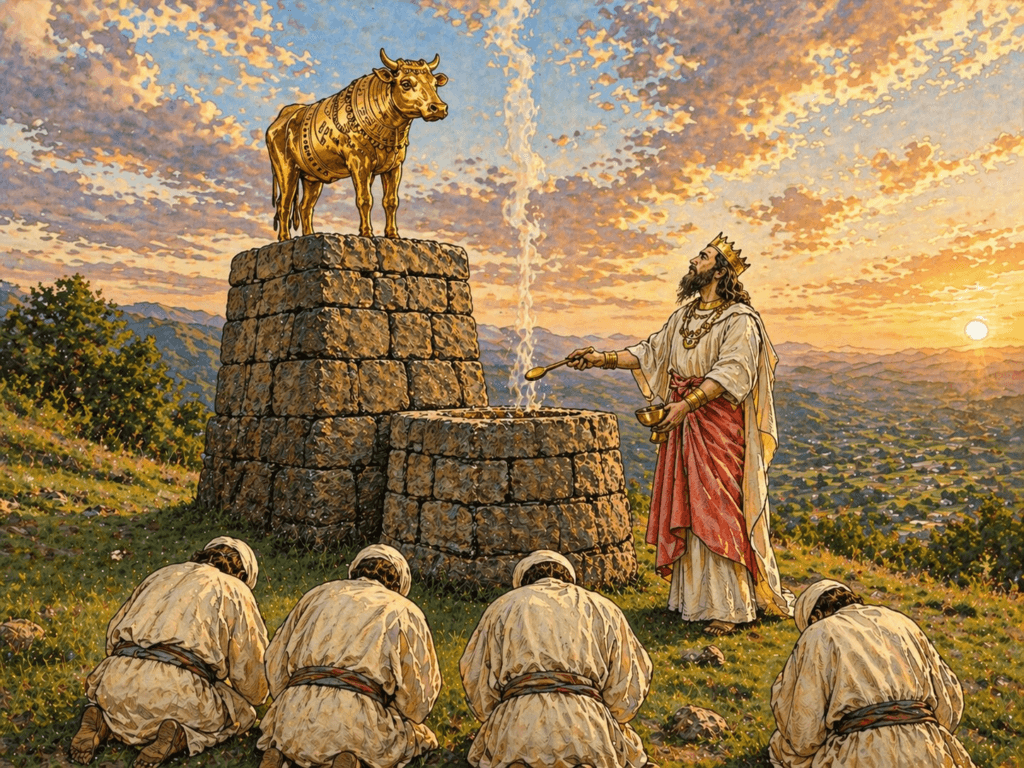
Image: Jeroboam’s Idolatry/Wiki Commons
How much time do you give to your phone? Have you ever really thought about it? We often don’t realise how effortlessly our devices distract us from our daily responsibilities, from the people we love and from moments that deserve our full attention. Think about how many times someone has been speaking to you while you were glued to a screen. It’s so common now that we hardly notice it, yet it happens all the time.
But there’s a deeper question here: does it get in the way of your relationship with God?
As Muslims, our declaration of faith is the proclamation that there is only one God and that He alone is worthy of worship. Yet when the time for worship comes, where are we? Are we physically, mentally and spiritually present? Or are our hearts occupied by the “idols” of our time: our phones, our screens and our constant distractions?
The things around us aren’t idols in the traditional sense, but anything that takes priority over God, anything that steals our attention and devotion, becomes an idol in practice. And sometimes these everyday habits slowly haul us away without us even noticing.
A common theme that we find in the Quran regarding idols is that they neither benefit nor hear; they are simply idle and powerless. Now, I shall highlight this idleness of idols by looking at various passages where the Quran describes them and how the prophets of Allah stood against idol worship. Whether it was the people of ‘Ad, the people of Thamud or even the people of Midian, each community had fallen into idolatry. The Quraish themselves worshipped hundreds of idols in and around the Ka‘bah.
Abraham (as) reveals the idols’ inability to help themselves
The Holy Quran presents Prophet Abraham (as) as a man of great wisdom and insight: “We gave Abraham his guidance and We knew him well.” (Surah al-Anbiya’, Ch.21: V.52) It also, whilst elucidating his bravery and wisdom, presents a unique story about him. Abraham (as), at a young age, was surrounded by staunch idol worshippers.
On one occasion, Hazrat Abraham (as) observed his community revering and worshipping sculpted statues, and he questioned them directly: “What are these images to which you are so devoted?” (Ch.21: V.53) Hearing the young Abraham (as), the people’s only reason and justification was tradition: “We found our fathers worshipping them.” (Ch.21: V.54) Then, when Abraham (as) tells them plainly that both they and their ancestors are in “manifest error’” (Ch.21: V.55), he also questions the very foundations of their traditions which they inherited and exposes the absence of a rational foundation behind the practice.
To demonstrate the idols’ powerlessness, Abraham (as) later carries out a brave and symbolic act. In private, he destroys all the idols except the largest one of them. This was a planned demonstration on Abraham’s (as) part meant to prompt them to reflect. When the people came to know of this, they accused the young Abraham (as), who pointed toward the largest idol and remarked: “Somebody has surely done this. Here is their chief. But ask them if they can speak.” (Ch.21: V.64)
This clear-cut answer was a serious blow to their intellect. It exposed the contradiction in their worship. The Quran says they momentarily realised their error and turned to each other, saying, “You yourselves are surely in the wrong.” (Ch.21: V.65)
But this temporary self-awareness swiftly collapses, and they revert to anger, showing how emotionally imbalanced they are: “Burn him and help your gods, if [at all] you [mean to] do [anything].” (Ch.21: V.69)
At this point, the one true God intervened and miraculously helped His servant and messenger: “O fire, be thou cold and [a means of] safety for Abraham!” (Ch.21: V.70)
Indeed, this was a method utilised by Prophet Abraham (as) to demonstrate the idol’s powerlessness and idleness.
There are valuable lessons to be learned from this story. The idol worshippers were made to reflect on their own foolishness. They were emotionally imbalanced, and their god could not even protect itself. In stark contrast, God helped His servant against them. Ultimately, the idleness of idols has been highlighted here.
The origins and spread of idolatry from Noah’s (as) time to the Quraish
It has been observed throughout history that whenever a prophet is sent to his people, it is commonly seen that he finds them misguided.
The Holy Quran states that the people of Noah (as) were steeped in idol worship. His people are recorded as having said to one another, “Forsake not your gods [under any circumstances]. And forsake neither Wadd, nor Suwa‘, nor Yaghuth and Ya‘uq and Nasr.” (Ch.71: V.24)
The astonishing part of this entire episode is how deeply steeped these people were in their ways. Chapter 71 of the Quran drives this point home. It begins with God stating that He sent Noah (as) as a messenger. It then recounts what Noah (as) said to his people, how he preached to them, and how he called upon them day and night. After that, it shifts to what Noah (as) said to God, explaining that he had done everything he could, yet his people still refused to pay heed.
The Surah goes on to list the signs of God that Noah (as) presented to his people: their own creation, the heavens, the earth, the rain, the sun, the moon and so on. Even then, the people responded arrogantly, insisting that they would never abandon their idols.
The way they stood so firmly by the idols that brought them no benefit is, to say the least, quite astonishing. It makes one think: how deeply engrossed can people be in things that do not benefit them?
The disbelievers at the time of Noah (as) had various idols. The Holy Quran mentions five in this verse. Alluding to the idols, Hazrat Khalifatul Masih I (ra), in his tafsir, explains that each idol represented something for the people and says that some had the figure of a man and others of a horse. (Haqaiqul Furqan, 2024, Vol. 4, p. 218)
In Sahih al-Bukhari, Kitab al-Tafsir, it is stated that many of the idols worshipped by the Arabs were actually the same idols once worshipped by the people of Noah (as). Different Arab tribes adopted them: Wadd, Suwa‘, Yaghuth, Ya‘uq and Nasr, each becoming tied to a specific community.
What’s striking is how these idols began. They were originally the names of righteous men from Noah’s (as) time. After those men died, people made statues just to remember them. At first, no one worshipped these statues. But as generations passed and the original purpose was forgotten, people eventually started treating them as gods. So idolatry didn’t start with open disbelief; it began with harmless memorials that slowly morphed into objects of worship once their meaning faded. (Sahih al-Bukhari, Hadith 4920)
From this, we learn many lessons. Indeed, the story of Noah (as) is like a mirror for later generations. God frequently mentions stories of the past nations in the Holy Quran as mirrors to illustrate to the believers so that they may recognise their own tendencies. By naming these idols explicitly, God calls out to the reader and tells us to look carefully within and learn, as this can happen to us as well.
We also learn about human emotions. People who are led solely by emotions can be led astray spiritually. These idols, as mentioned above in Sahih al-Bukhari were originally honoured and beloved people. The Quran shows that emotions like grief, love, attachment and nostalgia can all be manipulated into forms of worship.
It must be noted that shirk often survives across eras; by observing forefathers, generations are likely to continue their traditions and practices. These idols existed long before the Arabs, yet they are found even in the times of the Holy Prophet (sa).
However, when observed closely, these idols bore no favour upon the people who worshipped them.
When Bani Israel fell into idolatry: The story of the golden calf
After God rescued the Bani Israel (Children of Israel) by bringing them safely across the sea, they passed by a tribe that was worshipping idols. Still influenced by their former mentality and not fully understanding pure monotheism, some of them said to Moses (as), “make for us a god just as they have gods.” (Ch.7: V.139) Moses (as) responded firmly that they were acting ignorantly, reminding them that God had just saved them and that no created thing could be a god.
This part of the story offers us an insight into the people of Moses (as) and what they were thinking, even after receiving guidance. The Holy Quran goes on to narrate a deep episode from the history of Bani Israel: the worship of the Golden Calf during the 40-day absence of Prophet Moses (as).
This episode has been recorded in various places in the Quran. After studying all the instances, I have put them together to explain the events that unfolded.
In Moses’s (as) absence, his people fell into trial by Samiri, who “led them astray” towards idol worship. (Ch.20: V.86) When asked why they had become deceived, they later explained: “We were laden with loads of people’s ornaments and we threw them away, and likewise did the Samiri cast.’” (Ch.20: V.88)
From these ornaments was made a calf, which the Quran describes as “a [lifeless] body producing a lowing sound” (Ch.7: V.149). Subsequently, they gave up the religion of Moses. (Ch.20: V.89)
Aaron (as), the brother of Moses (as), had warned them: “O my people, you have only been tried by means of it (the calf), and surely the Gracious [God] is your Lord; so follow me and obey my command.” (Ch.20: V.91) Yet, they replied that they would not cease to worship it until Moses returned. (Ch.20: V.92)
When God informed Moses (as) of what was happening to his people, he returned, “indignant and grieved” (Ch.7: V.151) and said: “‘Evil is that which you did in my place in my absence.’” (Ch.7: V.150) Addressing his people, he told them how they had wronged themselves “by taking the calf [for worship].” (Ch.2: V.55) They acknowledged their error: “And when they were smitten with remorse and saw that they had indeed gone astray, they said, ‘If our Lord do not have mercy on us and forgive us, we shall surely be among the losers.’” (Ch.7: V.150)
Moses (as) then turned to Samiri to see what he had to say. Having done such a thing, what would he have to say? What response would he have? (Ch.20: V.96)
Samiri simply replied that “my mind commended to me.” (Ch.20: V.97) Hearing this response, Moses (as) declared: “Now look at thy god of which thou hast become a devoted worshipper. We will certainly burn it and then scatter it away into the sea.” (Ch.20: V.98)
The Holy Quran then closes this account with the final affirmation: “Your God is only Allah, beside Whom there is no God. He embraces all things in [his] knowledge.” (Ch.20: V.99)
The lesson we learn here is that idols (in this case the golden calf) are powerless. This calf was lifeless and could neither speak, guide nor benefit anyone. When one truly thinks about it, the roots of idolatry are often embedded in human weakness.
The people of Israel were led astray due to reasons mentioned in the Quran, i.e., impatience and manipulation. Despite seeing miracles, some of the Bani Israel said, “This is your god,” a sign of how ingrained they had become in idol worship.
This episode shows that, more often than not, idol worship originates from a mixture of emotional impulses and societal pressures, not from truth or reason. The idleness of idols reveals their inability to protect or forgive. When Prophet Moses (as) returned, his people feared punishment and sought forgiveness, but the calf could do nothing to help or save them. Only Allah could grant mercy.
The story also stresses that idols are useless and powerless. We also learn that blind imitation, emotional weakness or manipulation can lead people to worship what cannot help them, while God alone guides, protects and forgives.
The people of Elijah gripped in idol worship
Regarding the people in the time of Elijah (as), we find that they too had become deeply engrossed in idol worship. Prophet Elias (as), also referred to as Elijah (as), was a noble prophet and a believing servant of Allah. (Ch.37: V.133) It is said that he was a descendant of Aaron (as) (Ibn Kathir, Qasas al-Anbiya [Urdu], under Prophet Elias (as), p. 543); however, some claim that he was sent to the residents of Baalbek and its surrounding areas. (Tafsir al-Jalalayn, Vol. 3, Maktabatul Bushra, p. 167)
Elijah (as) lived during 900 BC. He lived in Gilead, east of Jordan. (Five Volume Commentary, Vol. 2, p. 891; 1 Kings, 17:1)
Elijah (as) stood as a brave challenger of idol worship. His central mission was to confront his people’s devotion to false gods and to call them back to the remembrance of the “Best of creators.” (Ch.37: V.125)
He was an uncompromising voice urging his people to return to the true God. He appealed to their own history, their lineage and the faith of their ancestors by saying: “Do you call on Ba‘l, and forsake the Best of creators, Allah, your Lord and the Lord of your forefathers of old?” (Ch.37: V.126-127) By this, he was trying to revive the knowledge of God that was already within them.
The name of the idol they worshipped was Ba‘l. These people worshipped the sun. Ba‘l may also stand for the sun-god, which belonged to the people of a town in Syria now called Baalbek. (Five Volume Commentary, Vol. 4, p. 2702)
If we think about it, the worship of Ba‘l represented an entire belief system deeply embedded in that society. Ba‘l was associated with the sun-god. Elijah’s (as) mission was not merely to deny an idol but to confront a view that had taken hold of the civilisation.
From the Bible, it is clear that Elijah (as) was not only calling his people to the true God; he was also standing against an entire system that promoted false gods. The Bible says that King Ahab, encouraged by Queen Jezebel, officially supported Ba‘l worship. (1 Kings 16:31-32) This means idol worship wasn’t a small mistake; it was the state religion, backed by political power.
Elijah’s (as) call was therefore both spiritual and ethical: to abandon a false order built on injustice and return to the worship of the one true God. Studying this particular story, we learn that even idols thrive when a society normalises them. Though idols are powerless, people give them power through their own fears and desires. Idols gain influence not because they have power, but because people project their hopes and needs onto them.
Sun worship of the people of Sheba (Queen Bilqis)
Another example of sun worship is found in the Quran, whilst speaking of the people of Queen Bilqis of Sheba. During the time of Prophet Solomon (as), there was a people who practised sun worship. The Quran explains that Satan had made their deeds appear attractive to them, preventing them from recognising the truth. (Ch.27: V.25)
Saba’, or Sheba, was a city in Yemen. The Queen of Sheba was given might and a high degree of civilisation. (Five Volume Commentary, Vol. 4, p. 2402) The Sabaeans used to worship the sun and the stars. It is said that such an act was most likely brought into Yemen from Iraq. (Ibid. p. 2403)
The people of Sheba were sun-worshippers rather than worshippers of carved idols. Although their queen later accepted the one true God through Solomon (as), the story stresses how even those at the highest levels of society can fall into forms of idol worship.
To read about this story in more detail, see the article about Prophet Solomon (as). In brief, through Solomon’s guidance, Queen Bilqis abandoned her idol worship and submitted to the one true God, saying: “My Lord, have I indeed wronged my soul; and I submit myself with Solomon to Allah, the Lord of the worlds.” (Ch.27: V.45)
The message we learn here reflects themes that repeatedly appear throughout the Holy Quran. They are mentioned above in each story: 1) the idleness of idols and 2) how such practices are simply inherited from the ways of one’s forefathers.
In this story of Sheba, however, one important point stands out: Satan made worshipping the sun appear attractive to them. In the Quran, God warns us not to follow in the footsteps of Satan, who gradually leads people away from God toward foolish or harmful practices: “and follow not the footsteps of Satan.” (Ch.6: V.143) Satan’s whispers are often subtle, like following one footprint after another, so people may not even realise when they have come under his sway. This shows that Satan’s whispers are gradual, not sudden and that caution is always necessary.
The meaning and significance of the creed: ‘There is none worthy of worship except Allah’
Having now studied and read about the nations of old, lost in the shadows of their idols, it is apparent for those whose hearts are awake and minds are clear that one cannot linger long in doubt. Islam provides a clear and simple guide to avoid such deception: there is nothing worthy of worship except Allah.
He alone deserves worship and turning to Him protects the heart from following the misleading footsteps of Satan. From these stories, we learn many important lessons, yet the one that stands out most is that idols are anything that draws us away from God. In truth, idols are just that, simply idle.
SOURCE https://www.alhakam.org/idleness-of-idols-lessons-from-the-peoples-of-yore
