
Bettina Baumann | Kristina Reymann-Schneider10/03/2022October 3, 2022
Germany has thousands of mosques, most of them tucked away in backyards or industrial parks. On Open Mosque Day, they open their doors to the public.

Open Mosque Day has been held in Germany on October 3 every year since 1997. This year, about 1,000 mosques across Germany opened their doors to bring Muslim and non-Muslim people together. The 2022 motto is “Scarce resources — great responsibility.” The “effects of the climate crisis can be observed in our country and in many parts of the world, as most recently with the devastating floods in Pakistan,” said Aiman Mazyek, chairman of the Central Council of Muslims in Germany (ZMD).
Here are six facts about mosques in Germany — and no one knows exactly how many there are. Estimates range from 2,350 to 2,750. According to a study by the German Islam Conference, 24% of the 5.5 million Muslims living in Germany visited these mosques at least once a week in 2019.
German Empire trained jihadis in Germany’s first mosque
The Wünsdorf Mosque in Brandenburg, built in 1915 at the request of the Mufti of Istanbul, was considered the first Islamic building in Germany and all of Central Europe. Erected in the center of a prisoner of war camp for Muslims, the mosque was nicknamed the “half moon camp.” It was a place for peaceful prayer, but the German Empire also used the mosque to stir up Muslim prisoners’ sentiments against their colonial powers, France and England. “Revolutionary strategy” is what the German Empire called it. Here, jihadis were sworn in and eventually sent to fight the “holy war.”

The Muslim POWs were also abused for research purposes that included language recordings and anthropological measurements. These later became part of a pseudoscientific area of study that the Nazis called “racial science.” In 1928, a new mosque was built in Berlin-Wilmersdorf, and the Wünsdorf mosque lost its importance. It was demolished in 1930, less than 15 years after its inauguration.
Resemblance to the Taj Mahal
The mosque in the Berlin neighborhood of Wilmersdorf is the oldest in existence in Germany today. The building strongly resembles a world-famous monument in India: the Taj Mahal. Two minarets, each more than 30 meters high (98 feet), frame the building. It was designed by German architect Karl August Herrmann for the Lahore Ahmadiyya community from what is now Pakistan and whose members came to Germany in 1920. They founded the German-Muslim Society in cooperation with German Muslims. The mosque in Berlin-Wilmersdorf became the center of Muslim life.

Women preach in one Berlin mosque
In 2017, a very special kind of Muslim place of worship was established in the German capital: the Ibn Rushd-Goethe Mosque. There, men and women pray together, women are allowed to preach, and queer people are not excluded. “The Ibn Rushd-Goethe Mosque represents a progressive, contemporary Islam that is compatible with democracy and human rights. We live an Islam in which women and men are equal,” the mosque’s website reads. It also says all faiths of Islam are welcome: “With us, all the faiths of Islam are welcome, Sunnis, Shiites, Sufis and Alevis feel a sense of belonging in our community.”
Seyran Ates, a lawyer, author and women’s rights activist who co-founded the mosque, has paid a high price for the progressive stance — she receives death threats and is under around-the-clock police protection.

Controversial mosque associations
In Germany, mosque associations run the mosques. Probably the best-known and largest Islamic association in Germany in terms of the number of mosque congregations is the Turkish-Islamic Union for Religious Affairs (Ditib). The association is criticized because it is subordinate to the Turkish religious authority Diyanet, the state presidium for religious affairs. The union’s imams, who are installed in German mosques for several years, are mostly trained in Turkey and funded by the Turkish state.
For years, critics have been warning about the Turkish state’s influence on the congregations. The 2018 Turkish presidential election showed that Turkish President Recep Tayyip Erdogan has many supporters in Germany, as have his visits to Germany, where he has been warmly welcomed and frenetically cheered by his supporters.
Advertisement
Mostly hidden away
While sacred Christian buildings are very visible in German cityscapes and the vast majority of villages were built around a church, mosques are hardly noticeable. Most of them are barely recognizable as such from the outside and often, only a sign indicates that there is a mosque behind an inconspicuous entrance to a home in a residential area or in commercial areas outside the city centers. The term coined in German for such tucked-away mosques is “Hinterhofmoschee,” or “backyard mosque.” While descriptively apt, it can have a denigrating connotation.

One exception is the Cologne Central Mosque, part of Ditib. Designed by German star architect Paul Böhm and open since 2017, the modern and imposing Islamic sacred building, made primarily of glass and exposed concrete, is flanked by two 55-meter-high curved minarets that rise well above the surrounding buildings. It was originally intended to be Germany’s largest mosque, but the design was changed after criticism of the building plans. It can accommodate 1,200 worshippers, as many as the Ditib mosque in the Marxloh district of the western German city of Duisburg.
Few use the muezzin call to prayer
In Islamic countries, a muezzin traditionally calls out daily prayers, as well as Friday’s public prayers from the minaret. Mosques may do so as well in Germany, but they rarely do. Most mosques in Germany don’t have a minaret. In addition, the practice is not widely accepted in society. Opponents of the muezzin call consider it a noise nuisance and criticize the religious confession it expresses. They argue that unlike church bells, the call has a theological meaning. The muezzin’s call is heard regularly from only about 30 mosques in Germany.
This article was originally written in German.
source https://www.dw.com/en/six-facts-you-didnt-know-about-mosques-in-germany/a-63292950
100-Mosque Scheme in Germany
Alhakam18th October 2019Save
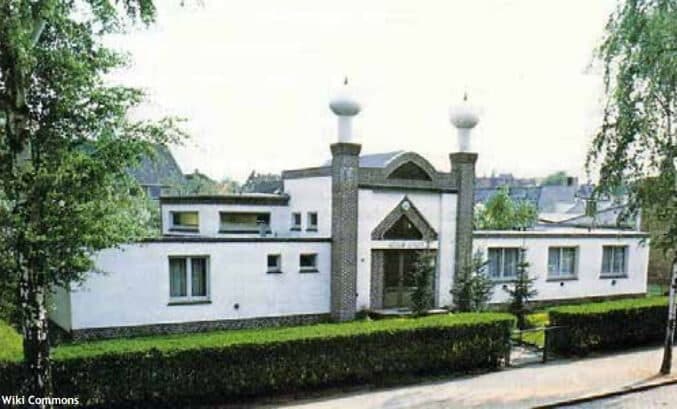
There are now more than 50 Ahmadi mosques in Germany and every fifth mosque now being built is by the Ahmadiyya Muslim Jamaat, Germany. These mosques are part of the 100-Mosque Scheme launched by Hazrat Khalifatul Masih IVrh as part of the Ahmadiyya centenary celebrations in 1989.
“I announced yesterday that to commemorate the hundred years of the Jamaat, Jamaat-e-Ahmadiyya Germany should plan a scheme to build a hundred mosques”, Hazrat Khalifatul Masih IVrh said in his address to the Jalsa Salana Germany in 1989.
Jamaat-e-Ahmadiyya Germany feels fortunate to have been picked by the Khalifa of the time for this blessed cause. Setting off in 1989, one mosque after the other was built with the financial sacrifice and dedication of the German Jamaat. The majority of these members are those that had fled the infamous constitution and the subsequent persecution in Pakistan to settle in Germany as refugees. They had arrived with little or no money at all.
With the scheme came a revolutionary change and these families that contributed towards making mosques – houses of Allah – eventually became capable of acquiring homes for themselves. Their children got the opportunities of the best education and have been able to prosper in all walks of life as German Ahmadi citizens of the country.
The scheme had been working in full swing and had started to bear fruits. Then started the era of Khilafat-e-Khamisa – the fifth Caliphate of the Promised Messiahas.

Hazrat Khalifatul Masih Vaa encouraged the German Jamaat in their pursuits in every way, especially by personally visiting Germany whenever a mosque or few mosques were ready to be inaugurated or even to lay foundation stones of mosques that had gone through the planning permission stage and its paraphernalia. Hazrat Khalifatul Masih Vaa advised the Jamaat in Germany to raise their goals and now aim for at least one mosque in every city of Germany. Members of the Jamaat took it upon themselves readily and the scheme entered a phase where it was to see new heights.
The history of mosques in Germany goes a long way when Noor Mosque was built in Frankfurt. With its very humble, yet prestigious character, this mosque always stood tall in the cultural and religious skyline of the country.
“There was a time when Masud Jhelmi Sahib [then Ahmadiyya missionary in Germany] would lead more than one congregational prayer on Eid,” recalls Dr Abdul Ghaffar Sahib who now serves as missionary in Germany. “This was so because this was the only mosque in Frankfurt and a huge number of Muslims, regardless of sect or denomination, would assemble at Noor Mosque. Humble as it is in its size, it could only hold a small number of worshippers at a time. People would wait outside the mosque for one congregational prayer of Eid to end before another congregation could be led.”
The Ahmadiyya mosques have carried this message of peace and harmony to this day and continue to do so. Missionaries posted at various mosques still have interesting stories to tell of how a Muslim person or family, driving past the mosque, felt compelled to stop and offer prayers. They find it fascinating to be able to pull over at a German roadside and be able to offer prayers in congregation.
“The doors of our mosques are open for all,” says Abdullah Wagishauser Sahib, the national president of Jamaat-e-Ahmadiyya Germany. “We feel happy in inviting Muslims and non-Muslims to our mosques. Our mosques have become a great source of introduction to the Jamaat, working as tabligh centres.”
Now that Ahmadiyya Muslim mosques have been built in a great number of German cities, schools and colleges are becoming more and more interested in visiting these mosques and rectifying their fears that are based on false propaganda against Islam.
“It is heartwarming to hear mayors of various cities referring to Ahmadiyya mosques as ‘our mosques’. It shows the acceptance of the German nation towards Islam,” Amir Sahib continued. “Our mosques have given us identity and we have become an integral part of the German society.”
The German Jamaat is proud to be steadily progressing in this project and attribute this success to the prayers and guidance of Hazrat Khalifatul Masihaa. It is not that Huzooraa only comes in the picture when a foundation stone is to be laid or an inaugural plaque is to be unveiled; every step of every phase of every mosque receives thorough and detailed guidance and blessings of Hazrat Khalifatul Masihaa.
Huzoor’s physical presence however is the greatest blessing that these mosques have been able to obtain. Every new mosque gets blessed with Huzoor’s physical presence at least twice – when the foundation is laid and when it is inaugurated. Receptions held on such occasions attract dignitaries, members of local authorities, neighbours and local residents. Those attending have always gone back with a clear mind, rather feeling delighted to have heard the message of the mosque directly from Hazrat Khalifatul Masih.
It is faith-inspiring to hear Ahmadis of the German Jamaat how they had never imagined having a mosque in their town and how this dream miraculously materialised and how it has led to their collective and personal wellbeing. They are delighted to have an abode of faith in their own town where they have felt their connection with the Jamaat grow stronger. In a society that is rapidly growing irreligious in its character, what could be better to have a lighthouse of faith at every few miles.
Whilst launching the scheme, Hazrat Khalifatul Masih IVrh had acknowledged the financial burden that it could entail on German Ahmadis. He said:
“I am aware that you are already offering great financial sacrifices and also that most of you struggle to make ends meet already … but I also know that our tasks have always been fulfilled by Allah the Almighty. He only makes us just touch [the surface], and He carries the whole burden Himself, just as a parent asks their child to lift a heavy object but then very cleverly assists in a way that the child still takes credit for lifting the whole weight. Similarly, if you make a firm decision to bear this burden in the way of Allah, then He who is far more loving and caring than a parent will take it upon Himself to carry this burden while you will still continue to consider it your effort.”
With this, the German Ahmadis came forward and contributed whatever they possibly could to make this desire of Hazrat Khalifatul Masih come true.
If you speak to the organisers of the 100-mosque scheme, they fail to hold back their astonishment about how men, women and children have leapt forward to offer sacrifices. They have stories to tell; a woman, not too wealthy, pledged 20,000 euros not even knowing where it would come from; some women presented all their jewellry; children saved up their pocket money to help build mosques in their areas. There are some individuals who, in their mulaqats with Huzooraa, offered to pay the whole amount required for building a mosque. A young boy of 15 told his local missionary that he wished to contribute 5,000 euros to the scheme. “Where will this come from?”, the missionary naturally asked. “You don’t worry. I will do it somehow!” was the boy’s reply. The boy was soon seen delivering newspapers door to door to generate the amount he had promised. Isn’t it incredible that he actually managed to save up and offer the whole amount towards the mosque funds!
A gentleman had only just saved up to buy his dream car that he heard a speech about the mosque scheme. He pledged 5,000 euros immediately for the scheme and in a day or two, had handed in the money to his local Jamaat. The dream of buying his favourite car had to be put aside. In less than a month’s time, the organisers relate, he came back to them, his face glowing with delight and joy. He couldn’t wait to tell them how, weeks after he had donated the funds, he got promoted to a post at work and the company had given him the same car that he had always desired to own.
The stories go on, and so does the amazing scheme of building mosques all over Germany; so do we continue to witness the awe-inspiring fruits of these sacrifices.
Isn’t it unbelievable that you are travelling on a German autobahn and your host asks you, “It’s almost time for Asr Salat. Shall we get off at this exit to get to the closest mosque? Or shall we carry on as there is another mosque near the next junction. And if we carry on another couple of junctions, we will still be in time to make it to another mosque which is near that junction. Or actually, shall we wait and Masjid Noor is also a few junctions away?”
Before you answer the question, you hear yourself say: “Masha-Allah! Alhamdolillah!”