
On the occasion of International Holocaust Memorial Day, which marks the 80th anniversary of Auschwitz’s liberation, Israel has released a government report revealing that Moroccan-born Jews represent 17% of Holocaust survivors currently living in the country. This makes them the second-largest group after those born in the former Soviet Union.
 by Adil Faouzi
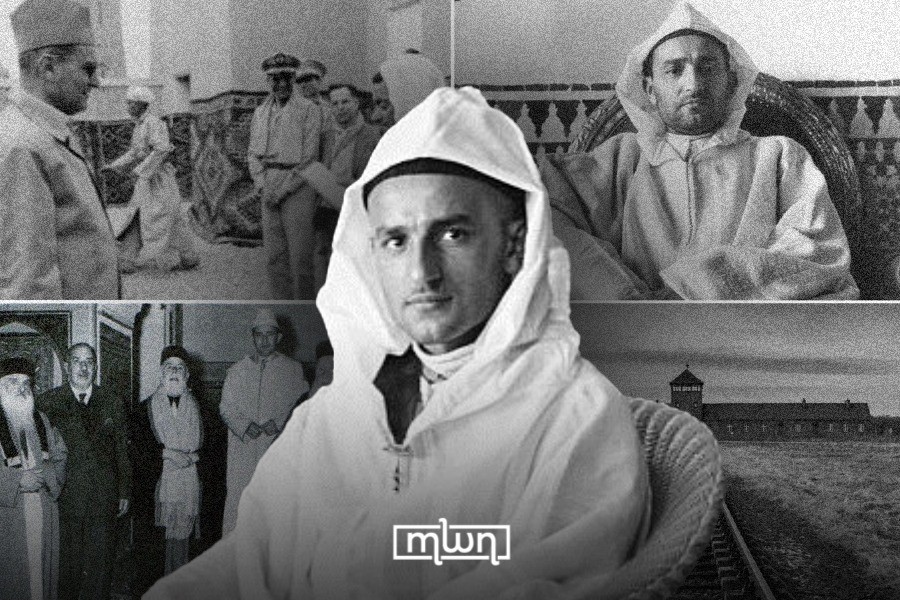

Sultan Mohammed V: The king who refused Nazi orders in 1940.
Doha – On the occasion of International Holocaust Memorial Day, which marks the 80th anniversary of Auschwitz’s liberation, Israel has released a government report revealing that Moroccan-born Jews represent 17% of Holocaust survivors currently living in the country. This makes them the second-largest group after those born in the former Soviet Union.
According to the report released Sunday by Israel’s Holocaust survivors’ rights authority, more than 123,700 survivors currently reside in Israel.
These survivors fall into three distinct categories: 41,751 who escaped Nazi persecution directly, 44,334 who fled advancing Nazi forces particularly in the Soviet Union, and 37,630 who experienced antisemitism during World War II, including Jews living under the Vichy regime in Morocco and Algeria.
The report indicates that government support for Holocaust survivors reached NIS 3.9 billion ($1.1 billion) in 2024.
Women constitute 61% of survivors, with 37% born in the former Soviet Union, 17% in Morocco, and 11% in Iraq.
One-third of the survivors arrived in Israel between 1948 and 1951, while 9% immigrated over the past 25 years, including 54 individuals in 2024.
A sultan’s extraordinary stand against Nazi persecution
During World War II, Morocco’s Sultan Mohammed V emerged as an unexpected protector of Jewish citizens, defying both Nazi Germany and the collaborationist Vichy regime that controlled Morocco after France’s fall in 1940.
At just 30 years old, the sultan – who was initially placed on the throne by French authorities who believed he would be easily manipulated – demonstrated remarkable courage in opposing antisemitic policies.
When Vichy officials moved to implement discriminatory measures against Morocco’s 250,000 Jews, Mohammed V’s response was unequivocal: “There are no Jews in Morocco. There are only Moroccan subjects.”
He viewed the protection of Jewish citizens as both his religious duty as Amir al-Mu’minin (Commander of the Faithful) and his royal responsibility, declaring to Vichy authorities, “Moroccan Jews are my subjects… and it is my duty to protect them against aggression.”
In a particularly bold move during the 1941 Feast of the Throne celebration, the sultan publicly challenged Vichy authorities by inviting Jewish rabbis and notables as guests of honor to the royal banquet.
Confronting outraged Vichy officials, he stated, “I absolutely do not approve of the new antisemitic laws, and I refuse to associate myself with a measure I disagree with. I reiterate as I did in the past that the Jews are under my protection, and I reject any distinction that should be made among my people.”
The sultan’s defiance carried significant personal risk, as Vichy authorities could have easily engineered his removal or assassination.
His steadfast opposition effectively delayed potential roundups of Jewish citizens until the Allied forces’ arrival in November 1942.
While 2,100 Moroccan Jews were interned in Vichy work camps in the Sahara as political prisoners, Morocco remained the only country under Vichy control where no Jews were deported to Nazi death camps.
Mohammed V’s protection of Jews extended beyond symbolic gestures. He refused to meet with Nazi officials in Morocco and later welcomed Allied forces, hosting the 1943 Anfa Conference with Franklin Roosevelt and Winston Churchill.
His actions earned lasting recognition from Jewish communities worldwide. As Serge Berdugo, head of the Council of Jewish Communities of Morocco, noted in 2005, the sultan earned the “eternal gratitude” of Moroccan Jews.
In a 2022 letter to current King Mohammed VI, Israeli President Isaac Herzog acknowledged this legacy: “When millions of Jews faced the horrors of the Holocaust… Mohammed V provided a safe haven for his Jewish subjects. Wherever they are, Moroccan Jews recall with pride and affection the memory of your grandfather.”
This protective tradition continued after Morocco’s independence in 1956, with Mohammed V ensuring equal rights for Jewish citizens.
Although Morocco’s Jewish population has decreased to approximately 2,100 today, the country’s 2011 constitution explicitly recognizes its Hebrew heritage as integral to national identity.
The late King’s principled stance during World War II established a model of Jewish-Muslim coexistence that continues to influence Moroccan society, as evidenced by his memorable declaration in 1957: “All Moroccans, Muslim and Jewish, are subjects of the same nation. They must act together.”